
A buyer asks for a hojicha vs green tea comparison, yet hojicha is itself a green tea. The useful comparison is between roasted hojicha and unroasted styles such as sencha, or powdered matcha. Processing changes color, aroma, preparation, and product fit. This guide gives beverage and food teams a way to choose a format and write an accurate specification without promising a caffeine or health advantage that a tea name cannot prove.
1. What does hojicha vs green tea really compare?
It is a member of the category
Hojicha is green tea that has been roasted after initial processing. “Green tea” names a broader family, not one opposing product. Japan’s Ministry of Agriculture, Forestry and Fisheries (MAFF) describes hojicha as roasted sencha or another suitable processed tea. Sencha, by contrast, is generally sold without this later roast. Matcha comes from ground tencha and is prepared as a suspension. A comparison between hojicha and an unspecified “green tea” leaves too many variables open. Name the actual alternative in a buyer brief.
Fix the question. Ask whether the team needs a roasted flavor instead of a fresh-green flavor, a brown color instead of green, a filtered infusion instead of a powder, or a different menu story. Each objective points toward a different sample set. If a café already sells a bright matcha latte, hojicha may add a distinct second flavor. If a bottled tea brand needs a pale green appearance, hojicha may be a poor fit despite attractive taste. Defining the comparator prevents a false either-or decision and helps suppliers send material suited to the actual product.
| Tea | Defining process or form | Typical buyer question |
|---|---|---|
| Hojicha | Green tea roasted during finishing | Which roast and form? |
| Sencha | Processed leaf, usually unroasted | Which leaf grade and brew? |
| Matcha | Ground tencha | Which grade and particle profile? |
2. How does processing create the difference?
Later heat builds roasted character
Japanese green teas are heated during processing to limit oxidation. Hojicha receives a further roasting treatment after the base tea exists. This later step darkens material and changes the balance of aromatic compounds. It does not turn the tea into black tea. MAFF’s Japanese green-tea overview distinguishes hojicha’s strong roast from sencha’s general production route. A roasting study reported by Japan’s National Agriculture and Food Research Organization identified aroma-active compounds that become prominent after roasting. Those chemistry findings explain a sensory direction, not the quality of every commercial lot.
Ask for the base tea. Hojicha’s name does not reveal whether leaves, stems, or a blend were roasted. Roast depth also differs. For a fair hojicha vs green tea comparison, know the base material and preparation for each candidate. A weak sencha brewed too dilute should not be used as a foil for a carefully prepared hojicha. Retain approved samples and ask suppliers to notify you when base tea or roast changes. Manufacturing details matter because a brand sells a repeatable cup, not an abstract processing category.
3. How do the flavors compare in a finished drink?
Roast and fresh-green notes play different roles
Hojicha often brings toasted, nutty, woody, or caramel-like impressions. Sencha can present fresh, vegetal, grassy, savory, or more astringent notes, depending on grade and preparation. Matcha’s suspended powder creates a different body and can remain assertive in milk. These are tendencies, not promises. A lightly roasted hojicha may preserve more of its base-tea character, while a strongly brewed sencha can taste quite bitter. The supplier’s dry-leaf aroma tells only part of the story. Compare infusions and finished recipes under declared methods.
Taste at service. For a latte, hold milk, sweetener, ice, and final mass constant while selecting sensible tea doses. For a clear tea, use a suitable brew method for each product and state it on the score sheet. Score tea identity, aroma, bitterness, mouthfeel, and finish. A stronger sample may win a one-sip test and become tiring across a full cup. Repeat after a normal holding interval. That second taste often reveals whether roasted aroma remains pleasant or a green note turns flat. The buyer’s answer should describe customer experience, not merely rank teas by intensity.
| Product target | Hojicha trial | Unroasted tea trial |
|---|---|---|
| Roasted milk drink | Medium roast powder | Matcha powder |
| Clear unsweetened tea | Loose hojicha infusion | Sencha infusion |
| Light dessert | Light roast powder | Suitable green-tea powder |
4. Why are the colors so different?
Color reflects material and processing
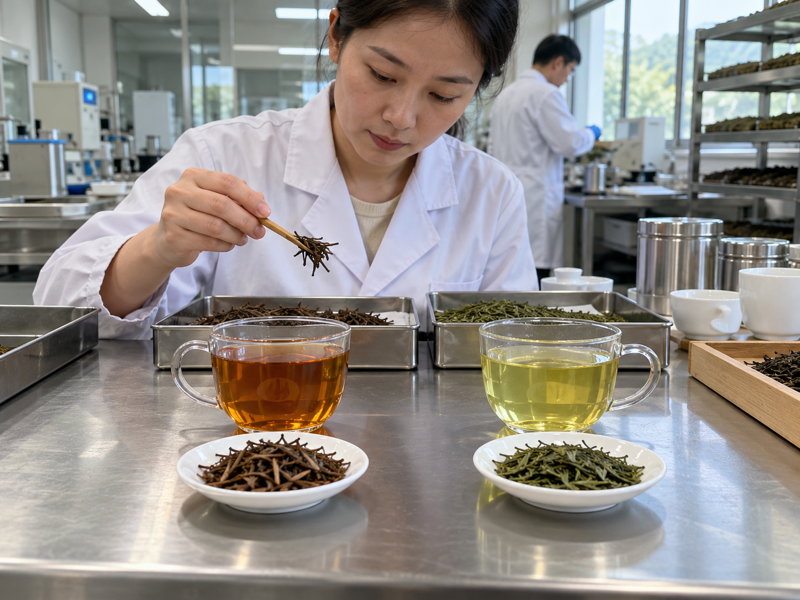
Hojicha usually produces brown leaves or powder and an amber-to-brown infusion because roasting changes the tea’s appearance. Sencha’s leaves and liquor often retain greener tones, while matcha can make a vivid green suspension. Color also depends on grade, concentration, lighting, and the other ingredients. A brown hojicha latte can signal a warm roasted flavor to customers. The same brown hue may conflict with a brand brief built around bright green matcha. Choose color deliberately instead of assuming every green-tea item should look green.
Use realistic package tests. Compare a drink in the actual transparent or opaque cup, under store lighting and after the expected holding period. For shelf-stable products, follow color through processing and storage. Do not use color as a shortcut for caffeine or antioxidant claims; appearance cannot establish chemical content. If your marketing team plans a photograph, ensure the photographed beverage matches the production formula. A product that looks appealing at launch but separates or changes shade in normal service will cost more in remakes and customer complaints than it saves in ingredient price.
5. Is hojicha lower in caffeine than green tea?
A category ranking is too broad
Hojicha contains caffeine. Japan’s MAFF caffeine table lists both hojicha and sencha infusions at 20 mg per 100 mL under their respective defined methods. A Japanese Tea Association roasting report measured an average decline after roasting for its samples, but the reduction varied. These findings do not establish that every hojicha cup is lower than every green-tea cup. Leaf origin, dose, extraction, serving volume, and powder use all affect what a customer receives.
Measure the product. A hojicha powder latte contains the dosed tea material, while a sencha infusion leaves spent leaves behind. Comparing those drinks by a single public concentration number would be misleading. Ask for a caffeine result on the relevant lot and test the finished beverage if a label or menu claim depends on it. Include other caffeine sources such as coffee, matcha, or cocoa. The U.S. FDA advises attention to all sources and serving sizes. A roasted flavor proposition can stand on its own without calling the drink caffeine free.
| Comparison | Missing variable | Better evidence |
|---|---|---|
| Two leaf teas | Dose and brew method | Prepared-cup results |
| Powder and infusion | Tea actually consumed | Serving-specific analysis |
| Menu claim | Final cup size | Tested mg per declared serving |
6. What about catechins or antioxidant claims?
Do not infer a health result from a tea name
Green teas contain several naturally occurring constituents, but their concentrations differ with material, processing, and preparation. A roast can change composition; it does not justify a fixed claim that hojicha has a specific percentage less or more than another tea unless the relevant products were measured. “Antioxidant” is often used as a marketing shortcut, yet a laboratory constituent result alone does not prove a clinical benefit from the finished drink. If a brand wants a nutrient, structure, or health claim, its regulatory team should review the precise wording and evidence in each sales market.
Keep safety context straight. The European Food Safety Authority distinguishes ordinary green-tea infusions from concentrated green-tea supplements in its catechin safety assessment. A beverage developer should not borrow a high-dose supplement finding to advertise a tea drink, or assume every extract is equivalent to an infusion. Record the exact ingredient form, dose, and serving. A buyer can discuss roasted aroma, preparation, and ingredient identity with confidence; health outcomes require a different standard of proof.
7. Should hojicha and sencha be brewed the same way?
Define a method for each material
Water temperature, leaf-to-water ratio, steep time, cut size, and roast all shape extraction. A supplier’s instructions are a reasonable starting point, but a café should test them against its own equipment and cup. A hojicha roast may release aroma well at relatively hot water, while a sencha grade may be chosen for a different balance of sweetness and astringency. The correct comparison uses methods suitable for both teas and reports them. Forcing identical brewing conditions can punish one candidate for a preparation mismatch rather than reveal its product fit.
Write the station card. State grams, water mass, target temperature, time, filtration, final yield, and maximum hold time under the food-safety plan. Taste each cup hot and after cooling. If either tea becomes a concentrate for milk or ice, evaluate the diluted drink as sold. Track staff variation over several shifts. Loose leaf and powder need separate instructions: powder requires dispersion and may settle, while leaf requires extraction and straining. A well-chosen tea cannot rescue an uncontrolled recipe.
| Control | Loose infusion | Powder drink |
|---|---|---|
| Tea input | Leaf grams | Powder grams |
| Liquid | Water mass and temperature | Mixing liquid and total base |
| Process | Time and filtration | Tool and mixing time |
| Output | Accepted yield | Clumps and sediment |
8. Which applications favor roasted or unroasted tea?
Match the flavor to the product matrix
Hojicha can complement chocolate, caramel, dairy, and toasted-grain desserts because a roasted profile can sit beside those flavors. Sencha may suit a clear tea, citrus-led drink, or product where fresh-green character matters. Matcha can support a vivid green latte or confection where its color and suspended body are part of the offer. These are trial directions, not laws. A particular dark hojicha may clash with delicate custard, while a strong sencha may disappear in a rich ice cream. Evaluate finished products after their real process.
Use application controls. Bake the cookie, freeze the ice cream, or heat-treat the bottled drink before selecting material. Record flavor retention, color, sediment, texture, and customer acceptance. Use a no-tea control and an existing menu benchmark. If a supplier offers only one grade for all applications, ask for evidence or request another sample. The tea that performs well in water may not have the lowest cost per saleable dessert. Format choice, dose, and process yield belong in the same decision.
9. How should a brand describe the comparison?
Name the roast without inventing a health hierarchy
“Roasted Japanese-style green tea” identifies hojicha more accurately than “not green tea.” A menu can describe its toasted profile and name the actual milk or sweetener in the drink. If an unroasted product is sencha or matcha, use that name rather than a vague “green tea” that implies the category contains only one style. For import and private-label work, align ingredient specification, carton label, retail copy, and staff training. An origin claim must reflect the specific lot and applicable rules, especially when roasting or packing happens in a different country from cultivation.
Review implied claims. Brown color and an evening-themed campaign might suggest low caffeine even when the copy does not say it. Assess the whole impression. The U.S. Federal Trade Commission requires substantiation for health-related advertising messages, including implied ones. Avoid using “detox,” “safe for everyone,” or “caffeine free” as shortcuts for a roast story. A precise tasting note can help customers choose a drink without turning product differentiation into a medical claim.
| Copy choice | Issue | Better approach |
|---|---|---|
| “Not green tea” | Misstates category | “Roasted green tea” |
| “No caffeine” | Unsupported for tea | Test and state a compliant value |
| “Tastes toasted” | Sensory claim | Check against production lot |
10. What should a B2B buyer specify before ordering?
Make the comparison commercially repeatable
Send suppliers the target application, format, recipe, desired flavor, color, budget, destination, pack size, and expected volume. Request base material, processing description, ingredient list, lot code, specification, shelf life, relevant test reports, and a production-representative sample. Ask for two or three candidates rather than a catalog of unconnected grades. Test them under a written method in the final product. Note whether a candidate meets sensory, technical, regulatory, and commercial requirements separately, then approve a retained sample.
Choose the job each tea does. Matcha Village offers matcha and hojicha powder for B2B applications; buyers can send a brief through its contact page. Keep change notices and incoming-lot checks in the supply agreement. A successful decision may keep both a green and a roasted item if customers want each, or choose one if the menu needs focus. The right result is a reproducible finished product whose name, appearance, flavor, and evidence agree.
FAQ
Q1: Is hojicha a green tea?
Yes. It is green tea roasted after initial processing.
Q2: Why is hojicha brown?
The later roasting step changes the tea’s color and aroma.
Q3: Does hojicha have no caffeine?
No. It contains caffeine; measure a specific serving for a public amount.
Q4: Is hojicha the same as matcha?
No. Matcha is ground tencha, while hojicha describes roasted tea that may be sold as leaves or powder.
Q5: Which one works better in milk?
Test the final recipes. Hojicha offers roasted notes, while matcha offers a different green-tea profile and color.
Compare roasted hojicha with a named unroasted style under defined recipes. The MAFF tea overview provides the processing baseline; your production pilot decides fit.