
A purchasing brief that says only “hojicha tea leaves” leaves too much open: the bag might contain broad leaves, stems, fines, or a blend with a roast too strong for your drink. Hojicha is processed green tea roasted during finishing. The useful buying questions concern material, cut, roast, extraction, and lot consistency. This guide helps tea brands, cafés, and ingredient importers turn a category name into a testable leaf specification.
1. What are hojicha tea leaves?
Roasted, already processed green tea
Hojicha tea leaves are green-tea material that has received a later roasting step. The name points to processing, not to one mandatory leaf grade or harvest. Japan’s Ministry of Agriculture, Forestry and Fisheries (MAFF) describes hojicha as tea made by roasting sencha or kawayanagi. Its wider Japanese tea overview also describes roasted sencha or bancha. Those examples show why a supplier should name the actual base rather than selling “hojicha” as though every lot starts from the same leaf. The finished tea is usually brown, but shade alone does not establish grade or taste.
Ask for both names. A useful offer gives the finished type and the source material: for example, a leaf-led roasted tea for infusion or a stem-rich roasted tea for a distinct aroma. A tea brand needs this detail for consistent retail descriptions. A café needs it to predict brew behavior. A manufacturer needs it to decide whether a leaf extraction line can handle the material. Request the botanical identity, processing description, and intended use in writing before approving a sample. Those details prevent confusion with roasted barley tea or other non-tea ingredients that may also look brown.
| Question | Supplier answer to request | Use |
|---|---|---|
| What plant? | Camellia sinensis | Ingredient identity |
| What material? | Leaf, stem, or blend | Flavor and extraction |
| What process? | Base tea and roast description | Lot consistency |
2. Can hojicha contain stems as well as leaves?
Many styles use different parts of tea
Yes. Roasted tea may be made from leaf, stem, or a blend. Stem-led regional styles show why calling every hojicha product “leaves” can be imprecise. MAFF’s Kaga bocha description covers a roasted stem tea with a distinctive aromatic profile. Neither stems nor leaves are automatically superior for every use. A smooth unsweetened cup, a milk drink, and a strong bakery flavor can each favor a different starting material. Ask for a description of the supplied composition and taste the production sample rather than judging a grade solely from the photographed dry tea.
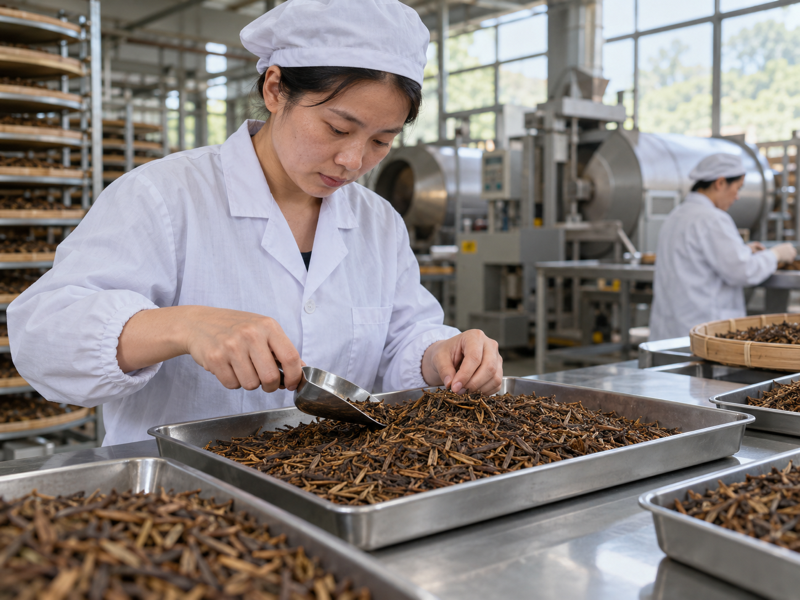
Look at the blend. Open a representative bag and inspect whether long stems, leaf pieces, and fines are evenly distributed. If material separates in shipping, the first and last scoops may brew differently. Ask how the supplier blends and packs it and whether the accepted composition has a stated tolerance. For retail tea, visual appearance matters to customers as well as to extraction. For a food factory, the practical question may be particle handling in a brew tank. Record what the delivered lot actually contains and compare it with the retained approved sample.
3. How does roast level change the leaf?
Aroma and color move together imperfectly
Roasting changes leaf color and builds toasted aroma, yet two equally brown samples need not taste alike. Base tea, roast equipment, temperature profile, and handling all affect the result. MAFF’s roasted stem-tea account notes that light roasting retains more original tea flavor while deeper roasting brings stronger toasted aroma and perceived sweetness for that product. For a B2B buyer, “light,” “medium,” and “dark” are supplier descriptions, not universal technical grades. A retained sensory reference is more useful than a color adjective alone.
Compare three cups. Ask for roast options made for the same intended application. Brew them at a controlled leaf ratio and taste both hot and cooled. Score tea body, roast intensity, sweetness impression, astringency, and any burnt finish. A deep roast may work with milk and chocolate but be too sharp in a plain cup. A lighter roast may make a clear tea that disappears in a pastry cream. Specify the approved profile with a sample, preparation method, and change notice. A new roast setting can change customer experience even when leaf shape and invoice description remain the same.
| Roast observation | Possible use | Check before approval |
|---|---|---|
| Light, tea-forward | Plain tea or delicate food | Does aroma survive the recipe? |
| Moderate toast | Café beverage | Does milk mute it? |
| Deep roast | Chocolate or sweet dessert | Is the finish burnt? |
4. What can a buyer learn from dry-leaf inspection?
Appearance is a screening tool
Dry-leaf inspection can reveal the relative presence of stems, large pieces, fines, and visible foreign matter. It can also flag uneven roast color or excessive dust. These observations help a buyer decide what to investigate, but they do not replace a brewed-cup test or a supplier’s quality report. A very aromatic bag may make a weak cup, and a uniform-looking leaf may have an unpleasant finish. Open multiple samples from the lot if purchasing at scale, because one small pouch may not represent a full shipment.
Use a simple tray method. Weigh a fixed amount, spread it on a clean light surface, photograph it under consistent lighting, and note the proportions of visible leaf, stem, and fines. Keep the result with the lot code. For an automated brewing or packing line, inspect how the cut behaves in the actual hopper, filter, or sachet machine. A fine fraction may clog a filter or escape a tea bag. If the visual specification matters for retail, agree on sample-based acceptance criteria rather than expecting a verbal “premium” grade to settle the question.
5. How should loose hojicha leaves be brewed for testing?
Lock the method before comparing suppliers
Record dry tea mass, water mass, water temperature, steep time, vessel, agitation, and filtration. Taste the same infusion volume from each sample. Without a fixed method, a stronger cup may simply have received more tea or a longer steep. Japan’s food composition entry uses 15 g tea in 650 mL at 90°C for 30 seconds for its analytical infusion. That method is a defined reference, not a required café recipe. Supplier directions can provide a starting point, and your service conditions should determine the final method.
Measure yield. Note how much liquid remains after filtration and whether fines make the cup cloudy. Taste immediately and after a realistic holding period. If the tea will become a concentrate, dilute it into the planned milk or water base and judge that final drink. For a retail leaf product, test more than one reasonable home-brewing method and write instructions customers can reproduce. A supplier sample that performs only under an unusually precise laboratory setup may struggle in ordinary service. Preserve the recipe with the approved lot for later quality checks.
| Trial variable | Record | Risk if omitted |
|---|---|---|
| Tea dose | Grams | Unfair strength comparison |
| Water | Mass and temperature | Changing extraction |
| Time | Seconds or minutes | Variable bitterness |
| Yield | Filtered mL | Wrong cost per cup |
6. When should a buyer choose powder instead of leaves?
Form changes the process and texture
Loose leaves are brewed and removed. Powder is dispersed or incorporated into food, so the material usually remains in the finished product. Leaves may be a good starting point for a clear unsweetened tea or a filtered bottled beverage. Powder may suit a latte, cookie, cream, or ice cream where the formula can carry tea particles. Neither choice is inherently better. Powder can save a brewing step yet introduce sediment or grit; leaves can give a clean liquid yet create extraction loss and spent-leaf handling.
Test both where possible. Compare flavor in the exact product, preparation time, line cleaning, yield, and cost per accepted serving. For powder, request particle information and check dispersion at the intended temperature. Ask whether the product is ground roasted tea or a soluble extract, because those forms have different identities and use rates. For leaves, inspect cut size and filtration behavior. A buyer can then choose on product performance rather than on a supplier’s generic claim that one form is more “versatile.”
7. How should hojicha leaves be packed and stored?
Protect the approved aroma
Tea aroma can change during storage, especially when packages are repeatedly opened or exposed to moisture and strong surrounding odors. Request the supplier’s storage guidance, shelf-life basis, package material, and pack sizes suited to your turnover. A café may prefer smaller sealed units that can be used promptly. A factory may need larger packs that fit controlled inventory and sanitation procedures. Keep lot numbers visible through repacking. A bulk bag without a clear identity or resealing procedure undermines the sensory reference chosen during development.
Test shelf conditions. Compare a newly opened production pack with material held under the proposed service conditions for the expected time. Assess dry aroma, brewed flavor, and any stale note. Do not infer an expiry date from a laboratory tasting alone; follow a documented stability program for retail or packaged applications. Rotate inventory according to the approved plan and record damaged seals. If your team changes packaging format, check the tea again. The cheapest carton can become costly when its final servings no longer smell like the approved sample.
| Storage control | Buyer question | Check |
|---|---|---|
| Barrier pack | How is aroma protected? | Inspect seal and material |
| Pack size | How fast will it be used? | Open-pack trial |
| Lot marking | Can material be traced? | Inventory reconciliation |
| Shelf life | What supports the date? | Review stability basis |
8. Which quality documents belong with the leaves?
Ask for evidence tied to the actual product
At minimum, request a product specification, ingredient identity, origin and processing information, lot code, shelf life, storage instructions, and a certificate of analysis suited to your market and application. Depending on destination and buyer requirements, that may involve microbiological criteria, pesticide residues, heavy metals, or other tests. Do not assume a supplier’s general certificate covers every tea, factory, or shipment. If organic or another certification is relevant, check its scope and validity for the specific product and supply chain.
Connect paper to the cup. A report may show the lot meets technical limits, while a sensory difference still makes it unsuitable for your menu. Keep both quality and tasting approval steps. Confirm that the sample lot, quoted lot, and shipped lot can be linked. If a distributor repacks leaves, ask how traceability survives that step. For international supply, agree on which documents travel with each shipment and which are provided on request. Buyers should set acceptance criteria before receiving the goods, not after a complaint exposes an undefined requirement.
9. How can buyers compare the real cost of leaf grades?
Price by accepted drink yield
Calculate dry-leaf cost per batch, then divide by the volume of saleable filtered tea. Add labor, waste, filtration materials, and any rejected or remade cups. If a lower-priced leaf needs a heavy dose to achieve the flavor target, it may be more expensive per cup. A finer cut may extract quickly but cause filtration trouble. A visually attractive leaf may sell well in retail packs even if another grade is more practical for a central brew line. Choose the cost model that matches the business, rather than forcing one price-per-kilogram ranking onto all buyers.
Hold flavor constant. Compare candidate grades at doses that produce an accepted cup, not at equal bag weights regardless of taste. Track the time staff need to brew and strain. For retail, count pack fill accuracy and visible leaf quality. For foodservice, include lead time and minimum order because stock gaps can erase a small ingredient saving. If seasonality changes the base tea or roast, ask how the supplier will keep the sensory target. A reliable supply can be worth more than a one-time discount that requires repeated reformulation.
| Cost line | Measurement | Decision effect |
|---|---|---|
| Leaf input | Grams per accepted batch | True ingredient cost |
| Infusion yield | Filtered mL | Servings produced |
| Handling | Staff and filter time | Service capacity |
| Supply | Lead time and variability | Continuity |
10. What should a sample request for hojicha leaves say?
A short brief gives suppliers a useful target
State whether the tea will be sold loose, brewed in a café, extracted at a factory, or used as the basis for a powder. Describe desired roast, customer taste, cup color, serving recipe, filtration equipment, expected volume, pack size, and destination market. Ask for base-tea and leaf-versus-stem details, a representative lot sample, brewing directions, specification, quality documents, and change-notice terms. Include a benchmark cup if one exists. The supplier can then propose a small set of relevant materials rather than a long list of grades with unclear differences.
Approve the normal lot. Run the same visual inspection and brew test on a production shipment before rolling out a menu. Matcha Village offers hojicha powder for B2B applications; buyers seeking powder can send their application and performance requirements through its contact page. If sourcing leaves elsewhere, use the same discipline. The final decision should identify the exact material and method that produce the intended cup, then give the quality team a way to recognize a change.
FAQ
Q1: Are hojicha tea leaves green tea?
Yes. They are processed green tea roasted during finishing.
Q2: Can hojicha include stems?
Yes. Ask for the supplied material and blend rather than assuming all products are leaf-only.
Q3: Does dark color mean stronger taste?
No. Color is useful to inspect, but a controlled brew and finished-product tasting decide flavor.
Q4: Are leaves and hojicha powder interchangeable?
No. Leaves are normally infused and removed; powder usually stays in the food or drink.
Q5: What should a buyer keep after approval?
Keep the specification, brew method, retained lot sample, quality reports, and change-notice agreement.
Specify the leaf, roast, and brew performance together. MAFF’s tea descriptions establish the category; a representative lot makes it purchasable.