
Hojicha tea is easy to describe as “roasted Japanese green tea.” Buying it for a café, food brand, or distributor takes more care. Leaf cut, roast level, powder grind, brewing yield, and origin documents all change the product a customer receives. A useful purchasing brief specifies the tea form, sensory target, yield, and documents for the actual lot.
1. What is hojicha tea, exactly?
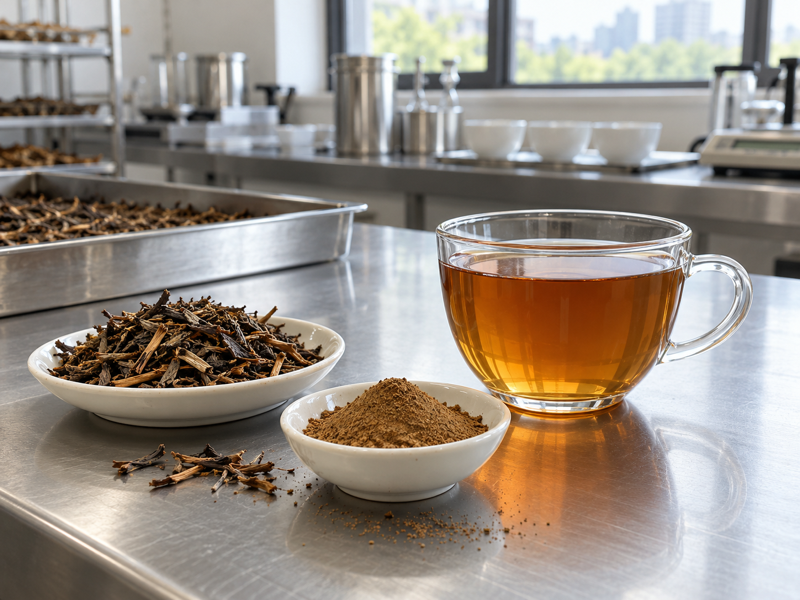
Hojicha is tea whose processed leaves or stems are roasted, giving the brewed drink an amber-brown color and a toasted aroma. It comes from the tea plant. Japan’s Ministry of Agriculture, Forestry and Fisheries lists hojicha among the forms of Uji tea alongside sencha and genmaicha. Bon Appétit’s hojicha explainer describes loose-leaf tea and powder for different café drinks. A buyer still needs a specification for the actual product being purchased.
Ask the supplier whether a sample is whole or broken leaf, stem-rich tea, ground roasted tea, or a sweetened drink mix. All may be marketed around hojicha, but they perform differently. Pure leaf can be strained into a clear beverage; pure powder stays in the drink and works in lattes or food; a premix brings sugar and perhaps other ingredients. A request for “hojicha” alone leaves too much room for mismatch. Identify the sale format and whether the café wants a cup of tea, a milk drink, or an ingredient for dessert before requesting prices.
| Form | Typical use | Specification focus |
|---|---|---|
| Loose roasted leaf | Strained tea service | Cut, stems, roast and brew yield |
| Pure roasted powder | Latte or food formulation | Grind, dispersion and purity |
| Sweetened premix | Fast beverage station | Tea content, sugar and allergens |
2. What does roasting change for the finished cup?
Roasting changes the color and aroma of processed tea. Buyers often describe the result as toasted grain, caramel, nuts, or light smoke, but no single note is guaranteed across lots. Leaf material and roast treatment both affect the outcome. A gently roasted sample can remain mild and sweet; a much darker one may taste dry or ashy when brewed strongly. Build a lot-specific sensory reference instead of writing a poetic description once and applying it to every shipment.
In a sample session, brew all candidates with the same water, leaf mass, vessel, time, and temperature. Record dry aroma, brewed aroma, liquor color against a white cup, body, bitterness, and aftertaste. Then taste the tea in the intended application. A roast that is pleasing in plain hot water may disappear behind milk, while a darker roast that seems blunt as plain tea may remain clear in a dessert. Photograph the cup under consistent light. If the menu promises “nutty” or “caramel,” confirm that trained staff can find that note in the actual served recipe.
3. How should a business choose loose leaf versus powder?
Choose by process, not by fashion. Loose leaf is brewed and removed, which suits a clear hot cup or a filtered cold tea. Powder is ground roasted tea that remains in the beverage or food, which can give a stronger visible color and fuller tea solids. It also creates a risk of sediment or grit. Bon Appétit’s consumer article makes a similar practical distinction between leaf for steeping and powder for lattes. A buyer should go further: measure how many servings a kilogram produces in the intended system and how much labor each method requires.
Run one plain-tea test and one application test for each form. For a café that sells both brewed tea and an iced latte, buying two specifications may be simpler than forcing a single ingredient into both roles. Ask whether the powder is pure roasted tea; a premix changes sweetness and ingredient declarations. For leaf, check filter behavior and the amount of liquid lost in the wet leaves. For powder, inspect the bottom of a finished cup after five minutes. The least expensive pack may have the highest cost per satisfactory drink if its flavor is faint or its particles are coarse.
| Decision | Loose leaf check | Powder check |
|---|---|---|
| Flavor yield | Filtered tea per gram leaf | Tea recognition per gram powder |
| Appearance | Liquor clarity | Suspension and bottom sediment |
| Operations | Brew and strain time | Dispersion and cleaning time |
| Waste | Wet leaves and retained liquid | Powder left in equipment |
4. What should a supplier’s origin statement prove?
“Japanese tea” and “Uji tea” are not equivalent claims. MAFF’s description of Uji tea refers to a defined production and processing tradition involving tea leaves from certain prefectures and processing in Kyoto. A café should not place “Uji hojicha” on a menu merely because a distributor is based in Kyoto or because a sample tastes premium. Ask for country of cultivation, processing location, relevant regional documentation, and lot traceability. If the supplier offers a blend, ask how origin is recorded across components. Keep marketing copy no more specific than the supporting documents.
Origin is one procurement criterion, not a flavor guarantee. Compare the actual roast, cleanliness, price, lead time, and consistency of candidate lots. A buyer who needs year-round service may value a stable blend with clear records over a tiny single-origin lot that cannot be replenished. Record who roasted and milled the tea where those steps matter to the claim. If a product will be sold in several countries, have local regulatory and labeling staff review origin language on packaging.
5. How can a buyer describe hojicha flavor without overpromising?
Use a small, repeatable vocabulary tied to an approved sample: toasted cereal, mild sweetness, woody roast, light smoke, or a dry finish. Avoid stacking all of those words on every menu. Roast lots differ, and the beverage base changes perception. Taste blind against a plain green-tea control only if that comparison helps the buying decision. For each candidate, score aroma before sipping, first-sip flavor, body, bitterness, and lingering note after the cup cools. Record defects too: stale cardboard, ash, sourness, or an overly thin liquor should not become romantic “complexity” in the sales copy.
Have at least two people from different functions evaluate the same coded cups. A buyer may focus on price and continuity; a barista may spot a slow brew or powder that clumps; a chef may care about how the roast survives cream. Agree on an acceptance range and retain a sealed sample from the approved lot. Repeat the test when a new lot arrives, using the same water and recipe. It need not pretend that every cup tastes exactly like chocolate or caramel.
6. What brewing test should a café run before setting a recipe?
Start with a weighed leaf-to-water ratio, a controlled water temperature, and a fixed contact time. For a simple screening cup, try 3 g loose hojicha in 200 g hot water, then compare slightly weaker and stronger cups using the same vessel and lot. These are trial numbers, not a universal brewing rule. Strain at the chosen time and weigh the finished liquor. Taste immediately, after cooling a little, and in the cup size that will be served. A large mug may require a different dose from a small tasting bowl. Track the effect of the site’s water, not just a laboratory water sample.
Measure service practicality. Can staff weigh leaf or use a pre-portioned sachet accurately? Does the filter retain fine particles? What happens if the tea stands for several extra minutes during a rush? If iced service is planned, test the hot brew over the real ice load and compare it with a separately developed cold brew. Do not assume hot and cold methods deliver the same aroma or handling profile. A menu recipe needs specific input weights, a vessel, a timer, a target yield, and a disposal rule for spent leaves. “Steep until ready” is not enough for multi-site consistency.
| Variable | Starting trial | Record |
|---|---|---|
| Leaf | 3 g | Lot and cut |
| Water | 200 g | Source and temperature |
| Contact | Timed, fixed across samples | Start and strain times |
| Yield | Filtered liquor | Grams served |
7. Which quality questions should be asked before a bulk order?
Request an ingredient declaration, product specification, country and processing information, lot code system, packaging format, storage guidance, shelf life basis, and a sample representative of saleable stock. For powder, include grind and dispersion performance. For loose leaf, include cut distribution and visible stems where relevant. Ask how the supplier handles lot-to-lot variation and what notice it gives before a major roast or source change. The buyer should sample at least one full production lot, not approve a hand-selected showroom tin. Keep the purchase order aligned with the tested form and pack size.
Evaluate an opened pack during the expected use period. Does the roast aroma remain acceptable after routine opening and resealing? Does powder clump in a humid bar station? Set storage and rotation rules appropriate to the purchased product and the supplier’s guidance. Keep lot samples and notes so complaints can be traced to a shipment rather than argued from memory. Buying quality includes delivery reliability and documented corrective action, not only the first cup’s score.
8. Where does hojicha tea fit on a menu?
A plain hot cup is the clearest demonstration of leaf quality. An iced tea emphasizes refreshment and makes dilution important. A latte can carry a strong roasted powder but also masks weak tea behind milk and syrup. Desserts and savory dishes can use the roast as an ingredient, though they require their own formulas. Choose one lead application, then develop adjacent products only when the ingredient performs in each. Test yield, labor, and customer response in the actual menu before deciding which tea format deserves a permanent SKU.
For each proposed menu item, write the served portion, tea grams, labor time, acceptable sensory result, ingredient allergens, and packaging. Test the product after a realistic delay: hot tea cools, iced tea dilutes, and powder lattes may settle. Do not use the plain-tea tasting score as proof a sweet milk drink will be good. Train staff to offer a short, accurate description rather than an origin story that the sourcing documents cannot support. A menu that starts with one excellent brewed cup can be stronger than four nominally hojicha items in which customers barely taste the tea.
| Item | Tea form | Main test |
|---|---|---|
| Hot tea | Loose leaf | Roast and filtered yield |
| Iced tea | Loose leaf | Flavor after ice melt |
| Latte | Powder or strong infusion | Recognition through milk |
| Dessert | Powder or infusion | Tea in final bite |
9. What should a café say about caffeine and health?
Hojicha comes from tea and contains caffeine unless a specific product has been tested and lawfully described otherwise. Leaf selection, brewing method, and serving size can affect the final amount. Bon Appétit calls hojicha lower in caffeine than matcha, but that general comparison is not a numerical result for a buyer’s cup. Avoid “caffeine-free,” “safe at night,” or a precise milligram claim based on another brand’s sample. If caffeine information matters to the menu or a packaged product, define the recipe and serving size, then obtain an appropriate finished-product test.
Similarly, do not turn a tea description into a medical or calming claim. A café may describe the roast and flavor without promising a physiological effect. For a latte or dessert, evaluate the whole formula before calling it low sugar or low calorie. Milk, syrup, toppings, and portion size matter. The FDA’s food-allergen resource applies to packaged-food labeling and outlines major U.S. allergens and cross-contact controls; pure tea may be simple, but a milk-based drink is not. Have the relevant regulatory team approve any nutrient or health language before publication.
10. How should an operator compare suppliers and place a first order?
Build a side-by-side scorecard from the intended use. Evaluate approved sensory sample, lot documentation, brew or dispersion performance, landed cost per successful serving, packaging, lead time, and backup supply. Calculate cost from actual yield: leaf retained in the filter and drink rejected for weak flavor both affect economics. For powder, include the grams needed to reach the target and the time to disperse it. Ask for a quote at the volume the business can realistically use before quality degrades after opening. A low per-kilogram price is not a bargain if it forces oversized packs into a slow-moving shop.
Release a purchase specification with the supplier’s approved lot profile and a simple incoming test. On delivery, verify pack integrity, code, ingredient form, and a small brewed or mixed sample against the retained reference. Record exceptions and whether the supplier corrected them. Train staff with the exact service recipe, then monitor customer feedback and waste for several weeks. Revisit the specification when the roast, leaf cut, powder grind, water, milk, or cup size changes.
| Dimension | Evidence | Decision owner |
|---|---|---|
| Sensory fit | Blind served-cup test | Beverage lead |
| Traceability | Lot and origin records | Quality |
| Economics | Cost per passing serving | Buyer |
| Continuity | Lead time and backup plan | Operations |
Frequently asked questions
Q1: Is hojicha a green tea?
Yes. It is a roasted form of Japanese tea; the roast changes its color and aroma. Confirm the exact leaf or powder specification for a purchased product.
Q2: Does every hojicha taste smoky?
No. Roast level and starting material vary. Some lots taste gently toasted, while others are much darker. Taste the served cup before writing flavor copy.
Q3: Can a café use one hojicha for tea and lattes?
It can test that choice, but loose leaf and powder have different processes. Separate specifications often make service and quality easier to control.
Q4: Is hojicha caffeine-free?
No general claim supports that. Caffeine in the final serving depends on the ingredient and preparation; test the specific product before making a number claim.
Q5: What should a buyer request first?
Ask for a representative lot sample, ingredient declaration, product specification, origin documentation, packaging information, and a realistic quote at the intended volume.
References: Bon Appétit on hojicha formats; MAFF’s Uji tea classification; and FDA food-allergen guidance. Test the example brew weights against the chosen lot and equipment.