
A bag labeled “hojicha powder” tells a café buyer surprisingly little about the finished latte. One lot may dissolve quickly yet disappear in milk; another may taste vivid but leave gritty sediment. Start in the cup. This guide treats hojicha powder for latte as a recipe ingredient that must pass sensory, handling, and purchasing tests before a menu launch. It focuses on pure roasted tea powder. A sweetened instant mix belongs in a separate comparison because its sugar and creamer change both the recipe and the label.
Contents: product definition · roast · grind · milk trial · recipe · iced service · cost · documents · pilot · purchase decision
1. What does “hojicha powder for latte” actually mean?
Identify the ingredient before testing it
Hojicha is roasted Japanese green tea, and powder is a milled form intended for direct incorporation. The name does not guarantee a particular leaf grade, roast depth, grind, or formulation. Ask whether the supplied material is 100% tea. If it contains sugar, milk solids, flavoring, or a dispersing aid, treat it as a formulated beverage base with a different cost and nutrition profile. A buyer also needs the supplier's intended application: a fine powder for suspension behaves differently from coarse leaf particles meant for an infuser. Read the specification, then make the drink. Product samples should carry a lot identifier so the tasting result can be linked to the material actually offered. For a chain, keep the approved reference sample sealed and dated. Otherwise the team's memory of “the good brown powder” will not help when a later shipment tastes different.
| Material offered | What the buyer should verify | Likely recipe consequence |
|---|---|---|
| Pure hojicha powder | Tea only, roast, grind, lot | Control sweetness and milk separately |
| Sweetened latte mix | Full ingredients and sugar | Rebalance syrup and nutrition |
| Ground leaf for brewing | Intended use and particle size | May need filtration rather than whisking |
2. Which roast profile survives milk without tasting burnt?
Evaluate aroma in both water and milk
Roasting makes hojicha recognizable, but “dark” is not automatically better for a latte. In water, a darker sample can smell assertive; in dairy it may turn ashy or bitter. A lighter roast might preserve a gentle tea note but become nearly invisible behind oat milk. Prepare several coded samples at one powder dose, using the milk and cup size planned for sale. Smell the dry powder, taste a water slurry, then taste the complete drink after three and ten minutes. Record descriptors that staff can act on: toasted grain, caramel, smoke, astringency, or stale oil. Reject vague votes. “I like sample B” is less useful than “B carries through milk but leaves a dry aftertaste.” The Japanese agriculture ministry describes hojicha as a roasted tea category; it does not define a universal roast standard for cafés. Your own beverage brief must set the target. A dessert drink may welcome a deeper roast than an unsweetened morning cup.
3. How fine should the powder be?
Match particle behavior to station tools
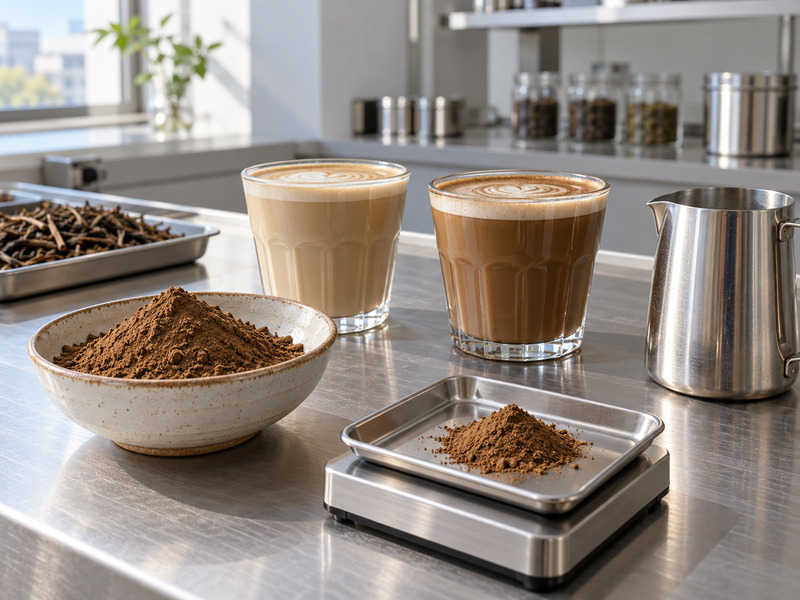
Particle size affects mouthfeel, dusting, wetting, and settling. A powder can look fine in its pouch and still form floating islands when cold milk hits it. Test with the whisk, frother, shaker, or automated dispenser already used at the counter. Weigh a portion, add a measured warm-water charge, mix for a fixed time, and note visible clumps. Pour the drink into a transparent glass. Check the bottom after ten minutes, not just the first sip. Keep the failure sample. A photograph of sediment or a ring on the glass helps purchasing and the supplier discuss the same problem. Fine grinding is not a complete answer: very fine powder may dust during scooping and slow down cleaning. If a high-speed mixer solves the texture but the ordinary station has only a spoon, that sample has not passed operational testing. A sieve can remove coarse particles during development, yet routine sieving adds labor and changes the delivered dose.
| Check | Simple bench method | Record |
|---|---|---|
| Wetting | Same powder and water mass, timed mix | Dry spots after mixing |
| Suspension | Clear glass, ten-minute hold | Sediment depth or visible ring |
| Service fit | Normal barista tools | Seconds, cleanup, remakes |
4. Which milk should be used for a fair comparison?
Test exact cartons rather than generic categories
Milk choice can change the perceived roast more than a small change in powder dose. Dairy adds its own sweetness and body. Oat drinks may reinforce cereal notes; almond drinks can thin a cup; soy can create a different aftertaste. Those are tasting possibilities, not rules. Use the actual cartons, temperatures, and sizes planned for the menu. If two milk choices will be offered, each needs its own acceptance test. Do not choose a tea powder on water tasting alone, then assume it will work in every milk. Control one variable at a time. Hold tea mass and total liquid constant while changing the milk; then hold milk constant while adjusting tea mass. The second pass tells you whether a weak cup needs more tea or a different roast. Keep ingredient labels for allergen review. FDA guidance treats milk, soy, and tree nuts as major allergen categories in the United States; a plant drink's exact ingredients must still be checked.
5. What is a useful starting recipe for a café trial?
Write a measured pilot card
For a 12-ounce-style development cup, a practical first trial is 4 g of pure hojicha powder, 40 g of warm water, and approximately 180 mL of milk. These are test inputs, not a standard recipe. The right dose depends on cup fill, ice, milk, roast, and customer preference. Hydrate the powder in water before adding milk; this makes clumps easier to see and correct. Ask two baristas to repeat the recipe from a one-page card. Weigh the finished drink and note whether the tea still reads clearly after several minutes. Then adjust only one parameter per round. If the drink lacks roast flavor, trial a higher tea dose and a different roast as separate experiments. If the drink feels chalky, more syrup will not fix dispersion. A recipe card should include gram weights, tool, mixing time, cup, and visual reference. Keep sweetness out of the baseline; add it later as a measured choice.
| Pilot variable | Starting point | Adjustment question |
|---|---|---|
| Pure powder | 4 g | Does roast remain clear in milk? |
| Warm water | 40 g | Are dry pockets gone? |
| Milk | About 180 mL | Does body suit the cup? |
| Added syrup | 0 g | Is sweetness actually needed? |
6. Does the same powder work in an iced latte?
Rebuild the cold drink as its own product
Ice changes dilution and aroma release. A powder that is pleasant in a hot latte may taste faint once a customer stirs an iced drink. Make the iced trial with a small warm slurry, chilled milk, and a weighed ice charge. Taste it immediately and after the expected drinking interval. If the drink is layered for photography, stir it before final sensory judgment; the customer will eventually combine those layers. Check whether the powder settles below the ice or forms specks on the lid. Watch the ten-minute cup. A beautiful handoff photograph cannot tell you whether the last third is gritty. If delivery is part of the channel, repeat the test in the sealed packaging after travel and a short hold. Record any foam collapse or separation. A café may choose one powder for both formats, but that decision should follow two recipes and two pass criteria rather than one hot-cup approval.
7. How should the buyer calculate cost per sellable cup?
Price the finished recipe, not the bag
A lower price per kilogram can be misleading if the powder needs a larger dose to taste like tea. Multiply landed price per gram by approved grams per serving. Add milk, syrup, packaging, expected waste, and preparation time. Compare candidates using the same cup and sensory target. A supplier with a higher unit price might still produce a cheaper cup if its flavor carries at a lower dose; the reverse is also possible. Run the arithmetic openly. Note how many drinks a pouch yields at the approved scoop weight and how much powder is lost during setup or closing. For a multi-store operation, include minimum order, lead time, and shipping pattern. A low quote with a long replenishment window can create stockouts or force stores into unapproved substitutes. If the product is a private-label sachet rather than a café drink, include filling, packaging, and shelf-life validation separately.
| Cost line | Calculation | Buyer question |
|---|---|---|
| Tea | Delivered price/g × approved g | Same taste at same dose? |
| Milk | Price/mL × served mL | Any approved alternative? |
| Waste | Test and discarded portions | Does mixing create remakes? |
| Supply | Freight and inventory | Can lots be replenished? |
8. Which supplier documents belong in the approval file?
Link claims to the actual lot
Request a specification, ingredient statement, origin and processing information, shelf life, storage guidance, and the supplier's applicable quality records. Ask how grind, roast, and microbiological controls are checked for each production lot. If a brand wants to print “organic,” “Japan origin,” or a precise caffeine number, the exact product and destination market need documents that support those words. Avoid carrying claims over from another tea or an older lot. Write down the evidence gap. A supplier may be able to provide a current certificate of analysis but not a caffeine assay for the finished drink. That does not prevent a café from selling the product; it does mean the menu should avoid an unsupported number. Matcha Village supplies hojicha powder for B2B evaluation, but a buyer should confirm the current SKU's specification and paperwork before approving label copy. Regulatory review should use the final formulation, especially if milk or sweetener is added.
9. How should a two-week pilot be run?
Observe normal shifts, not only tasting panels
Start with one recipe, two operators, and a defined set of cups. Keep a reference beverage made by the development team. For each service day, record drink count, remake reason, preparation time, and any customer request to change sweetness or milk. A small number of specific notes is more useful than a survey full of “nice” and “interesting.” Train operators to distinguish powder clumps from roast bitterness; those faults need different fixes. Let the queue test the method. A process that works in an empty test kitchen may be too slow when orders stack up. Check powder handling after the pouch has been opened and used repeatedly. If the scoop mass drifts, switch to a calibrated method or schedule a scale check. Repeat the sensory trial with a second lot before a wider rollout. Product approval should survive ordinary people, ordinary shifts, and ordinary supply variation.
| Pilot signal | What to count | Possible action |
|---|---|---|
| Remakes | Clumps, weak flavor, wrong milk | Change method or recipe |
| Service time | Seconds per drink | Simplify slurry step |
| Consistency | Blind comparison across shifts | Retrain or revise card |
| Repeat orders | Customer response over pilot | Keep, adjust, or stop |
10. When is hojicha powder ready for purchase?
Sign off flavor, process, and supply together
The answer is not “when everyone likes the sample.” A purchase decision needs a drink that hits the sensory target at a documented dose, mixes with available tools, stays acceptable through the intended serving window, and comes with records for the claim language used on menus or packs. Purchasing should confirm price and replenishment; quality should review the ingredient and lot file; operations should demonstrate repeatable preparation. Keep one approved version. Store the recipe card, reference photo, supplier lot, and decision date in the same place. If milk, powder, or equipment changes, re-test the cup rather than assuming it will stay identical. For a buyer approaching Matcha Village, send the target roast character, milk choice, cup size, expected monthly volume, and market. Those details make a sample request more useful than asking for “the strongest hojicha.”
Final recommendation
Buy hojicha powder for latte service only after a measured milk trial, an iced check, a service-time check, and a lot-specific document review. The result should taste of roasted tea even when a barista you have never met prepares it during a busy shift.
FAQ
Q1: Is hojicha powder the same as instant hojicha latte mix?
No. Pure powder is tea; an instant mix can include sugar, milk ingredients, and other components. Read the ingredient statement.
Q2: Can a café use one powder for hot and iced cups?
Yes, if each format passes its own recipe and hold test. Ice changes dilution and powder behavior.
Q3: Does darker powder always make a stronger latte?
No. Roast, dose, grind, and milk all affect the finished flavor. A dark sample can taste ashy rather than clear.
Q4: Should the powder dissolve completely?
Pure tea powder is a suspension, not necessarily a soluble extract. Evaluate clumps, mouthfeel, and sediment in the served drink.
Q5: What should a sample request include?
State cup size, milk, roast target, channel, expected volume, and the documents needed for your market.
Sources: Japan MAFF, Uji tea categories; Japan MAFF, Kaga bocha roasting; FDA, food allergens.