
Hojicha latte calories cannot be reduced to one web-search number. A café can use the same roasted tea powder in an unsweetened small milk drink or a large iced cup with syrup and foam. The calorie total changes with the recipe and the serving sold. This guide gives foodservice teams a reproducible calculation, a test plan, and a review path for menu or retail labeling. It uses FDA serving-size guidance and ingredient data rather than an unrelated recipe’s estimate.
1. What determines a hojicha latte’s calorie total?
Start from grams and milliliters actually served
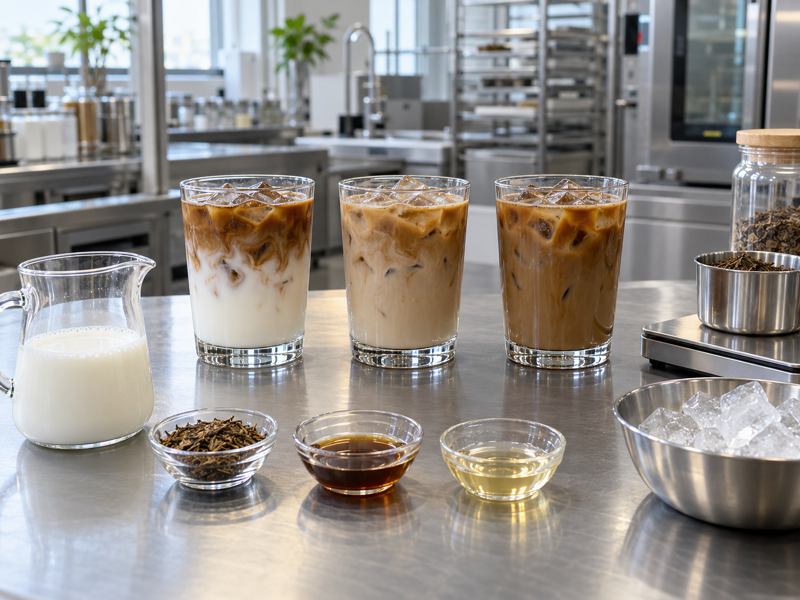
Tea powder, milk, sweetener, syrups, whipped cream, and other toppings each contribute according to their measured quantity and product-specific nutrition data. Water and ice add volume without adding the same energy as milk or syrup. Write down the full build. A menu name is not a formula. Define powder grams, water volume, milk brand and volume, syrup grams, topping mass, and final cup size. Then use the supplier’s current nutrition information for each ingredient, normalized to the amount used. Calculate one served cup, not a theoretical batch before line loss. If a staff member adds syrup by an uncalibrated pump, measure several pumps and set a standard. A powder sold as a latte premix may already contain sugar or creamer, so counting it as pure tea will understate the total. Keep the ingredient declarations and calculation version with the recipe.
| Recipe part | Measure | Data source |
|---|---|---|
| Tea or premix | Grams | Supplier label |
| Milk or alternative | Milliliters | Current carton |
| Syrup or sugar | Grams | Supplier label |
| Topping | Grams | Supplier label |
2. How much do hojicha powder and premix contribute?
Composition comes before arithmetic
Pure hojicha powder is roasted tea ground into particles. A “hojicha latte mix” can be a formulated blend with sweetener, milk solids, plant creamer, or flavor. Those are different ingredients with different calorie values per gram. Read the product label. Request the exact formulation’s nutrition panel and ingredient list from the supplier; do not copy a number from a competing brand. The quantity per cup also matters. A small amount of pure tea may contribute less energy than milk or syrup, but the statement should follow actual data, not an assumption. For a premix, calculate calories from every gram used even if staff add only water. If the supplier adjusts its blend, update the recipe sheet and nutrition calculation. In product development, choose a powder for flavor and dispersion, then calculate the calorie profile from the resulting recipe. Reversing that sequence can leave a low-number drink customers do not reorder. For a distributor selling both pure tea and a premix, create separate spec sheets and order codes. A warehouse substitution between them would alter sweetness, allergen declarations, mixing method, and the nutrition calculation at once. Receiving staff should see those differences on the purchase order, not only in an R&D notebook.
3. How does milk choice change the number?
Use the exact carton and serving volume
Whole dairy milk, reduced-fat dairy, oat drink, almond drink, and coconut drink can differ sharply, including between brands and sweetened versions. A barista’s “milk swap” is therefore a recipe change, not a cosmetic variation. Read serving units. One carton may list nutrition per 100 mL; another may use a cup. Convert both to the measured pour. Record whether the team tops a 12-ounce cup to a fill line or dispenses a fixed 180 mL. Ice changes available liquid volume in an iced drink, so hot and iced versions may have different milk quantities even under the same menu name. Use a scale or marked pitcher during calibration. In training, emphasize the exact milk SKU: changing supplier cartons can change the calorie calculation even if staff make identical drinks. Keep a substitution table for every approved milk rather than one generic “plant milk” value.
| Milk variable | What to record | Why |
|---|---|---|
| Brand and SKU | Exact carton | Nutrition varies |
| Sweetened status | Ingredients | Added sugar may differ |
| Volume | mL per cup | Controls total energy |
| Foam loss | Measured output | Changes served amount |
4. What do syrups and toppings add?
Small extras can dominate the variance
Maple syrup, brown sugar syrup, vanilla syrup, whipped cream, cold foam, and sweet dustings belong in the calculation. Even when hojicha itself has a restrained flavor, a café may add enough sweetener to turn the drink into a dessert-like product. Weigh the pump. Dispense ten standard pumps into a tared container, divide by ten, and check whether individual staff create a similar dose. For hand-poured syrup, adopt a measured utensil or station bottle. Count a topping only when it is part of the sold default drink; list optional additions separately. If a cream layer includes several ingredients, calculate it as a batch recipe and allocate the actual topping mass per cup. Do not call a drink “unsweetened” merely because no sugar is added at service when its premix or milk already contains sweetener. The ingredient list decides that statement.
5. Why does serving size change the answer?
One cup name can hide several formulas
The FDA explains that nutrition information is tied to a stated serving. For cafés, small, medium, and large cups may use different ingredient ratios rather than a simple scale factor. A large iced cup often contains more ice, not proportionally more milk. Calculate each size. Do not multiply a small latte’s calories by 1.5 until the recipe confirms every component scales that way. Ask whether tea powder stays constant while milk grows, whether syrup pumps change, and whether foam is capped at the same height. A chain might also offer a double-strength tea option. Each defined variation needs a controlled recipe and calculation. Packaging introduces a separate question: a bottle may contain more than one labeled serving under applicable rules. Decide the sales and consumption unit early so the nutrition team can apply the correct market-specific format.
| Size | Tea | Milk | Syrup | Action |
|---|---|---|---|---|
| Small hot | Measure | Measure | Measure | Calculate |
| Large hot | Measure again | Measure again | Measure again | Calculate |
| Iced | Include dilution recipe | Measure liquid | Measure | Calculate |
6. How can a team build an auditable calorie worksheet?
Keep the units visible
For each ingredient, multiply quantity used by calories per gram or per milliliter, then sum the rows. Convert a per-100 mL label value by multiplying it by milliliters used and dividing by 100. Repeat for per-100 g data. Show the math. A worksheet with hidden copied values becomes stale when an ingredient changes. Record the source label date, brand, SKU, ingredient quantity, conversion, and result. Store a separate revision for each menu size and milk choice. Have someone other than the recipe author check units, since confusing grams with milliliters or a 30 mL syrup serving with a 100 mL reference creates large errors. Run a small production audit by making several cups and weighing the actual additions. If measured pours differ from the card, correct the workflow or calculate from the actual standard. The worksheet should describe the sold cup, not a perfect demonstration drink.
7. Can a lower-calorie version retain tea flavor?
Change one ingredient at a time
Reducing syrup or using an unsweetened milk can alter calories, but it also changes sweetness, body, and how roasted notes register. A lower-sugar drink may need a different tea dose or roast profile to taste balanced. Test the full swap. Prepare a controlled set: current recipe, reduced syrup, alternate milk, and a combination. Keep serving size fixed. Have a tasting panel rate tea clarity, sweetness, texture, and aftertaste without seeing the formulas. Record ingredient cost and mixing time too. Do not imply that a particular calorie number makes a drink medically suitable for every customer. If the alternate milk contains an allergen, update the disclosure. When a version passes, give it a separate recipe code and nutrition calculation so staff cannot drift between two builds. A useful menu option remains repeatable during busy service.
| Trial | Variable changed | Check |
|---|---|---|
| A | None | Control flavor |
| B | Less syrup | Roast sharpness |
| C | Different milk | Texture and allergen |
| D | Combined change | Acceptance and cost |
8. What should appear on menus and retail labels?
Match the claim to its regulatory setting
For US chain restaurants covered by federal menu-labeling rules, FDA requires calorie information on menus and menu boards, with additional nutrition information available on request. Packaged retail drinks follow packaged-food rules, including serving-size and Nutrition Facts requirements where applicable. Other countries differ. Ask the local reviewer. The importing partner or regulatory specialist should approve the market-specific format and any “low calorie,” “no added sugar,” or similar claim. A calculated internal worksheet does not itself authorize a front-panel claim. Include approved milk variations and toppings in staff materials so a customer does not mistake the default calorie number for every customization. For a private-label product, verify that artwork and ingredient formula refer to the same revision. Keep supporting labels or analyses in a file that can be produced when a retailer asks how the number was derived. A chain should also define how online ordering displays calories for milk swaps and extra syrup. If the ordering interface cannot calculate customizations, explain clearly what the posted number covers. Otherwise a precise default value may give a misleading impression about an altered cup.
9. How can operations keep calories consistent?
Calibrate the tools that control dose
Standardize powder scoops by weight, syrup pumps by mass, milk pitchers by volume, and topping portions by a defined tool. A scoop that looks full can vary with powder packing; a syrup pump can deliver less when it clogs. Audit the station. Have a trainer make several cups, then compare measured ingredient usage with the approved card. Check hot and iced stations separately. If a chain buys milk from regional distributors, approve exact substitute SKUs and update nutrition records. A batch concentrate needs a yield record: tea, water, sweetener, and final volume per batch, followed by concentrate milliliters used per drink. Staff should know when a customer customization changes the published default number. This operational work protects both consistency and the taste that made the recipe worth selling. It also makes ingredient purchasing forecasts more reliable.
| Control point | Field check |
|---|---|
| Powder scoop | Weigh five portions |
| Syrup pump | Weigh ten strokes |
| Milk line | Check poured mL |
| Batch base | Record final yield |
10. What should happen before a calorie figure goes live?
Approve the recipe, data, and copy together
Freeze the ingredient SKUs and serving build. Recheck the arithmetic against current nutrition labels or laboratory data where needed. Verify several actual cups and document any process loss. Send the worksheet and intended wording to the qualified reviewer for each sales market. Lock the revision. Assign the approved recipe, menu board copy, training card, and retail artwork one shared version identifier. Create a trigger for recalculation after supplier, dose, pack size, or topping changes. Matcha Village can discuss pure hojicha powder or blended product options, but the latte’s calories depend on the buyer’s finished formula. A sample request should include target serving size, milk choice, desired sweetness, and sales market. That lets product development test flavor while nutrition and regulatory teams build a defensible number. The figure should follow the drink customers can buy today. For a practical beverage build, compare our hojicha latte guide before calculating your own formula.
Hojicha latte calories come from a measured recipe. Calculate each sold size and variation from current ingredient data, verify station behavior, and have market-specific label copy reviewed before launch.
FAQ
Q1: Does plain hojicha have the same calories as a latte?
No. Milk, sweetener, and toppings change the finished drink’s energy total.
Q2: Is every oat-milk hojicha latte equal?
No. Oat drink brands and pour volumes differ, as do syrup and powder doses.
Q3: Can a recipe-page estimate be used on a menu?
Use your own approved recipe and ingredient data, then follow applicable menu-labeling rules.
Q4: Does ice reduce calories?
Ice adds volume without energy, but the answer depends on how much other material goes into the cup.
Q5: When should the worksheet be updated?
Update it after any ingredient, dose, cup size, or process change that affects the sold drink.
Sources: FDA serving-size guidance; FDA restaurant labeling overview; USDA FoodData Central.