
A warm ice-cream base can smell strongly of roasted tea, then taste strangely quiet after freezing. More hojicha powder may bring color but leave a gritty scoop. A shop or manufacturer needs to test the tea within its actual frozen base, process, pack, and sale window. This hojicha ice cream guide focuses on product development rather than a home recipe. It helps teams choose a roast, judge texture, and approve a production scoop that tastes of tea on a normal service day. Food-safety and shelf-life decisions remain with the finished-product maker.
Contents: brief · tea · base · dose · mixing · freezing · texture · holding · cost · launch
1. What should the frozen dessert taste like?
Set a flavor target after freezing
Decide whether hojicha should be the lead flavor or a supporting roasted note behind vanilla, caramel, or chocolate. Write desirable and reject descriptors in ordinary language. A clean toast finish can make a scoop distinct; ash, smoke, or stale oil can make it unpleasant. Set the serving format too: hard scoop, soft serve, bar, or packaged pint. Each format changes texture and temperature, so one test cannot approve all of them.
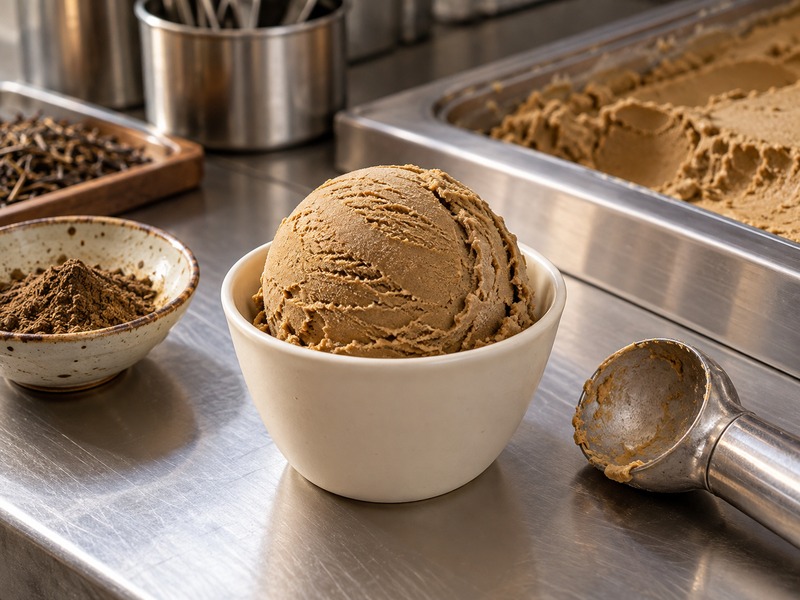
Taste the saleable scoop. A warm mix sample is useful for diagnosing ingredients but not for final approval. Serve the frozen product at the actual temperature, portion size, and delay expected in the shop. Ask tasters blind whether they can identify roasted tea. Keep an unflavored base as a control. If a dark brown scoop tastes only of sweet dairy, the formula has a marketing color, not a finished tea flavor.
2. Which hojicha ingredient belongs in the base?
Compare powder with infused leaf if useful
Fine powder can give strong flavor and color but adds particles. A leaf infusion may produce a smoother base but can add water and lose strength under fat and sugar. Prepare both routes at a measured tea input and final mix weight, then freeze them under the same process. A sweetened premix is a third formula with its own sugar and dairy contribution. Ask the supplier for a production-representative sample and a current product file.
Inspect the finish. A powder that works in a hot latte can still feel gritty in a frozen scoop. A leaf infusion may taste clean yet fade after a week in the freezer. Choose by the product’s intended sale point. If powder is selected, record grind, roast, dose, and mixing method. Keep a retained reference lot for later shipments. The ingredient that makes the best test cup is not automatically the one that makes the best ice cream.
| Tea route | Benefit | Risk |
|---|---|---|
| Fine powder | Strong color and body | Particle feel |
| Leaf infusion | Smooth liquid | Dilution |
| Sweetened blend | Fast formulation | Sugar and label |
| Concentrate | Controlled addition | Storage validation |
3. How does the base affect tea flavor?
Hold fat, sugar, and vanilla fixed
Dairy fat and sugar can soften a roast. A plant base can add coconut, oat, or other notes. Choose the commercial base for the first tea trial and keep it fixed while comparing hojicha samples. Check sweetness and vanilla level; both can hide tea. If the team uses chocolate chips or a caramel swirl, add them only after the plain tea base works. It should be possible to taste the roasted note without an explanatory menu card.
Keep one control tub. Freeze the base without tea under the same conditions. That lets tasters identify what the ingredient adds. If the tea version feels less creamy, the added solids or process may be involved. If it tastes flat, changing the base or roast may help more than adding powder. A dairy-free line needs its own allergen and ingredient review. Do not describe it as safer for all customers merely because it lacks milk.
4. How should the powder dose be tested?
Use a measured series in one base
Prepare several tea levels while holding base formula, mix age, freezer method, and pack constant. Record powder as a percentage of finished mix weight. Taste after freezing and after the planned storage period. A low dose may disappear; a high dose can make color muddy or mouthfeel coarse. A darker roast can achieve stronger recognition at a different dose, but check for harshness. Use blind codes so a team does not reward the most expensive or darkest sample automatically.
Do not change two things at once. If a higher dose produces a stronger tea note and a harder scoop, retain it as a candidate and run a second trial adjusting one texture variable. If every dose fails, try another powder or infusion route. A universal recipe from the web cannot account for the shop’s base and equipment. The winning level should be the lowest one that gives the desired tea character without damaging texture or cost, not merely the one with the most aroma in an unfrozen bowl.
| Trial measure | Record |
|---|---|
| Powder mass | Percent of mix |
| Frozen flavor | Tea and off-notes |
| Color | Served scoop |
| Texture | Grit and hardness |
| Cost | Tea per sellable serving |
5. When should tea be added to the process?
Disperse it consistently
Powder can clump when tipped into a cold high-fat mix. A small slurry or controlled mixing stage may help, but the exact sequence depends on the plant’s process and food-safety plan. Test the real mixer and batch size. Observe whether powder stays suspended, accumulates on equipment, or concentrates in early and late portions. A bench blender can produce a smooth cup that a production tank does not reproduce.
Sample the discharge. Compare mix from the start, middle, and end of a run before freezing. If the tea level differs, review mixing and filling. Avoid adding so much mechanical work that the base changes texture or temperature outside its approved process. The quality team should sign off the route and any sanitation controls. A supplier can advise on powder behavior, but the manufacturer owns the finished process and its validation.
6. What changes during freezing?
Test with the actual equipment
Freezing changes aroma perception and physical structure. Hard-pack ice cream and soft serve are different products. Record the batch freezer or continuous line, draw condition, hardening, pack, and serving temperature. Overrun can change how a scoop feels and how strongly tea is perceived per volume. A small hand-frozen sample may not predict a commercial run. Compare samples prepared on the equipment intended for launch.
Keep the spoonful comparable. Taste equal mass as well as normal scoop portions. If one sample has more air, equal-size scoops may contain different amounts of tea. Check whether powder particles become more noticeable as the ice cream melts. A serving that is pleasant when very cold can become gritty at the end of the cup. If a swirl is planned, test whether it migrates or dominates the base during storage.
| Process point | Product question |
|---|---|
| Mix tank | Is tea uniform? |
| Freezer | Does texture change? |
| Hardened pack | Is scoop stable? |
| Served temperature | Is tea clear? |
7. How can texture stay clean?
Separate ice crystals from tea particles
A gritty perception can come from tea powder, ice crystals, or other dry ingredients. Diagnose it by tasting the plain base and tea base under identical storage. Inspect powder fineness and dispersion, then review freezing and temperature history. Do not assume more stabilizer or more milk fat will fix a coarse tea grind. Change one factor at a time and repeat the frozen test. The objective is a scoop that feels intentional as it melts.
Taste the empty bowl. Fine tea sediment may remain after the creamy portion disappears. If customers eat the product from a paper cup, check the last spoonful there. A topping can add crunch, but it should not conceal unwanted sandiness. For a packaged pint, simulate a customer’s ordinary tempering before scooping. A texture that only passes straight from a production freezer may not pass at home.
8. What should happen during frozen storage?
Validate the finished product and package
The manufacturer must set food-safety controls and shelf life for its exact formula and pack. Sensory quality should be checked across the proposed sale window as well. Tea aroma can fade, the surface can change color, and temperature swings can damage texture. Record freezer conditions, transport, and display. A good scoop from the factory is only the first checkpoint. Retail doors and delivery routes can create a different product experience.
Open the late pack. Taste at the end of the approved period and compare with a fresh control. Note aroma, color, ice crystal size, and tea residue. If quality fails before the safety limit, the commercial sale window may need shortening. A new tea roast, base, or pack can change the result. Keep the study with the finished recipe version, not only the supplier’s powder specification.
| Holding check | Evidence |
|---|---|
| Tea aroma | Blind late-pack taste |
| Texture | Scoop and melt test |
| Appearance | Normal display |
| Safety and life | Validated product process |
9. What does one sellable serving cost?
Include production loss
Cost tea, base, inclusions, pack, energy, labor, testing, freight, and unsellable product. A stronger powder may cost more per kilogram and less per scoop if the dose is lower. A powder that causes tank residue or inconsistent filling can raise loss. Measure finished yield and actual scoop mass. Soft serve brings a different waste pattern from prepacked pints; estimate each under ordinary demand rather than one perfect pilot.
Watch slow days. A flavor that sells only occasionally can still work as a rotating special if the powder pack size and frozen inventory fit. It may be poor as a permanent SKU with large minimum production runs. Ask the supplier about smaller sealed ingredient packs for trials and scale. The cheapest powder quote is not useful if a large bag stays open until the roast fades.
If the flavor is served from a scoop cabinet, include display time in the trial. A sample eaten straight from the hardening room may feel firm and clean, while the same batch becomes soft or icy after repeated opening of the cabinet. Measure the serving temperature and compare scoops from the top and bottom of a pan. The powder choice should pass this service test, because that is the texture a guest buys.
10. When is hojicha ice cream ready to sell?
Approve the served scoop and the repeat lot
Run a production pilot using regular staff, equipment, pack, and distribution. Taste early and late product from the batch after the planned hardening and storage. Check powder uniformity, scoop texture, tea recognition, complete ingredient and allergen labels, and validated safety. Keep a retained powder sample and finished-product reference. If a later tea lot changes, compare before adjusting the recipe across production.
Give the supplier a finished-product brief. Matcha Village can discuss hojicha powder for frozen applications; share the base type, process, trial dose, desired roast, and intended pack. A buyer should ask for the exact item and lot documents, not a generic “ice cream grade.” The product is ready when an ordinary customer’s scoop tastes of roasted tea through the last spoonful.
| Launch gate | Pass evidence |
|---|---|
| Tea flavor | Clear in frozen scoop |
| Texture | Smooth melt |
| Production | Uniform batch |
| Safety | Validated process |
| Supply | Approved powder lot |
Final recommendation
Choose tea in the frozen base, not from a warm aroma test. Keep the roast clear, the mouthfeel smooth, and the next powder lot tied to a repeatable scoop test.
FAQ
Q1: Is powder better than brewed tea for ice cream?
Each has tradeoffs. Compare them in the same frozen base at a controlled tea input.
Q2: Why does tea flavor fade after freezing?
Cold serving and the base can mute aroma. Judge the frozen scoop and adjust the ingredient or formula.
Q3: Can more powder fix weak flavor?
Sometimes, but it may add grit or bitterness. Test roast and base first.
Q4: Does a home recipe establish a commercial shelf life?
No. The finished formula, process, and pack need validation.
Q5: What should the supplier receive?
Share base type, frozen format, process, trial dose, desired roast, pack, and expected volume.