
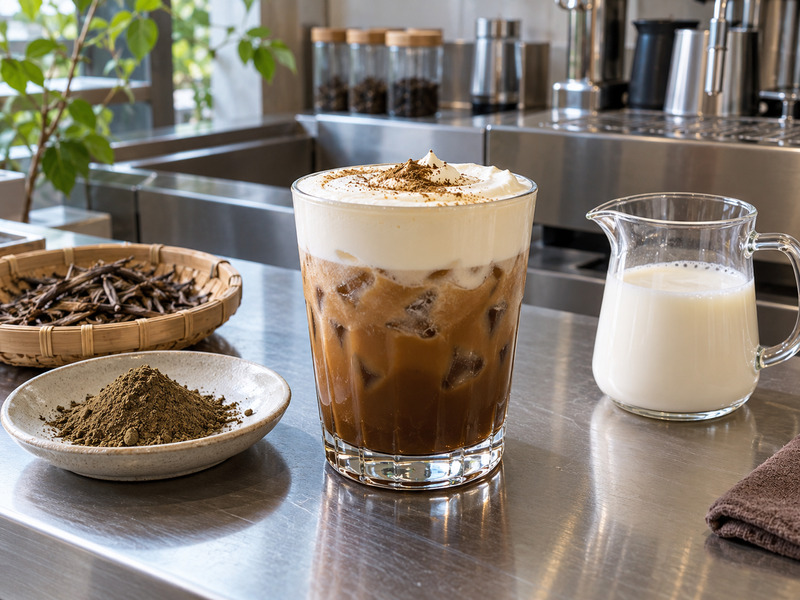
A hojicha einspanner puts a cream cap over roasted tea. That simple description hides the difficult part: the first sip should carry cream and tea together, and the last sip should still taste intentional. A café also has to decide whether it means a whipped cream topping, a pourable cream foam, or a dairy-free version. This guide develops a serviceable drink, with quantities presented as trial points rather than a universal recipe.
Contents: drink definition · tea base · cream · sweetness · layering · hot version · service · safety · cost · launch
1. What makes a hojicha einspanner recognizable?
Keep the contrast between roast and cream
Traditional einspanner is associated with coffee under whipped cream. In this variation, roasted tea supplies the dark, aromatic base. The point is not to make tea look like coffee; it is the meeting of a bittersweet base and a cool, rich top. A menu should name the actual components. If there is no coffee, say so when customers ask. If espresso is added, label that version separately. Protect the contrast. A weak tea base disappears behind cream, while an overly smoky one tastes harsh once the topping thins. Before discussing decoration, set a target sip: how much tea aroma should reach the nose, how sweet should the cream feel, and should a straw be provided? That serving choice changes the drinking experience. A customer sipping through the cream gets a different beverage from someone stirring the whole cup at once. Test both, because neither behavior can be controlled after handoff.
| Design choice | Customer experience | Trial question |
|---|---|---|
| Thick whipped cap | Distinct cream-first sip | Does tea reach the palate? |
| Pourable cream foam | Easier mixed sip | Does it collapse quickly? |
| Stirred cream tea | Consistent sweetness | Is the roast still visible? |
2. Which hojicha base has enough presence?
Compare powder and brewed concentrate
A pure hojicha powder slurry carries the roasted material into the drink and can give strong color and body. A brewed leaf concentrate may feel cleaner but can become weak after ice and cream are added. Trial both with the same finished cup size. For powder, disperse a measured mass in a small warm-water portion before chilling. For leaves, record dry mass, brew water, contact time, and filtered yield. Taste beneath the topping. The unsweetened base should be pleasant but assertive; it should not depend on cream to hide a burnt or stale note. When judging candidates, let the drink stand for ten minutes. Powder sediment, tea haze, and cream drainage become easier to see. The best base is not necessarily the darkest one. It is the one that still offers a clear roasted tea flavor once a real customer drinks the assembled cup.
3. How should the cream topping be formulated?
Set a texture target before a recipe
Heavy whipped cream, a light dairy foam, and plant-based topping will not behave alike. A thick cap may hold a shape but demand a spoon; a thin foam can be sipped easily but drain into the tea within minutes. Define the target: spoonable peaks, pourable foam, or a soft cap that settles slowly. Then vary cream composition and whipping endpoint one at a time. Measure the top. Weigh the amount placed on each cup and photograph the side profile at handoff and after five minutes. If the formula uses a sweetener or stabilizer, include it in both costing and ingredient review. A dairy-free alternative should be evaluated for flavor and stability with roasted tea, not selected only because it whips in a separate bowl. For a chain, specify mixer, speed, batch size, and stop point; “whip until ready” invites variation.
| Topping trial | Target observation | Likely correction |
|---|---|---|
| Too stiff | Tea cannot pass through | Reduce whipping or density |
| Too loose | Cream falls into base | Adjust formulation or process |
| Grainy | Fat separates on hold | Review temperature and whipping |
4. Where should sweetness go?
Split sweetness with purpose
A sweet cream can make an unsweetened tea base taste balanced, especially on the first sip. But if most sweetness stays in the cap, the final tea may seem abruptly bitter. Test three versions: sweetness only in the cream, only in the tea, and measured amounts in both. Keep total sugar comparable so the panel judges distribution rather than quantity. Sip the whole cup. Taste from top, middle, and bottom after a normal drinking interval. A syrup with vanilla or caramel notes can complement roast, but it can also erase what makes hojicha distinct. If the menu offers a “less sweet” option, define which component changes; a barista should not improvise by reducing only the tea syrup while leaving the cream untouched. For packaged or nutritional claims, calculate the full recipe rather than describing the tea base alone. A cream cap adds calories and milk allergen even if the tea underneath contains none.
5. How can the two layers stay attractive?
Control temperature, density, and pour
Layering is a process, not a garnish. Chill the tea base if the drink is iced, use a measured ice load, and pour the cream over a spoon or through a controlled dispenser. A very warm base melts the cap; a watery base can make the foam slide. Watch the edge of the glass. Cream streaks on the outside or tea splashed into the cap make a finished drink look careless. Photograph the cup from the side at handoff, five minutes, and ten minutes. Then stir it and taste again. This test prevents an attractive visual from winning over flavor. If staff need several slow spoon pours to achieve the photograph, the technique may not survive a queue. An acceptable service design might be a less dramatic layer that every barista can repeat. Define a visual tolerance rather than demanding an unrealistic perfect line on every cup.
| Control | Trial setting to document | Failure signal |
|---|---|---|
| Tea temperature | Actual cup temperature | Rapid cream melt |
| Ice mass | Weighed per cup | Dilution or floating cap |
| Cream dose | Grams per serving | Inconsistent top thickness |
| Pour method | Tool and motion | Streaks or mixed layers |
6. Does a hot hojicha einspanner need another formula?
Treat hot service as a separate test
Hot tea changes the cream faster than an iced base. A spoonable cap may melt into a rich drink, which can be pleasant, but the shop should decide whether that is the intended result. Test a hot tea base at the service temperature used by the business, add the approved cream dose, and observe how long the topping remains present. Check the first and fifth minute. If the top vanishes before the guest reaches the table, either change the formulation or describe the hot drink honestly. Avoid using an iced-drink photo for a hot menu item that looks entirely different. A hot version may also need less sweetener because warmth changes aroma perception. Recalculate serving mass and price; ice no longer fills part of the cup, and more tea base may be needed. If the topping is made in advance, its preparation and holding procedure need review just as the cold version does.
7. What can a barista repeat during a busy shift?
Build a short station procedure
Use a recipe card with base mass, tea preparation, ice or hot water, cream dose, cup, lid, and serving instructions. Put the cream tool beside the station rather than in a remote prep area. Have two operators make consecutive orders while someone records time and visible variation. Make the card testable. “Add a cloud of cream” is evocative menu language but a poor production instruction. “Add 35 g of prepared topping” can be checked. If each cup requires a scale, decide whether the service speed supports that; a calibrated dispenser may be better after development. Train staff on what a failed cup looks like: collapsed foam, cream curdling, unblended powder, or a base that tastes like warm water. Customer instructions should be brief. A simple “sip through the cream or stir for a sweeter drink” can prevent confusion without turning the counter into a lecture.
8. What food-safety and allergen issues need review?
Treat cream as a controlled ingredient
Dairy cream brings a major allergen and can require temperature control. Plant alternatives may contain soy, nuts, or other ingredients that need disclosure. FDA guidance identifies milk and several other foods as major allergens in the United States; the actual label and market govern the finished product. The FDA Food Code provides retail guidance for holding food that needs time or temperature control. Use the shop’s approved procedure. Record how topping is prepared, dated, stored, dispensed, and discarded. Do not invent a universal safe countertop window from a recipe blog. A whipped topping can look stable while its handling has become unsuitable. Shared whisks and nozzles also create cross-contact questions if the shop promises a dairy-free option. Review that promise with the operational setup, not only the ingredient list. Staff need to know which version is safe to describe as dairy-free and when they should decline a substitution.
| Review item | Record | Owner |
|---|---|---|
| Ingredient statement | Dairy or plant topping components | Purchasing |
| Holding method | Time, temperature, container | Food safety |
| Cross-contact | Shared tools and cleaning | Operations |
9. How should this drink be priced?
Include topping loss and slower service
Cost the tea, water, ice, cream, sweetener, cup, and any topping garnish. Then measure the amount of cream left in the piping bag or dispenser after a batch. A rich cap can cost more than the tea below it, and a slow pour may add labor in peak periods. Price a sellable cup. Calculate based on the approved gram weights, not an idealized photograph. Compare a premium signature version with a simpler foam option using blind taste and service time. If customers prefer the simpler cup, complexity has no commercial value. Include remake rates during the pilot, because layered drinks can fail visually even when the ingredient cost looks modest. If delivery is offered, test whether the topping survives transport; a premium price is difficult to defend when every delivered cup arrives mixed and flat. The menu can state “roasted tea with whipped cream” clearly without promising that the layer will remain intact forever.
10. When should a café launch the hojicha einspanner?
Approve the cup customers will receive
Launch after the team has a specific tea base, topping formula, service sequence, holding rule, and visual standard. Use a short pilot at the actual counter, with ordinary operators and normal order volume. Compare a cup at handoff with one held for the expected customer interval. Ask for the last sip. A drink that begins elegantly but ends as watery tea or overly sweet cream needs another round of work. Keep a reference photo and an approved ingredient list with the recipe revision date. If the shop changes the tea powder, milk, or cream brand, recheck flavor and layers. A B2B buyer can send Matcha Village a target roast profile and cup specification when requesting a hojicha ingredient sample, then validate it in the final drink rather than accepting the dry aroma alone.
For a final service check, make several cups in sequence using topping prepared at the beginning and near the end of its approved use window. The first cup can look excellent while later cups have a looser cap. Compare thickness, tea visibility, and sweetness after a short carry. Record the result with the topping batch and the operator, then revise the method if only one person can make a good layer.
| Final check | Pass evidence | If it fails |
|---|---|---|
| Cream cap | Similar thickness across cups | Adjust batch process |
| Tea beneath | Clear after stirring | Strengthen base |
| Carry test | Acceptable at service | Change presentation |
Final recommendation
The successful hojicha einspanner is a measured roasted-tea drink with a cream top that stays pleasant across the entire cup. Taste it after the photograph has been taken; that is when the product, rather than the styling, proves itself.
FAQ
Q1: Does a hojicha einspanner contain coffee?
Not necessarily. A tea-only version uses hojicha as the base. If espresso is added, list it.
Q2: Can the cream be unsweetened?
Yes. Test the complete cup to see whether the tea base needs a separate measured sweetener.
Q3: Can this be made without dairy?
Possibly. Test plant topping stability and review the exact ingredients and shared tools before making a dairy-free claim.
Q4: Will a hot version look like the iced version?
Usually not for long. Hot tea melts cream faster, so develop and photograph it separately.
Q5: What is the most useful pilot check?
Taste the drink at handoff and after several minutes, including the final sips beneath the topping.
Sources: Japan MAFF, Uji tea categories; FDA, food allergens; FDA, Food Code 2022.