
A hojicha creme brulee should show roasted tea beneath a thin caramel shell. Pastry teams can control that result by measuring tea extraction, ramekin fill, custard set and torching at service. Formula amounts are development starting points and require site-specific safety and shelf-life validation.
1. What should a hojicha creme brulee deliver?
Product brief
The Okawari hojicha crème brûlée recipe presents leaves, tea bags and powder as ways to flavor egg-and-cream custard. A professional kitchen should choose one route and set a target for tea aroma, spoon texture and the caramel shell. The finished ramekin must deliver the same sequence of crack, smooth custard and roast note across a full service.
The dessert should present a clean caramel crack followed by smooth cream and a roasted-tea finish. Write that sequence into the sensory brief. A strong caramel top can obscure a faint tea custard, so taste the set base before and after torching. The required tea dose depends on the kitchen’s cream, extraction route and caramel finish.
Make a plain custard control and test at a fixed ramekin fill. Ask tasters to describe the second spoonful as well as the first; a tea note that appears only at the surface may not justify the menu name. A thin shell that fractures in one tap sets a different expectation from a thick shard; choose the shell target alongside the tea intensity.
2. Which restaurant or retail format should lead?
Format decision
A restaurant can caramelize sugar just before service. A prepacked dessert has a different shell and distribution problem. Define the target format before choosing toppings or writing a date code.
For a restaurant, separate custard preparation from final caramelization. The shell should be made close enough to service to meet the kitchen’s texture target, under its approved procedures. A retail pot with a preformed sugar layer is a different development project: moisture can soften the shell in packaging. A banquet kitchen may need a service method that several cooks can repeat rapidly.
Pick one lead route and specify ramekin diameter, portion weight and serving temperature. Then test with the equipment, staffing and holding conditions of that route. Do not assume an elegant bench ramekin will perform identically in a large service. If banquet service is the goal, test the number of ramekins one cook can finish consistently without leaving earlier tops to soften.
| Format | Technical issue | Trial |
|---|---|---|
| Restaurant ramekin | Fresh sugar shell | Service rehearsal |
| Banquet ramekin | Repeatability at volume | Normal crew run |
| Retail pot | Shell and pack behavior | Separate distribution study |
3. Should the custard use leaves or powder?
Ingredient choice
Leaf infusion offers a filtered tea phase; powder can produce stronger color but may leave specks or a dusty texture. Test each route in the actual cream and egg system.
Ask for traceable roasted leaves or plain powder and compare each in the chosen cream base. Leaf infusion requires a measured extraction and filtration yield; absorbed cream can change final batch volume. Powder avoids filtration loss but may leave visible flecks and roughness. Taste the custard after setting, not only the tea phase. If two candidate lots differ in roast level, compare them in identical custard batches.
Keep a reference sample and approved color photograph. The purchase specification should name the delivery route, ingredient identity and lot documentation, not merely a broad “hojicha” label. Check color and texture after filtering leaf infusion, since cream retained in the leaves can alter fill yield even when the tea flavor is attractive.
4. How should tea strength be screened?
Controlled formula trial
Use an approved plain custard as control. Compare three tea infusion strengths or three powder levels while keeping cream, egg, sugar, ramekin and process unchanged.
Test one variable at a time. A leaf route can compare three measured tea-to-cream charges while holding infusion process constant. A powder route can compare three weighed concentrations. Do not mix both routes in the same matrix and call the result a dose comparison. Keep cream, egg, sugar and fill mass fixed. Code ramekins before a blind tasting and record how much filtered tea phase enters each unit.
After choosing a tea level, test sugar-shell thickness separately. A sweeter or darker shell can change perceived tea strength without any change to the custard. Trial ranges remain exploratory until the kitchen validates its final process. Use identical ramekins in the trial; a wide, shallow vessel and a deep one can produce different center-to-edge sets under the same program.
| Version | Tea route | Constant |
|---|---|---|
| Control | No tea | Plain custard |
| Leaf A–C | Three infusion strengths | Same extraction process |
| Powder A–C | Three weighed levels | Same dispersion method |
5. What custard and bake details need records?
Production method
Portion by weight, record ramekin geometry and pan position, and follow the kitchen’s validated egg-custard process. The goal is an even set without a rubbery rim or liquid center.
Strain or disperse the tea phase according to the selected route, then record each ingredient lot and actual batch yield. Deposit equal custard mass into identical ramekins. Pan loading, water-bath depth if used, oven position and cooling method affect set, so document them under the site’s approved egg-custard process. A domestic recipe’s time and temperature cannot be transferred directly to commercial equipment.
Inspect the center and rim after chilling. A method another cook can reproduce is more useful than a single perfect development batch. Photograph an acceptable spoon cut and a rejected rubbery rim for the station file. Keep a sample from each oven position and record whether the middle wobbles differently from the rim after the approved cooling process.
Before a full service trial, run a small load and a near-capacity load using the same approved custard mix. Record filling variance, oven position and the number of acceptable portions in each run. Ask a second cook to follow the written station card without verbal help, then compare set and appearance with the reference ramekin. This exercise exposes vague instructions about straining, pouring and checking doneness. Keep the custard base and tea lot fixed while testing production scale. If a larger pan load changes the result, adjust and validate that process separately before changing the tea dose; otherwise a heat problem may be mistaken for a flavor problem.
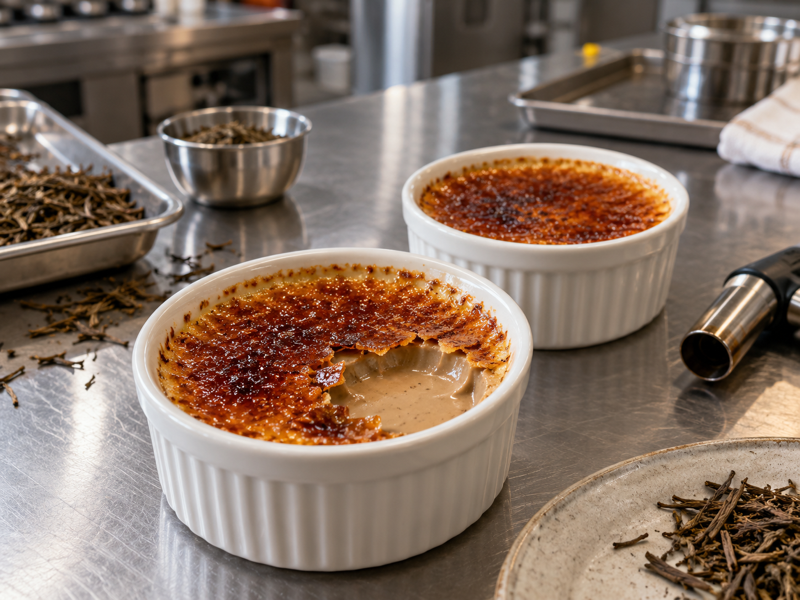
6. How should the shell and custard be tasted?
Sensory review
Taste a plain custard and tea versions with freshly caramelized shells. Score crack, caramel bitterness, tea aroma and custard smoothness separately.
Offer coded ramekins with comparable fill and the same measured sugar topping. Score shell fracture, caramel flavor, roasted aroma, custard smoothness and any eggy or dusty aftertaste. Taste a portion of untorched custard alongside the finished dessert; this reveals whether sugar masks tea. Check the rim and center, because they may set differently.
Have tasters choose a preferred sample at the planned menu price. A custard can be technically smooth yet fail if the tea is unrecognizable under a bitter shell. Record descriptive comments rather than reducing the result to one liking number. Taste the sugar shell at two caramelization levels only after selecting the custard, so the panel can identify whether bitterness comes from tea or sugar.
| Measure | Record | Interpretation |
|---|---|---|
| Shell crack | Texture note | Service quality |
| Tea aroma | Untorched and finished | Detect masking |
| Set | Rim and center | Process uniformity |
| Price choice | At menu price | Buyer response |
7. Why does the custard curdle or taste weak?
Defect analysis
A grainy custard may be overprocessed or contain tea particles. A weak roast note can be hidden by burnt sugar. Diagnose the layer causing the problem before increasing tea.
If a custard curdles or has a rubbery edge, investigate heat exposure, batch size and pan position using the plain control. If a powder version feels dusty, compare a filtered infusion and inspect particle size before changing the egg formula. If tea is faint, taste untorched custard; a heavily caramelized top may be responsible. Weeping or a liquid center needs process review under the kitchen’s safety plan, not a cosmetic topping fix.
Change one condition in the next test and photograph the defect at service temperature. A different tea lot should be checked against the approved reference before blaming the oven. If the tea aroma is clear in untorched custard but disappears after finishing, reduce shell intensity in a targeted comparison before raising tea dose.
8. Which egg and dairy safety checks are required?
Food safety and labeling
Egg and dairy are core ingredients. A restaurant service process and a packaged custard need distinct validated food-safety and product-life work.
Egg and milk require documented allergen and safety controls. The FDA food-allergen page identifies major U.S. allergens, while the exact destination market may have additional rules. Heat treatment, cooling limits, holding periods and product life require validation for the actual equipment and serving format.
Qualified staff must validate the custard process in its actual ramekin and equipment. Retail packaging requires separate distribution and date-code work. Keep tea, cream and egg lot codes tied to each batch. Do not use a home recipe’s cooling instructions as the basis for commercial service or a label claim. A retail extension with a separate sugar sachet would still need its own packaging, handling and label review; it is not a simple restaurant transfer.
| File | Why | Owner |
|---|---|---|
| Egg and cream lots | Traceability | Quality |
| Allergen review | Market declaration | Regulatory |
| Validated custard process | Safe production | Qualified team |
| Product-life study | Date decision | Quality |
9. How should a kitchen cost the finished ramekin?
Unit economics
Cost the filled ramekin, sugar shell, tea extraction yield, rejected custards and labor at service. A high reject rate can outweigh powder-price differences.
Cost each accepted ramekin from actual cream and egg use, tea extraction yield, sugar, fuel or electricity for finishing, vessel handling and rejected units. A leaf infusion that loses cream in filtration may cost more than its raw tea dose suggests. A powder route that creates visible specks may raise rejects. Count cracked or curdled custards in a normal production run. Price the dessert against the restaurant’s existing custard offer, including time needed to caramelize tops at service.
Supplier quotations should cover lot consistency and pack size. A small ingredient saving matters little if one in ten portions is rejected. Include the time a cook spends checking and remaking unacceptable tops, because finishing labor can change the economics of a seemingly simple dessert. Record the number of ramekins rejected for set defects separately, since a spoiled custard and a poor sugar shell have different process fixes.
| Line | Measured input | Concern |
|---|---|---|
| Custard | Fill mass | Variation |
| Tea | Charge and filtration yield | Loss |
| Sugar shell | Actual use and finish time | Service labor |
| Rejects | Curdled or cracked units | Margin |
10. What belongs in the service release file?
Five buyer FAQs
Approve a documented custard texture, tea intensity and caramelization method. Train the service team with an accepted shell photograph and repeat with a second tea lot.
Keep the approved formula, tea specification, ramekin fill weight, process records, accepted set photograph and sugar-shell standard in one release file. Run a service rehearsal with the cooks who will plate the dessert. Check whether the shell is consistently thin and the custard reaches guests at the chosen state. Repeat the custard with a second traceable tea lot.
A limited paid menu test should record orders and returns along with staff preparation time. If the product later moves into retail pots, restart pack and shelf-life validation. Send Matcha Village the selected leaf-or-powder route and roast target when requesting supplier samples. Use a normal service rehearsal to confirm that the custard leaves the kitchen with the same shell and spoon texture approved in development.
Q1: Can leaves and powder use one formula?
No. They deliver different water, solids, color and texture; screen them separately.
Q2: Should caramel sugar be added before storage?
That depends on the format and requires a separate texture and safety test.
Q3: Why is the rim rubbery?
Review heating pattern, fill and pan position against a plain custard control.
Q4: Can a home recipe set a commercial bake time?
No. Validate the process on the actual equipment and portion geometry.
Q5: What supplier data matter?
Request ingredient identity, lot traceability, roast profile and relevant documents.