
Hojicha cheesecake gives a bakery a roasted-tea flavor inside a rich cheese filling. A good test slice can still fail commercially through cracks, dark powder specks, weak tea aroma after chilling, or a crust that softens in its pack. This guide concentrates on baked cheesecake scale-up and cut-slice economics. Tea dose, bake settings, cooling, and shelf life are product-specific decisions; no consumer recipe can validate them for a production line.
1. What makes the cheesecake taste of hojicha?
Tea must survive cream cheese and chilling
Hojicha is roasted tea, so its flavor may read as toasted grain, nut, or cocoa-like aroma depending on material and roast. Cheesecake brings dairy richness, sweetness, and acidity that can soften or mask those notes. Write a full-slice target. A product team should describe how clearly the tea appears in a bite that contains filling and crust, not just in a spoon of raw filling. Use a plain cheesecake control and at least two coded tea levels. Taste the slice after the intended chilling period. If the tea appears only in its brown color, change the roast, ingredient placement, or formula before approving the name. A tea-forward product can place hojicha in the filling, a topping, or both, but each choice changes texture and process. Ask the panel to identify the dominant flavor without seeing a concept card. This reveals whether the intended roasted-tea character reaches a customer who has no recipe notes.
2. Which cheesecake format should be developed?
Whole cake, slice, and pie use different tolerances
A bakery may sell a whole cake to hospitality customers, a pre-cut wrapped slice to retailers, or a pie-style cheesecake with a prominent crust. Each needs a different level of cut precision, top appearance, and transport strength. Pick the primary channel. A rustic surface can be acceptable in a whole cake but look defective behind clear slice packaging. A loose crust that tastes pleasant on a plate can break during pre-cut wrapping. Define target portion mass, slice dimensions, pack, distribution route, and display time before adjusting the formula. Include an edge and center slice in tasting because bake exposure and crust ratio differ. A format change later can alter tea perception: a thin slice has more crust relative to filling than a thick restaurant portion. Keep one approved reference for the chosen channel rather than treating every cheesecake shape as the same product. For a wholesale restaurant cake, ask the customer how portions are cut after delivery and whether staff add sauce at service. A sauce can alter sweetness and hide the tea profile that passed the bakery panel. For a wrapped slice, inspect condensation and label visibility inside the proposed retail case.
| Format | Visible risk | Commercial measure |
|---|---|---|
| Whole cake | Top cracks | Transport survival |
| Wrapped slice | Smear and cut face | Sellable cut yield |
| Pie slice | Crust breakage | Crust-to-filling balance |
3. What hojicha powder belongs in the filling?
Roast and grind both matter
Pure milled roasted tea lets the bakery control sweetness. A pre-sweetened latte powder can introduce sugar or creamer that changes the filling formula and allergen review. Request the specification. Ask for the ingredient declaration, roast description, particle-size information where available, origin records, pack size, and traceable lot code. Taste powder candidates in a small filling sample after chilling, since dry aroma and a plain tea cup do not predict flavor in cream cheese. Fine powder may distribute more evenly, yet the actual mixing method still decides whether dark specks appear on the cut face. A deeper roast may cut through dairy but become bitter at a high dose. Retain a sample of the selected lot and ask for another production lot before national rollout. If the brand claims Japanese origin, confirm the cultivation and processing evidence for the exact SKU rather than reading geography from the word hojicha.
4. How should the tea dose be screened?
Change one variable in an approved base
Use the bakery’s proven plain cheesecake formula and hold pan size, batter mass, crust, sugar, and bake program fixed for the initial screen. Prepare low, middle, and high tea levels by weight relative to filling mass, plus a no-tea control. Code the pans. A blind panel can then compare roasted flavor, bitterness, filling texture, and appearance without price or supplier cues. Adding powder changes total solids; record whether it replaces a small part of another dry component or is added to the base. Do not adjust sugar and tea simultaneously or the team will not know which variable caused a change. After selecting a useful tea range, run a separate sweetness trial. Record batter handling and deposited weight for each pan. The final dose should be chosen from chilled finished slices at sale size, not warm filling tasted during mixing. If the brand intends a hojicha swirl rather than a uniform filling, run that as a separate design. Swirl depth and pattern can make tea strength vary between slices, especially at the cake edge. Record the deposit method and taste several portions before approving an image for the box. A dramatic cut pattern is useful only if it remains repeatable and edible.
| Sample | Tea level | Fixed items |
|---|---|---|
| Control | Zero | Crust, pan, bake |
| A | Low | Base formula |
| B | Middle | Base formula |
| C | High | Base formula |
5. How should hojicha be incorporated into the filling?
Prevent specks without overworking batter
Dry powder dumped into a thick cheese mass can form dark clumps that appear as defects after cutting. A controlled pre-dispersion step in part of the formula may help, but too much mixing can also change texture. Log the order. Record ingredient temperature, powder addition point, mixing speed, time, and how the team checks for uniformity. Sample batter from the top and bottom of the vessel before depositing. Check whether tea accumulates on mixer surfaces or in a depositor and alters the later pans. If the bakery uses a cream-cheese substitute or different fat content, run a separate trial rather than carrying over a successful dairy formula by assumption. Keep the crust recipe unchanged until the filling works; otherwise crust flavor and texture add another variable. A production method should be specific enough that another shift can follow it without the development chef standing beside the mixer.
6. Which bake and cooling observations should be recorded?
Look beyond a single oven timer
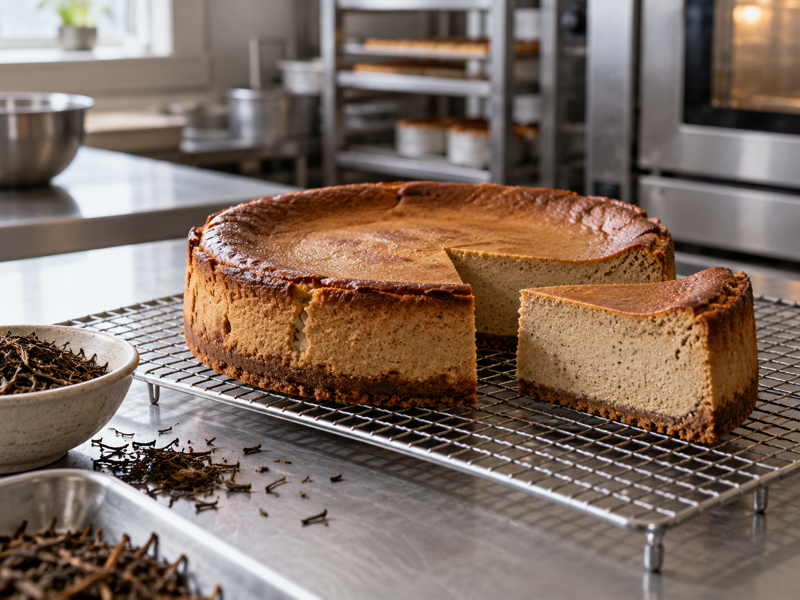
Cracking, dark edges, wet centers, and uneven rise can result from formula or thermal conditions. The bakery’s existing validated bake and cooling program provides the starting framework; a consumer oven time does not define a plant process. Map the pan positions. Record oven load, pan location, deposited mass, temperatures or endpoints used by the approved program, and appearance after cooling. Compare center and edge pans, since they can receive different heat exposure. If a tea-rich sample cracks while the control does not, investigate solids and batter handling before changing the oven for every SKU. Follow the site’s qualified cooling procedure and record when cakes are moved, wrapped, or cut. A slice that tastes balanced warm may become flat or sharply bitter after chilling. Evaluate the cooled product at the intended sale temperature before deciding the roast level.
| Stage | Record | Defect clue |
|---|---|---|
| Deposit | Pan mass | Uneven portion |
| Bake | Position and approved endpoint | Dark edge |
| Cooling | Time and condition | Crack or condensation |
| Cut | Center and edge result | Smear or break |
7. How should slice quality be judged?
Inspect the cut face and complete bite
For retail slices, the cut face is a quality signal. A visible dark dot may be a powder clump; a wet center may reflect process; a broken crust may result from cutting or moisture transfer. Sample across the cake. Weigh center and edge slices, photograph cut faces under the same light, and taste both after normal packaging and hold. Record roasted-tea recognition, cheese balance, crust texture, and aftertaste. A strong powder can produce a good plain filling but taste harsh when paired with a dark toasted crust. If the top receives a glaze, taste with and without it so the team understands whether glaze masks tea. Use a retained approved slice image and a measurable weight range in the specification. A visually perfect slice that tastes only of vanilla should not pass a tea-forward brief. Conversely, a flavorful cake that cannot be cut consistently may need a different format or process.
8. Which allergens and storage claims require review?
Use the full formula and validated product life
Cream cheese and eggs are common filling components; wheat or nuts may appear in the crust. The actual recipe and production environment determine allergen declarations. FDA lists milk, eggs, wheat, and tree nuts among major US allergens, with market-specific requirements elsewhere. Review the entire pack. Powder blends may add dairy or soy, and toppings may add more. A refrigerated cheesecake needs documented process controls and a product-specific shelf-life basis. Do not assume a cake remains safe because a home recipe says it keeps for several days. The FDA Food Code offers retail foodservice guidance for cooling and cold holding; a manufacturer must validate its own process and destination requirements. Confirm any organic or origin statement against current product records. Link final formula, lot documents, process revision, and label artwork so an ingredient change triggers a review before the next print run.
| File | What it supports |
|---|---|
| Ingredient bill | Allergen and nutrition review |
| Process record | Repeatable bake and cooling |
| Product-life study | Date code |
| Origin evidence | Geographic wording |
9. How should cheesecake economics be calculated?
Price the sellable slice, including rejects
Cheese and labor often dominate cost, while tea dose can affect yield through cracking, cut quality, or a need for topping. Count every slice. Record full-cake ingredients, number of acceptable pieces, edge trim, broken crusts, packaging loss, and retained quality samples. A higher tea price might be justified if a lower dose gives better roasted flavor; test that in the full chilled slice rather than assuming it. Compare a whole-cake sale with pre-cut retail only after including the different packaging and labor. Add cold-chain costs and forecast waste for a short-life launch. Ask the tea supplier for minimum order, pack size, lead time, and a second-lot sample. A recipe that tastes good but yields too few clean slices may need a different pan or channel. Keep margin analysis beside sensory and production evidence, never as a substitute for them.
| Cost line | Measurement |
|---|---|
| Tea and filling | Batch grams |
| Crust and topping | Actual formula |
| Cut yield | Accepted slices |
| Pack and cold route | Commercial quotation |
10. What should a scale-up sign-off include?
Prove repeatable flavor and cut quality
Approve one tea SKU, filling formula, crust, pan, bake and cooling method, slice weight, and sensory standard. Have regular production staff run a batch on the intended equipment without constant R&D intervention. Compare a second tea lot. If aroma, color, or particle behavior shifts, investigate before buying a season’s supply. Quality approves process and product-life evidence; regulatory approves label copy; purchasing approves replenishment terms; sales tests the actual slice in its target channel. Retain a reference photograph and traceable sample. Record failure gates such as excessive cracks, bitter edges, visible tea clumps, poor cold-chain survival, or unacceptable cut yield. Matcha Village can discuss hojicha powder for bakery trials, but the buyer should ask for the current product specification and test in the selected filling. Launch the slice that passed, not a generalized “hojicha cheesecake” concept.
Q1: Can a darker tea powder fix weak cheesecake flavor?
It may help, but test bitterness and texture in a chilled full slice.
Q2: Does tea powder replace flour in cheesecake?
There is no universal replacement rule; screen measured levels in the approved filling.
Q3: Can one oven trial set the commercial process?
No. Verify performance on the intended equipment and batch size.
Q4: Which allergens are likely?
Milk, egg, wheat, or nuts may be present; review the actual formula and site.
Q5: What proves the supplier can repeat quality?
Compare a second production lot in the same filling and retain the approved reference.