
“Hojicha benefits” often leads buyers toward medical promises their product cannot support. A more useful review starts with what roasted tea can do in a real formulation: add a distinct flavor, widen a menu, and fit several food formats. Hojicha is green tea roasted after initial processing. This guide separates documented tea characteristics from commercial benefits that need a pilot and health claims that need far stronger evidence.
1. What flavor benefit can hojicha offer a menu?
A roast profile distinct from green tea
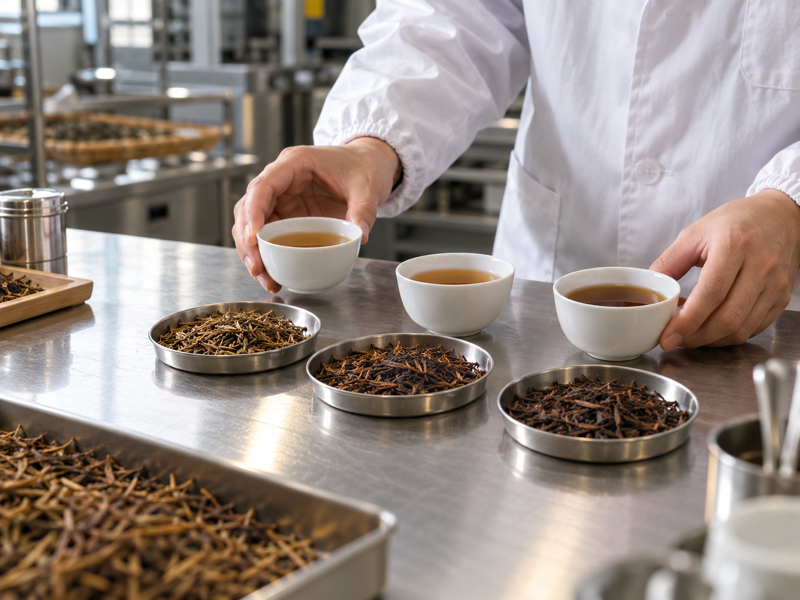
Hojicha’s later roasting step shifts its sensory profile toward toasted, nutty, and sometimes caramel-like impressions. These are descriptors, not added ingredients or guaranteed notes in every lot. Japan’s Ministry of Agriculture, Forestry and Fisheries (MAFF) describes hojicha as a tea with a roasted aroma and a clear drinking character. A product team can use that difference to offer a brown roasted-tea drink alongside greener matcha or sencha products. The commercial benefit is a wider flavor range using a familiar tea category, subject to actual customer acceptance.
Test the finished cup. A plain-water sample may smell compelling and still disappear in milk. Compare two roast styles at a fixed dose in the same base. Record aroma, tea identity, bitterness, body, and finish after serving and after a realistic wait. A deeper roast may suit chocolate or a sweet latte; a lighter roast may suit unsweetened tea. Avoid writing “naturally delicious” in a buying specification. Write the profile your customer can recognize and keep a reference sample so the next lot can be compared against it.
| Product goal | Roast to trial | Acceptance question |
|---|---|---|
| Unsweetened tea | Light and medium | Is the finish clean? |
| Milk drink | Medium and deep | Does tea remain identifiable? |
| Chocolate dessert | Deep and medium | Do cocoa and roast compete? |
2. Which applications make the roast useful?
One ingredient can enter different product briefs
Hojicha can be considered for leaf tea, café lattes, bottled tea, bakery fillings, chocolate, and frozen desserts. Its roasted character fits recipes that already use cocoa, caramel, dairy, or toasted grains. That does not mean one powder works equally well in all six. A clear bottled beverage may need a filtered infusion. A soft-serve mix may need a fine powder that disperses without grit. A biscuit may require a stronger profile because baking can mute aroma. The benefit for a manufacturer is a candidate ingredient across multiple lines, with validation for each line.
Assign a job to each trial. For a café, compare preparation time and cup consistency during normal service. For a packaged drink, assess sediment, flavor after heat treatment, and stability through the proposed shelf life. For bakery, compare tea added before and after baking. Let one application pass or fail on its own terms; do not use a successful latte pilot as proof that a cookie formula is ready. Record the required tea dose and yield. Those figures determine whether the flavor benefit survives commercial production and a realistic selling price.
3. Is lower caffeine an established hojicha benefit?
Do not turn a tendency into a universal claim
Hojicha contains caffeine because it comes from tea. Some roasted material may test lower than its unroasted starting material, but that is not the same as being caffeine free. A Japanese Tea Association report measured an average reduction of about 17% across its roasting samples, with wide variation. Japan’s food composition table lists 20 mg per 100 mL for a defined hojicha infusion. That reference sits at the same concentration as its listed sencha infusion, although the brew methods differ. Neither source supports “no caffeine.”
Measure your serving. A powder latte, a leaf infusion, and a bottled blend have different recipes. Ask the supplier for a lot result with units, then calculate or test the intended serving. Add any caffeine from cocoa, coffee, or other teas. If a menu comparison matters, compare equal declared portions and state the basis. The U.S. FDA notes that caffeine content varies by product and portion. A brand can benefit from offering a roasted tea option without making an unsupported promise about what every customer will feel after drinking it.
| Claim idea | Current evidence needed | Safer working description |
|---|---|---|
| Caffeine free | Finished-product testing and legal review | Roasted green tea |
| Less than coffee | Defined drink and portion comparison | State tested mg per serving if approved |
| Evening drink | Careful audience and claim review | Describe flavor and serving size |
4. Can hojicha help a brand reduce added sugar?
A sweet impression is not measured sugar reduction
Some roasted teas produce an impression of sweetness through aroma. MAFF’s Kaga bocha profile notes that deeper roasting increases roasted aroma and perceived sweetness in that particular style. A developer might therefore trial hojicha in a less sweet latte or dessert. The outcome depends on the exact tea, customer palate, milk, and other ingredients. Do not say hojicha “replaces sugar” without a successful sensory and nutrition analysis. A deep roast might also need sweetness to balance a harsh finish, which moves the formula in the opposite direction.
Run paired recipes. Make one drink at current sugar level and another with a measured reduction, while holding tea dose and serving size fixed. Test both blind with the intended customer group. Record liking, roasted identity, bitterness, and perceived sweetness, then calculate actual added sugar per serving from the formula. If the lower-sugar version wins, the claim should describe the finished product using the relevant market’s nutrition rules. If it loses, try another roast or base before making a public promise. The useful benefit is a route to formulation work, not a free nutritional claim.
5. Does hojicha offer a clean ingredient story?
Simple identity still needs product documents
A single-ingredient hojicha powder can support a short ingredient list in a beverage or dessert, provided the supplied material truly is only roasted tea. A latte blend with sugar, creamer, or flavoring is a different product and should be assessed as such. Ask for a complete ingredient specification, allergen statement, and processing description before drafting copy. “Natural” and “clean” are broad marketing words with different legal and consumer interpretations. A precise description such as “roasted green tea powder” usually conveys more useful information than an unqualified purity claim.
Check the exact pack. For private-label work, obtain specifications for the actual blend, not just a base tea sample. Verify traceability, lot coding, storage, and any certification scope for the destination market. A supplier’s overall credentials do not automatically apply to each SKU. If a brand wants organic wording, confirm that the specific lot and supply chain meet the relevant certified scheme. If it wants a no-additive positioning, read the ingredient list and check the manufacturing documents. The benefit of a simple ingredient story survives only when procurement, artwork, and the delivered bag describe the same material.
| Marketing phrase | Document to inspect | Decision |
|---|---|---|
| Roasted green tea | Product specification | Confirm botanical and processing identity |
| Single ingredient | Full ingredient list | Check every component |
| Organic | SKU and lot certificate chain | Review destination-market rules |
| Private label | Final blend specification | Match artwork to supplied product |
6. Which format benefits café or factory operations?
Leaf and powder solve different jobs
Loose hojicha leaves make an infusion that can be strained for a clear tea. Powder puts ground roasted tea into the final product, which can help flavor a latte, bakery mix, or dessert without a separate extraction stage. Neither is universally faster or cheaper. Leaves create a filtration and spent-material step, but may offer a cleaner drink. Powder is easy to weigh, yet it may clump or settle in thin liquid. A product team should test both if the choice is open. The operational benefit comes from matching format to equipment and service conditions.
Count accepted servings. Price per kilogram does not show brew yield, losses, cleaning time, or rejects. For a café, measure the minutes needed for a standard drink and how often staff deviate from the recipe. For a factory, record dispersion, process yield, sediment, and flavor after treatment. If an infusion line already exists, leaf may fit. If a bakery must avoid added water, powder may be preferable. Ask the supplier whether “powder” means ground tea or a soluble extract; those have different ingredient identities and processing behavior. Choose the form that makes a repeatable saleable unit.
7. What quality benefits need proof from each lot?
Consistency is earned through controls
A steady roast profile can help a chain keep the same menu taste across stores, but that benefit depends on quality control. Base tea, roast intensity, milling, moisture, packaging, and storage all affect the material received. Set a retained sensory reference and a written product specification. Request lot codes and a certificate of analysis covering criteria relevant to the product and import market. For powder, check particle size or a suitable sieve measure and test it in the final base. For leaf, examine cut size, extraction, and unwanted fines.
Use a pilot lot. A supplier’s presentation sample may be especially fresh or prepared under favorable conditions. Verify that a normal production lot makes the same cup under your standard operating procedure. Keep a sealed reference for comparison, and agree on a change-notice process. If an incoming lot differs, describe the deviation with a coded tasting and the same brew method. A scalable supply story becomes valuable only when later shipments pass the same practical tests. That is particularly relevant to international buyers whose lead times make a replacement slow.
| Quality point | Evidence | Buyer test |
|---|---|---|
| Roast profile | Retained reference lot | Blind cup comparison |
| Powder texture | Particle or sieve data | Dispersion in final base |
| Traceability | Lot and production records | Mock recall check |
| Market fit | Relevant test reports | Regulatory review |
8. Which health claims should buyers avoid?
Evidence must fit the actual product
Search results often list hojicha benefits such as better sleep, weight loss, detoxification, or disease prevention. Those statements should not be copied into packaging or sales materials without strong product-relevant evidence and market-specific review. Tea chemistry studies do not by themselves prove clinical effects from a particular commercial drink. The U.S. Federal Trade Commission says health-related advertising needs competent and reliable scientific evidence. The standard applies to implied messages as well as explicit sentences. A calming photograph next to a sleep claim can communicate more than the words alone.
Separate composition from outcome. It may be possible to measure caffeine or certain tea constituents in a product. That is different from showing that a serving improves sleep or metabolism in people. Ask regulatory staff which claims, if any, have adequate support for the finished formulation and the country of sale. The European Food Safety Authority also distinguishes ordinary green-tea drinks from concentrated supplement exposures when reviewing catechin safety. A food brand should not borrow supplement research as a blanket benefit or safety promise. Flavor, ingredient identity, and transparent serving information can carry the product story without medical language.
9. How should a buyer measure commercial benefit?
Compare finished-product economics
Use a fixed recipe target, then calculate tea cost per saleable serving. Include the dose, extraction or mixing yield, discarded material, preparation labor, equipment cleaning, packaging, and likely rejects. A cheap leaf that requires an inefficient concentrated brew may cost more in use than a higher-priced powder. Conversely, a powder with attractive aroma may need a large dose to be noticed in milk. Sensory quality and effective cost belong on the same sheet. Do not change one candidate’s dose until it becomes too weak merely to make its quoted cost look competitive.
Measure repeat purchase, not applause. In a café pilot, record sales at a defined price, staff preparation time, remake rate, and customer feedback across several normal shifts. For a packaged product, follow the approved shelf-life and sensory program before committing to volume. Keep the existing menu item or a control product in view, because a novelty launch can spike temporarily. A benefit is commercially meaningful when the roasted-tea proposition works within margin and service requirements and customers want another serving. Those are buyer-owned results, not supplier claims.
| Commercial measure | Record | Why it matters |
|---|---|---|
| Ingredient cost | Grams and price per accepted serving | Connects quote to recipe |
| Service cost | Minutes and remake rate | Shows store impact |
| Product fit | Blind preference and repeat interest | Checks demand |
| Supply fit | Lead time and lot consistency | Protects continuity |
10. What should a hojicha pilot brief contain?
Make the claimed benefit testable
Write one page naming the product, audience, destination market, desired roast, form, serving size, sweetness, base, process, target cost, and expected volume. State which benefit you want to test: recognizable roasted flavor, a broader menu range, a shorter ingredient list, or faster service. Those goals need different evidence. Request two or three documented samples, production-lot identification, specifications, and any market-relevant test reports. Run your own formulation and customer trial with the same inputs for each candidate.
Close the loop. Matcha Village offers hojicha powder for B2B development; buyers can send a detailed brief through its contact page. Approve a supply option only when flavor, process, documents, claim review, and commercial terms align. If the strongest result is sensory, tell customers about the roasted taste. If a numerical claim is central, obtain measured evidence for the actual product. The best hojicha benefit is one that remains true after the pilot becomes ordinary production.
FAQ
Q1: Is hojicha caffeine free?
No. It is tea and naturally contains caffeine. Measure a particular serving before making a numerical claim.
Q2: Does hojicha improve sleep?
A general sleep claim is not established for a commercial hojicha drink. Avoid it without product-relevant evidence and regulatory review.
Q3: Can hojicha make a latte taste sweet without sugar?
Roasted aroma may create a sweet impression, but test and measure any actual sugar reduction in the final recipe.
Q4: Is powder or leaf better for food production?
Choose based on the application. Powder can fit low-water formulas; leaf can make a filtered infusion.
Q5: What should a buyer ask for first?
Ask for material identity, form, roast profile, sample lot, product specification, and documents relevant to the intended market.
Build the case for hojicha around a tested product benefit. For claim standards, consult the FTC guidance and the rules in each sales market.