
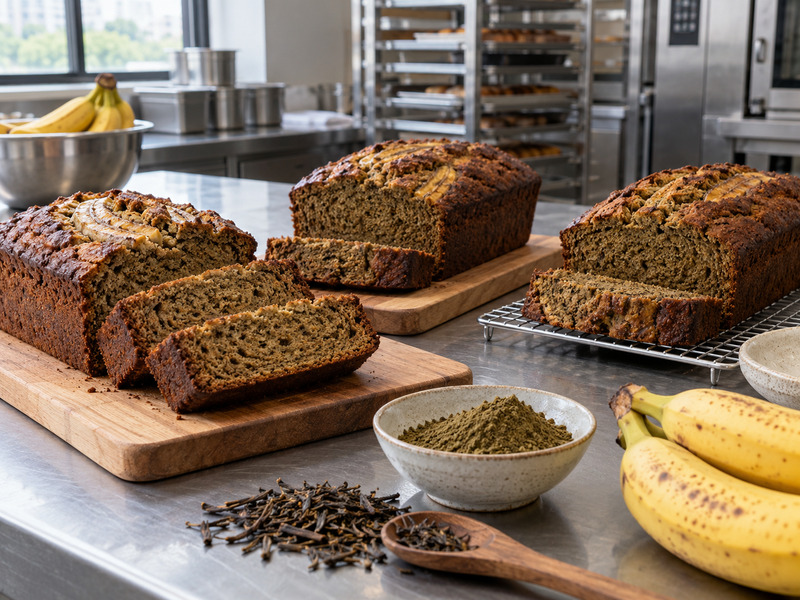
Banana bread already has a strong identity: sweet fruit, a soft crumb, and a browned crust. Adding hojicha can make the loaf more distinctive, but simply stirring brown powder into a familiar formula may leave only color or bitterness. A bakery needs a slice that tastes of both ingredients after baking and on the next day's shelf. This guide builds a development trial for a commercial loaf, with attention to formulation, handling, portioning, and the claims made at the counter.
Contents: flavor goal · tea form · banana · trial formula · mixing · baking · finish · holding · cost · launch
1. What should hojicha add to banana bread?
Write the sensory target before changing the recipe
Hojicha brings a toasted tea aroma that can sit beside banana's sweetness and the crust's browned notes. The risk is redundancy: if the bake already tastes strongly caramelized, a small tea dose may vanish. Another risk is an overly dark roast that makes a soft loaf taste scorched. Define a good slice. Ask tasters to identify banana first, tea second, and a clean finish after swallowing. If tea is detectable only when a taster sees the name card, the formula needs work. Test the loaf plain before pairing it with frosting, chocolate, or ice cream; toppings can hide a weak center. Also decide where the product fits. A breakfast slice may need a restrained sweetness and clear banana flavor, while a plated dessert can support a richer glaze. Keep the original banana bread as a control so the team can tell whether hojicha improves the product or merely changes its color.
| Target | Pass signal | Common failure |
|---|---|---|
| Banana presence | Fruit remains identifiable | Tea masks banana |
| Hojicha presence | Toasted tea in crumb | Color without aroma |
| Finish | Clean, not ashy | Bitter aftertaste |
2. Should the bakery use brewed leaves or powder?
Match the tea form to the batter
Powder is usually easier to distribute through a loaf, but its particle size and roast profile matter. Brewed tea can replace some liquid, yet a banana batter may already carry substantial moisture, and a light infusion can lose its aroma in the oven. Test pure hojicha powder separately from a sweetened drink mix. The latter changes sugar and other ingredients and should not be treated as an equal substitution. Keep the ingredient list visible. A clean tea powder offers more control over the loaf's sweetness and allergen profile. Sift the powder with dry ingredients to reduce concentrated streaks, then inspect the baked crumb for even color. If leaf particles are used as a topping, check whether they become unpleasantly hard or bitter after baking. Ask the supplier for lot and specification details; a new roast can change the same formula's flavor.
3. How does banana ripeness affect the tea?
Standardize the fruit input
Ripe bananas bring sweetness and moisture, but the spread from “yellow with spots” to nearly liquid overripe fruit is large. Weigh peeled banana, not the whole fruit. Note its condition and whether frozen fruit is thawed and drained. Watch the water. Extra liquid can push a loaf toward a gummy center and dilute the tea aroma, while drier fruit can make the crumb tight. During development, make one control batter and change only the tea amount. Later, test banana variation within the bakery's real purchasing range. A team that measures flour and sugar but tosses in “three bananas” will struggle to reproduce the loaf. If puree is purchased, review its ingredient statement for added sugar or acid. Record banana mass per pan and the acceptable range, then train prep staff with photographs of usable fruit. The goal is a predictable crumb that gives the roasted tea a fair stage.
| Banana input | What to record | Recipe risk |
|---|---|---|
| Fresh ripe fruit | Peeled mass and condition | Variable moisture |
| Frozen thawed fruit | Drained and undrained mass | Extra liquid |
| Purchased puree | Ingredients and solids | Hidden sugar or acid |
4. What is a sensible first formulation trial?
Run a small dose ladder
Start from a banana bread formula the bakery already knows. Make a control loaf with no tea and two tea versions, for example by replacing a small portion of flour with 2% and 4% pure hojicha powder relative to flour mass. Those percentages are trial settings, not a recommended commercial formula. Keep pan, batter mass, banana, oven, and bake endpoint constant. Cut the loaves blind. Taste the center and crust on baking day and the following day. If the higher dose tastes dry or bitter, lowering the tea is one option; changing roast or grind is another. Do not add extra sugar immediately, because it can hide a tea defect and shift browning. Record batter viscosity and loaf height. Tea powder absorbs some liquid and can affect texture even at a dose that seems small. A useful development sheet shows every ingredient in grams and the final loaf weight after cooling.
5. How should the powder be mixed?
Prevent stripes and overmixing
Sifting hojicha with the flour and other dry ingredients distributes it more evenly than sprinkling powder into a finished wet batter. Mix enough to eliminate dry pockets, then stop; prolonged mixing can toughen a quick bread. If a swirl is desired, create a separately weighed tea batter portion and test whether it stays visible after expansion. Check the center slice. A swirl that looks striking on the loaf end may disappear two slices later, which matters when the product is sold individually. Keep mix order and rest time in the production record. Different mixers can distribute powder differently, so a hand-mixed pilot may not predict a large planetary-mixer batch. Inspect the pan corners and scraper after mixing; dark tea pockets there can produce bitter spots. A bakery should be able to explain whether the tea is in the whole crumb, a swirl, a glaze, or only a dusting. The label and photograph should match the actual product.
| Method | Advantage | Check |
|---|---|---|
| Tea in all dry mix | Even flavor | Uniform crumb |
| Tea batter swirl | Visual contrast | Each slice shows it |
| Tea glaze | Strong surface aroma | Holding and sweetness |
6. How do you confirm the loaf is baked without drying it?
Use the bakery's validated endpoint
Tea darkens batter, making color a poor sole indicator of doneness. Set an endpoint using the bakery's tested internal-temperature or crumb method for its banana bread and verify that the tea variation reaches it. Avoid borrowing an exact number from an unrelated recipe. Check the center, especially in deep pans where the outer crust can be well browned while the middle remains gummy. Compare like with like. Keep batter mass and pan size constant during trials. Note bake time, oven setting, position, final loaf weight, and cooling time. If the high-tea loaf dries faster, consider a roast or dose adjustment before adding more banana. Make several loaves rather than deciding from one oven position. A product sold by the slice must have a texture that holds through cutting and packaging; a warm, fragile loaf that tears during slicing creates waste even if it tastes pleasant straight from the oven.
7. Which finish makes the tea clearer?
Let the crumb carry the claim
A light glaze, a cream cheese finish, or toasted nuts can make the bread more appealing, but each adds flavor, cost, and potential allergens. Taste the plain slice before approving any finish. If hojicha is only detectable in the glaze, call it a hojicha-glazed banana bread rather than implying that the loaf itself contains a meaningful tea component. Photograph the sellable slice. A studio loaf with a large garnish can misrepresent the individually wrapped item a customer receives. Consider portion format: café slices, mini loaves, and retail packs have different surface-to-crumb ratios. A small loaf may emphasize crust and make tea seem more roasted; a thick slice may need a stronger center flavor. If nuts or dairy are added, update ingredient and allergen review. The FDA lists milk, eggs, wheat, and tree nuts among major allergens in the U.S.; the precise recipe determines what must be declared.
8. How should shelf life and packaging be tested?
Evaluate the real selling window
Banana bread changes after cooling. Moisture redistributes, aroma fades, and a sealed pack can soften the crust. Define whether the product is sold same day, refrigerated, frozen, or in a validated retail pack. Taste at the end of sale. Compare day-of-bake slices with slices held under the exact intended conditions. Record texture, tea aroma, visible moisture, and package condensation. If a glaze is used, check whether it smears onto the wrap. Do not infer shelf stability from the word “bread”; a moist fruit loaf needs a food-safety and quality assessment appropriate to its formula and market. A commercial shelf-life statement requires more than a home kitchen observation. If freezing is planned, thaw through the actual process and check whether the crumb turns wet or the tea aroma weakens. Batch labels should allow the bakery to connect complaints to production date and ingredient lots.
| Hold trial | Observation | Decision |
|---|---|---|
| Unwrapped display | Drying and aroma | Same-day limit |
| Wrapped slice | Condensation and smear | Pack design |
| Frozen then thawed | Crumb and flavor | Frozen channel fit |
9. What should the bakery cost per slice?
Include yield, not only ingredients
Calculate flour, banana, tea powder, sugar, fat, eggs or substitute, finishing ingredients, energy, packaging, and labor. Then count sellable slices at a fixed thickness. A loaf that yields ten neat slices and two broken ends should not be costed as twelve perfect pieces unless those ends have a planned use. Weigh the waste. Record batter left in the bowl, trim, failed slices, and returns at the end of sale. Compare the tea dose with perceived flavor: spending more powder without a sensory improvement is not a good value. If a premium price is planned, ask whether the customer can recognize the tea in a blind tasting and whether the portion looks different enough to explain the price. A supplier quote should include delivered cost and pack size; a bakery may lose money through short shelf life or frequent small orders even when the ingredient's per-kilogram price looks reasonable.
10. When is the recipe ready for a menu trial?
Require a second bake and an ordinary shift
Approve a formula only after it works with another banana lot, another baker, and a second bake day. Give staff a gram-based formula, mixing sequence, pan fill, bake endpoint, cooling time, slice thickness, and sell-by rule. Listen for the product name in feedback. If customers call it “banana bread with a slightly burnt taste,” the tea needs a different treatment. If they identify toasted tea and banana together, the pairing has a case. Run a limited counter trial and track sell-through and waste. Keep the control loaf in the tasting record; it prevents the team from mistaking novelty for an improvement. For ingredient sourcing, ask Matcha Village for a pure hojicha powder sample with its current specification and roast profile, then test it in your own batter. The supplier cannot approve a baked flavor without your oven, banana, and formula.
For the bakery's final trial, compare slices from the center and both ends of several loaves. Oven position and pan fill can give those pieces different moisture and tea intensity. A product sold individually needs a standard that covers ordinary slices, not only the best center cut. Record how many pieces meet the display standard and use that number in the price calculation.
| Final check | Pass evidence | If it fails |
|---|---|---|
| Center crumb | Baked and moist | Adjust endpoint |
| End slices | Saleable appearance | Change pan or trim rule |
| Tea note | Present next day | Revise roast or dose |
Final recommendation
Good hojicha banana bread has an identifiable roasted-tea note, a moist but sliceable crumb, and a saleable shelf window. Develop it by measured comparison, then name and price the exact loaf customers will buy.
FAQ
Q1: Can brewed hojicha replace powder in banana bread?
It can replace part of the liquid, but may produce a weaker tea note and change batter moisture. Test both approaches.
Q2: Does hojicha powder need more sugar?
Not automatically. Change tea dose or roast before using extra sugar to mask bitterness.
Q3: Can a bakery use overripe bananas?
Yes, within a defined condition and weighed mass. Very wet fruit can change crumb texture.
Q4: Is a tea glaze enough for the product name?
It can support a clear “hojicha-glazed” description. The name should reflect where the tea actually appears.
Q5: What is the best shelf-life test?
Taste and inspect slices at the end of the intended selling window in their real packaging.
Sources: Japan MAFF, Uji tea categories; FDA, food allergens; FDA, water activity and food stability.