
Cold brew hojicha is roasted tea leaf extracted in cool water over time. For a café, the central questions are leaf dose, filtered yield, the flavor left after ice, and a documented cold-handling process. This guide starts from the linked household method, then shows how to run controlled service trials without treating a home steep time as a commercial safety limit.
1. What is cold brew hojicha in commercial service?
Product brief
The linked home recipe explains cold extraction of roasted leaves and gives a household ratio. Commercial teams should use that as a comparison point, not a validated processing instruction or safety limit. The target unit is one finished cold serving. Describe where roasted aroma should appear, which texture matters and how a control without tea should compare. The linked home recipe Cold Brew Hojicha is useful as application context, not evidence that a commercial formula has been validated.
Keep the definition precise: the tea leaves contact cold water, then the spent leaves are removed. A hot infusion chilled over ice can be useful, but it is a different extraction and should be tested and labeled as such. The Hojicha Co. cold-brew guide describes cold extraction and proposes a household ratio of 1 g leaf to 100 ml water, steeped six to eight hours. Treat that as a sensory starting point only. A café must choose its own water source, vessel, leaf lot, filtration, and handling plan. Define what a finished cup should deliver: a clear roasted aroma, refreshing body, minimal leaf particles, and sufficient flavor after the customer adds ice.
2. Which cold-tea channel should lead?
Channel decision
A café may brew overnight for next-day service under its own food-safety plan. A beverage plant might produce a bottled tea with a separate process authority. Define the route before setting extraction targets. For tea chains, cafés and beverage producers, the immediate route is a café-prepared cold tea. A shelf-stable bottled tea requires a separate technical brief. Record buyer questions about portion, pack and intended eating or drinking state before ordering ingredients.
Select a service route before increasing batch size. A café can prepare a controlled refrigerated batch for next-day service under its approved procedures; a made-to-order overnight infusion is impractical unless the shop has planned inventory. Draft a sales forecast by daypart and decide the smallest batch that can cover demand without avoidable disposal. A bottled retail version raises further processing, packaging, and shelf-life questions; this café bench method cannot answer them. Decide whether the menu drink is unsweetened straight tea, tea over ice, or a flavored cold tea. Each changes the tasting target. Measure the glass and ice charge, because a pleasing straight infusion can become faint once poured over a full service cup of ice.
| Item | Starting approach | Decision point |
|---|---|---|
| Café batch | Filtered tea served over ice | Plan batch demand and controls |
| Made-to-order | Not practical for long contact | Avoid uncertain inventory |
| Bottled retail | Separate product process | Validate shelf life and label |
3. Which roasted leaves should a buyer specify?
Ingredient specification
Leaf cut and roast affect extraction and filtration. Powder is not a direct substitute: it creates different solids and sediment. Buy a documented leaf lot and compare results in the intended water. The proposed tea ingredient is roasted hojicha loose leaf. Judge it after contact with potable water, because that matrix determines perceived flavor and physical behavior. Record differences against the approved lot.
Ask for loose-leaf hojicha that can be evaluated consistently across lots. Record roast style, leaf cut, visible stems, aroma, moisture condition on receipt, packaging, and lot traceability. A very fine cut may extract quickly but burden filtration; large leaves may need longer contact for the same cup. Pure hojicha powder is not a direct substitute because it remains suspended instead of being strained. Screen two or three candidate leaves at the same leaf-to-water ratio and water source, then compare filtered yield and sensory profile. Check for an unpleasant stale or smoky note before adjusting the brew. Supplier samples should be large enough for repeated pilot batches, and the approved specification should describe performance in cold water, not merely dry-leaf appearance.
4. How should leaf-to-water ratios be compared?
Trial design
Hold water source, vessel and leaf lot constant while varying leaf ratio. Record brew yield after filtration because absorbed tea and filter loss change cost per serving. Compare three leaf-to-water ratios around the supplier’s home-recipe reference of 1 g per 100 ml, using the same leaf lot and cold-water process. Record the purpose of each sample before tasting, then decide which variable to change next.
Start with the household 1:100 ratio as a benchmark: for 750 ml water, weigh 7.5 g leaf. Compare a somewhat lighter and stronger trial using the same vessel, water, contact time, and temperature. Weigh the filtered liquid, not only the water charged; leaf absorption and filter retention lower sellable yield. A simple data sheet should record dry leaf grams, water grams, steep start and finish, vessel temperature log, filtered grams, and cups produced. Taste each sample neat before adding ice. Do not call a ratio “best” based on color alone; roast aroma, dryness, clarity, and yield determine which option serves the menu. An overly concentrated batch may be useful only if the café intentionally dilutes to order.
| Item | Starting approach | Decision point |
|---|---|---|
| Light | Less than 1 g leaf / 100 ml water | Check whether ice erases roast |
| Reference | 1 g leaf / 100 ml water | Compare with linked home guide |
| Strong | More than 1 g leaf / 100 ml water | Check dryness and filtered yield |
5. Which brewing and filtration steps need control?
Process method
The home method uses time in cold water, but a commercial team must validate its own process. Keep vessels covered and identifiable; log start, filter and service steps under approved controls. Use a cleaned, covered vessel and the site’s water and chilled handling controls; filter the brewed tea and record actual yield. Watch another operator follow the written sequence and revise unclear instructions.
Design the brew around repeatable steps and an approved cold-handling procedure. Sanitize or clean the vessel as required by the operation, add potable water and weighed leaf, cover it, identify the batch, and keep it under the facility’s controlled conditions. Filter through the chosen screen or paper, then measure the liquid yield and transfer it into the approved service container. The six-to-eight-hour time in the linked home recipe is a taste reference, not a validated safety time for a retail batch. A second extraction from spent leaves should be treated as a new trial with separate yield and quality records. Write down what happens if the brew is interrupted, unlabeled, or outside the approved process; staff should not improvise its disposition.
6. How should a cold brew be judged after ice?
Sensory evaluation
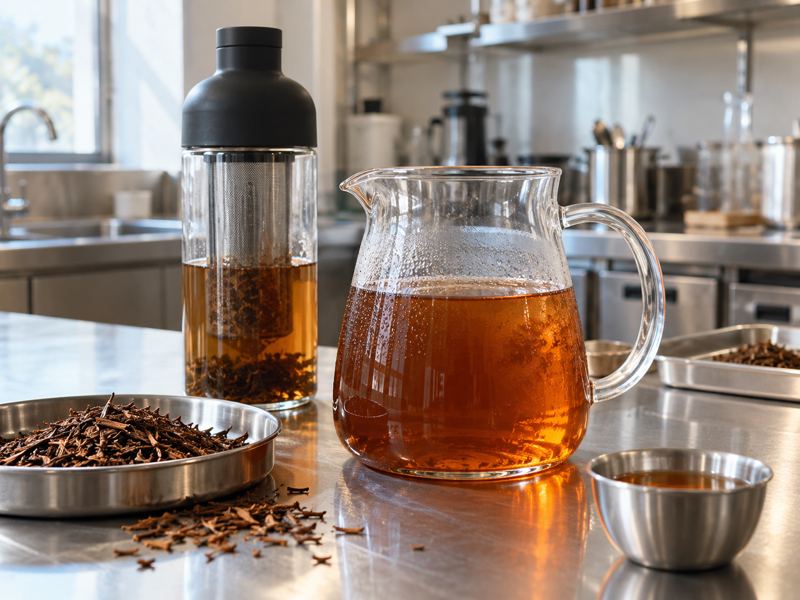
Taste the brewed tea before ice and after the expected ice melt. Aroma should remain recognizable without relying on sweetener. Check clarity against a defined visual standard. For this item, score roasted aroma, clarity, extraction balance, color and taste after ice dilution. Taste at the actual serving state rather than relying on an attractive production sample.
Assess the product in the state actually sold. Taste filtered tea straight, then over the standard ice portion immediately and after ten minutes. Have panelists describe roast aroma, sweetness perception, body, clarity, dryness, and stale notes. Record whether the tea remains distinctive without syrup. If the menu includes citrus or sweetener, run that as a separate finished formulation because an acid or strong flavor can hide the tea. Compare the cold brew with a hot-brewed, rapidly chilled hojicha control of equal final tea concentration to learn whether the long cold extraction earns its time and equipment space. Blind the samples and change one variable at a time; a darker color does not guarantee a better roasted flavor.
| Item | Starting approach | Decision point |
|---|---|---|
| Neat filtered tea | Roast, body, clarity | Catch extraction faults |
| Fresh over ice | Aroma and balance | Judge service presentation |
| After ten minutes | Roast persistence | Measure ice dilution |
| Hot-brew chilled control | Blind preference | Test value of cold process |
7. Why does cold brew turn weak or cloudy?
Defect diagnosis
A weak cup may reflect ratio, leaf age, water or dilution. Bitter samples need a controlled extraction comparison. Particles point toward filtration and leaf cut, not automatically poor tea. Look specifically for weak extraction, excessive bitterness, floating particles, cloudy presentation or inconsistent yield. Each symptom should trigger a narrow experiment with an unchanged control.
Weakness can come from low leaf dose, short contact, low-yield filtration, or too much serving ice. Investigate in that order using the batch record. Haze may come from fine leaf particles that pass the selected filter; compare screen grades and record how much liquid each retains. A harsh or woody cup could reflect the specific roast, leaf cut, contact time, or an overstrong concentrate. Do not solve cloudiness by promising that every cold brew should be crystal clear, because some natural variation may be acceptable in a fresh service drink. Define a visual standard with photographs under consistent light. Reject lots with off odors instead of using syrup to disguise them. Repeat any change in at least two small batches before scaling.
8. What cold-extraction safety checks are needed?
Food safety and labeling
Cold water extraction does not remove microbiological concerns. Use the facility’s approved hygiene, chilling and hold procedures. Bottled distribution needs process-specific validation and life testing. The format requires review of potable water, vessel hygiene, chilled holding, filtration and separate validation for packaged tea. Verify the actual market and process before approving any claim or date code.
Cold extraction does not include a hot kill step, so the shop needs its own hazard review rather than a home-style “leave it overnight” instruction. Use potable water, controlled ingredients and equipment, a documented cooling or cold-holding procedure, batch identification, and local regulatory advice where needed. The FDA Food Code is a model for retail adoption, not a universal rule applied unchanged everywhere. The Austrian food-safety agency AGES reported no rejections among 40 sampled cold-prepared teas in one survey; that small survey does not validate this café’s leaf, water, vessel, or shelf life. For bottled distribution, seek a product-specific process and microbiological validation before setting a date code.
| Item | Starting approach | Decision point |
|---|---|---|
| Leaf lot and water | Record identity and mass | Trace variation |
| Start and finish | Record time and process state | Reproduce extraction |
| Filtration | Filter type and yield | Catch loss or haze |
| Disposition | Approved holding and discard | Food-safety owner |
9. How should filtered yield be costed?
Unit economics
Calculate leaf cost on filtered yield, not water charged to the vessel. Include filter labor and discarded tea. Compare a second lot before setting a national menu specification. The cost model must capture leaf dose, extraction yield, filtration loss, water, cup and chilled handling. Use actual sellable yield rather than theoretical batch weight.
Calculate leaf cost per gram of filtered beverage, not per gram of water poured into the brew vessel. If a trial charges 750 g water but yields 680 g filtered tea, use 680 g in the serving-cost calculation. Add filter material, vessel cleaning, refrigeration space, labor, and discarded batch volume. A finer filter may improve appearance but lower yield or slow service; compare both sides of that tradeoff. Estimate the number of finished iced cups from the actual pour amount, including ice displacement. If sales vary sharply by day, a smaller batch can protect margin even if it takes slightly more labor per liter. Report cost together with blind flavor scores so a cheap but weak brew does not win by spreadsheet alone.
| Item | Starting approach | Decision point |
|---|---|---|
| Leaf | Dry grams × landed cost/g | Allocate to filtered grams |
| Water and filter | Actual materials | Include retained liquid |
| Labor and equipment | Brew, filter, clean, chill | Use observed time |
| Waste | Unsold or rejected batches | Reflect demand forecast |
10. What should a café approve before service?
Five buyer FAQs
Choose one target aroma and documented brew method. Train operators on weights and filtration, then measure finished cups from normal service. Ask suppliers for a consistent roasted-leaf specification. The pilot should show that cold-brew hojicha tea remains consistent across operators and a second ingredient lot. Keep final decisions in a signed launch file.
Approve one dated brew sheet after a small service pilot. It should state approved leaf and water, grams per batch, vessel, covered extraction method, target contact window chosen by the operation, required process controls, filter type, minimum acceptable filtered yield, service portion, and disposal rule. Photograph acceptable clarity and record a sensory reference for the tea after ice. Let two staff members run the batch from the sheet without the developer’s help; compare yield and taste. Verify the food-safety plan with the responsible local team before service. Reopen the specification when leaf cut, water source, filter, vessel size, or serving ice changes. Those inputs can alter both the flavor and the amount of product available to sell.
Q1: Can powder be used instead of leaves?
It creates a different suspended-solids drink and needs its own trial.
Q2: Is a 1:100 ratio a production specification?
No. It is a reference starting point; validate your target strength and actual filtered yield.
Q3: Does cold extraction sterilize tea?
No. Use approved hygiene and process controls.
Q4: Can café brew be bottled for sale?
Only after separate packaged-beverage validation and market review.
Q5: What should a leaf specification cover?
Roast, cut, lot traceability, appearance and performance in your water.
Ask Matcha Village for a traceable roasted hojicha loose leaf sample suitable for cold-brew hojicha tea trials. Send the planned one finished cold serving, target roast and destination market with the request so the sample conversation begins with an actual application.