
Coconut water matcha looks simple: green tea powder, coconut water and ice. In a busy cafe, however, the drink has to taste balanced at the first sip and after the ice starts melting. A bottled version raises different questions about settling, processing and shelf life. The Matchaful recipe shows a home preparation; this guide helps a foodservice or beverage team turn the idea into a repeatable product. Start with ingredients and a sensory target. Decide on packaging only after the drink works in the cup.
Contents
- 1. What should coconut water matcha taste like?
- 2. Which coconut water belongs in the trial?
- 3. Which matcha performs in a clear drink?
- 4. How should the powder be mixed?
- 5. What does settling tell the team?
- 6. How should an iced cafe version be specified?
- 7. What changes for a packaged drink?
- 8. What must the label and safety review cover?
- 9. How should a buyer compare suppliers?
- 10. When is the product ready to sell?
1. What should coconut water matcha taste like?
Set a target before anyone adjusts the recipe
Decide whether coconut water is meant to refresh a recognizably tea-forward drink or carry the main flavor. Coconut water has its own sweetness and a mineral note; matcha adds grassy and sometimes bitter notes. Neither ingredient is completely neutral. A useful tasting brief describes the first sip, middle of the cup and finish, with examples of unacceptable flavors such as a stale coconut note or chalky tea residue. Taste with the planned ice and serving cup. A room-temperature spoonful is a poor proxy for a cold drink served through a straw.
Make two or three versions with measured quantities, not an open-ended sequence of additions. A sweeter coconut water may make extra syrup unnecessary; another brand may make the tea seem sharp. Record the coconut water brand and lot, matcha dose, water used to disperse the powder, ice mass and final fill volume. A blind comparison is more useful than asking whether the newest version is better. Include at least one person who did not develop the formula, and ask them to describe what they actually taste before showing the product name.
2. Which coconut water belongs in the trial?
Compare products by their labels and their taste
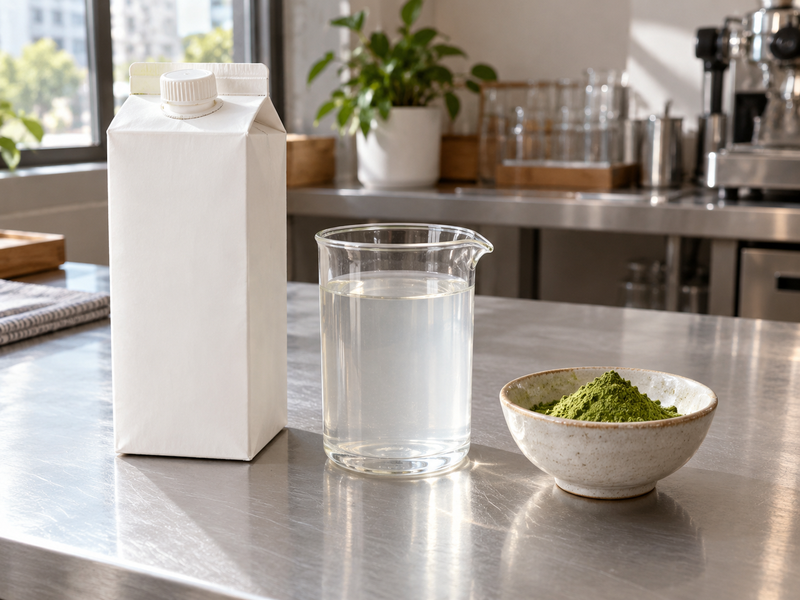
Products sold as coconut water vary. Some are plain; others include added sugar or other ingredients. Processing and packaging also change flavor. Read the ingredient declaration and nutrition panel for each candidate, then taste it on its own before mixing. Do not assume a higher price or a coconut illustration on the carton predicts performance. A strong coconut note can dominate a modest matcha dose. A bland one may leave the finished drink tasting thin. Ask the supplier for product specifications, storage conditions and a consistent supply plan if the drink is intended for more than a short special.
Use a single controlled recipe to compare the samples. If the team adjusts matcha and sweetener for every carton, it will learn little about the coconut water itself. Once a preferred product is identified, make a second round of recipe changes. Consider the available formats as well: a refrigerated cafe can open a single-serve carton and build each drink, while a commissary may need a different pack size and handling plan. Opened product must be managed according to the manufacturer’s instructions and the operation’s food-safety procedures, not an improvised hold time.
| Coconut water check | Evidence to collect | Why it matters |
|---|---|---|
| Ingredients | Current package declaration | Added sugar changes the formula |
| Sensory quality | Blind taste alone and in drink | Coconut flavor can mask tea |
| Format | Pack size and opening method | Waste and handling differ |
| Supply | Specification and availability | Recipe consistency depends on it |
3. Which matcha performs in a clear drink?
Taste the powder in its final medium
A matcha that works in a creamy latte may taste severe when diluted with coconut water. Request lot-linked samples from suppliers and test each at the same dose. Evaluate aroma, tea presence, bitterness and finish in the finished cold drink. Inspect color as one attribute, but do not choose a powder from color alone. An exceptionally bright dry powder can still make a drink that settles quickly or tastes rough. There is no universal grade label that predicts performance across every coconut water, so a supplier’s “ceremonial” or “premium” designation is a starting description, not a purchase decision.
Ask how the powder is stored and packed, what documentation accompanies a shipment, and how substitutions are communicated. If the menu promises a particular origin, grade or organic status, verify that the supplied lot supports the claim. Retest when either ingredient changes. A small cost saving per kilogram may disappear if the new matcha requires a larger dose or more sweetener to meet the original flavor brief. Calculate cost from the accepted serving, not from the price of a bag on a supplier sheet.
4. How should the powder be mixed?
Make a smooth concentrate first
Matcha is a fine suspended powder; it does not dissolve like sugar. Pouring dry powder directly over a full cup of cold coconut water often leaves green islands at the surface and dense lumps at the bottom. Sift only if the procedure is practical at service. More reliably, wet a measured dose with a small amount of compatible liquid, whisk until smooth, and then combine it with the rest of the coconut water. Test the same method with the whisk or mixer the stores will actually use. The concentrate should be smooth before it meets ice, since a chilled cup makes defects harder to correct.
Write down the order of operations. A standard might specify powder dose, mixing liquid, mixing time or visual endpoint, coconut water quantity, ice and final stir. Train staff to remake a concentrate with dry clumps rather than hiding it beneath more liquid. In a central kitchen, a larger batch requires its own mixing validation; scaling a cup recipe by simple multiplication can change dispersion and settling. Record the batch’s first and last pours and compare them. If they differ visibly or in taste, the process needs adjustment.
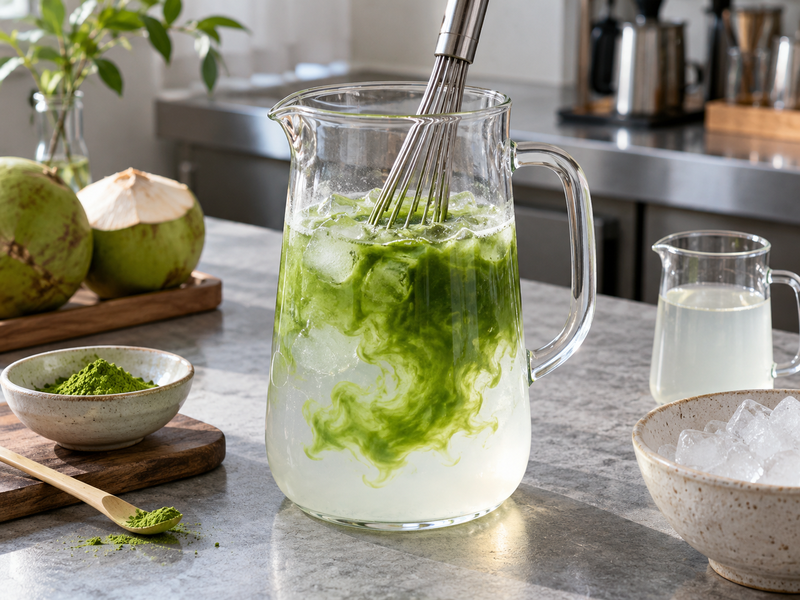
| Step | Acceptable observation | Corrective trial |
|---|---|---|
| Wet powder | Even paste, no dry core | Change addition order |
| Whisk concentrate | Smooth, pourable green liquid | Adjust tool or mixing time |
| Add coconut water | Even color after a brief stir | Review dilution sequence |
| Serve over ice | No lumps in final sip | Remake failed concentrate |
5. What does settling tell the team?
Look at the drink through its real service window
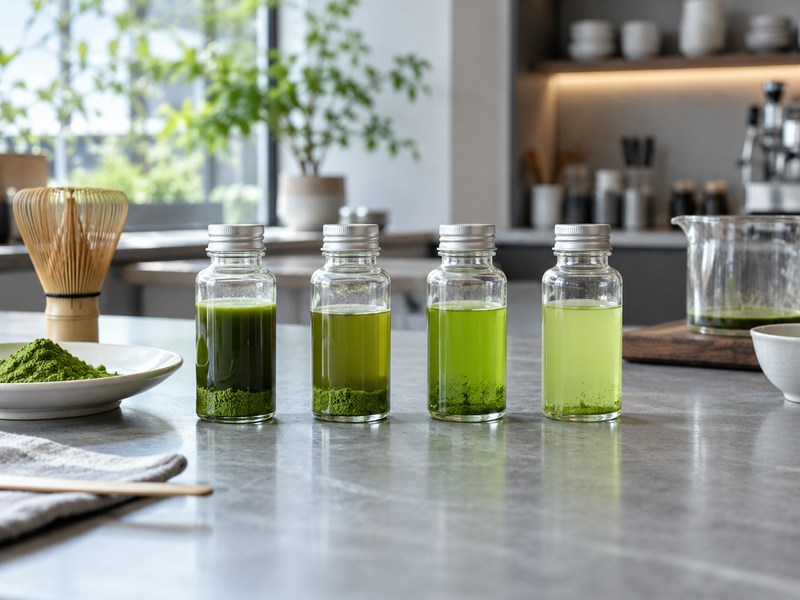
Some settling is expected in a matcha beverage because the leaf particles are suspended. The question is whether the movement is acceptable for the product and the customer. Photograph a freshly made cup, then check it after the time a customer might wait at the pickup counter or carry it away. Taste from top, middle and bottom. A dramatic pale layer above a dense green sediment may make the last sip harsh. If a gentle swirl restores an acceptable drink, a transparent service instruction may be enough for a cafe cup. A sealed retail bottle faces a different expectation and should be evaluated by a qualified beverage developer.
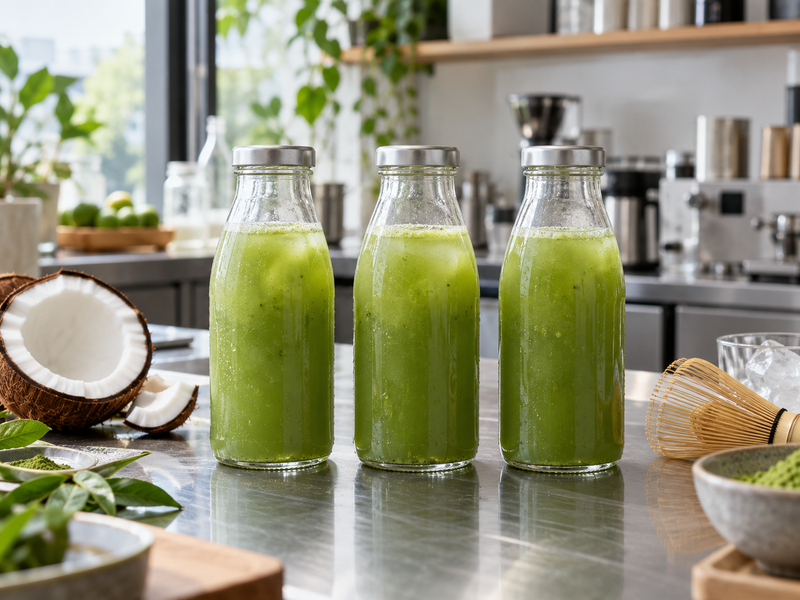
Do not equate visual uniformity with safety. A drink can look stable and still require a separate microbiological and processing review. Conversely, normal leaf sediment does not automatically make a freshly prepared drink defective. Keep the two questions separate: sensory stability and food safety. If a formula needs a stabilizer, ask what it does to mouthfeel and labeling before adopting it. Test every change in the actual container, under the planned storage and handling conditions. A clear glass at a tasting table cannot predict a week in a distribution chain.
6. How should an iced cafe version be specified?
Define the cup the customer receives
Measure ice, coconut water and matcha concentrate by weight or a repeatable tool. Mark the final fill line and the permitted cup size. A recipe with “a handful of ice” will vary with scoop size, and the same liquid poured into a larger cup can look underfilled. Test the beverage at the moment it is handed over and after a normal waiting interval. A stronger starting concentrate may survive dilution better, but extra powder can also make the last sip gritty. Let sensory testing decide, and keep the chosen dose on a recipe card.
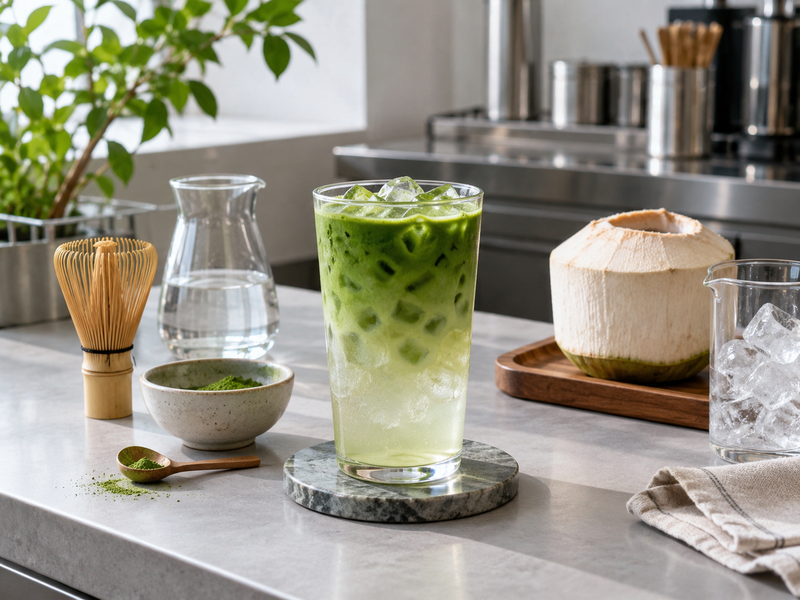
Decide whether the cup should be layered or fully mixed. A layered version photographs well, but the customer may first taste plain coconut water and then a concentrated green layer. If layering is part of the menu promise, specify a brief stir instruction and check how reliably staff can make it at speed. For delivery, test the actual lidded cup and travel time. Include straw or drinking-lid differences: they change the point from which liquid is drawn. If the drink is offered with sweetener or fruit, price and label those additions separately so the base recipe remains understandable.
| Service variable | Record on recipe card | Check during trial |
|---|---|---|
| Matcha | Grams per serving | Tea remains present after ice melts |
| Coconut water | Product and volume | Flavor is consistent across cartons |
| Ice | Scoop or weight | Final cup dilution |
| Mixing | Tool and sequence | No visible dry particles |
| Delivery | Cup and travel interval | Last sip remains acceptable |
7. What changes for a packaged drink?
Start a separate development project
A ready-to-drink bottle is not a cafe cup with a cap. Ingredient behavior during filling, processing, distribution and storage must be studied by specialists. Matcha can settle; color and flavor can shift; coconut water brings its own processing questions. Do not assign a shelf life from a home recipe or a successful overnight refrigerator sample. Work with a qualified food scientist and a processor to establish the product’s formulation, process, hazard controls, package compatibility and validated shelf life for the intended market.
Think through consumer use as part of the design. Will the bottle say to shake? Can a reasonable shake restore an even drink? Is the cap easy to open after refrigeration? Does the product look acceptable on a shelf under store lighting? Sample at the planned storage temperatures and at realistic points during distribution. If the formula needs a stronger process that changes the tea flavor, reformulate against the original sensory target rather than accepting a beverage that only shares the original name.
| Packaged-drink question | Evidence needed |
|---|---|
| Is it safe through distribution? | Qualified process and hazard review |
| Does it remain acceptable? | Sensory and physical stability trials |
| What is the date code? | Validated shelf-life basis |
8. What must the label and safety review cover?
Keep claims tied to the actual formula
For a cafe, review the current ingredient declarations and any allergen or cross-contact information supplied by manufacturers. A coconut water matcha can be described by its ingredients and taste without unsupported claims about hydration, detoxification or health effects. For a packaged product, ingredient order, nutrition labeling, claims and jurisdiction-specific requirements need professional review. The U.S. FDA says coconut water is considered juice under its Juice HACCP regulation. Whether and how that regulation applies to a particular finished blend and operation requires a product-specific regulatory assessment.
Retail food handling should follow the local authority’s requirements and a documented food-safety plan. The FDA Food Code is a model for retail food safety in the United States; local adoption and rules differ. Maintain traceability for the matcha and coconut water lots, an approved cleaning procedure for whisks or mixers, and an escalation path for ingredients that arrive damaged or outside specification. Avoid a universal opened-carton holding time in a public recipe. Use the manufacturer’s directions and the operation’s validated procedures.
9. How should a buyer compare suppliers?
Compare the cost of an accepted cup
Ask matcha suppliers for a specification, representative lot sample, packing format, storage guidance and lead time. Ask coconut water suppliers the same operational questions plus ingredient declaration and available pack sizes. Build sample drinks at a fixed dose and evaluate them blind. Then price only versions that meet the target. The cheapest powder and cheapest coconut water do not necessarily make the lowest-cost acceptable cup. One may require a higher tea dose, extra sweetener or more waste from partially used packs.
Keep the sampling record short enough that a cafe manager will use it. Record sensory notes, photographs at set times, lot identifiers, recipe version and direct cost. If a supplier offers a substitute, compare it using the same method before approving it. Multi-site operators should test at least one store outside the development kitchen, since different water, ice and staff routines can expose a weak process. A written acceptance rule makes supplier conversations clearer than a loose request for “better green color.”
| Buyer question | Ask the matcha supplier | Ask the coconut-water supplier |
|---|---|---|
| Identity | Grade, origin and lot | Ingredient declaration and lot |
| Handling | Packing and storage | Pack format and opened-pack guidance |
| Repeatability | Specification and change notice | Flavor and supply consistency |
| Economics | Accepted grams per cup | Accepted volume and waste |
10. When is the product ready to sell?
Approve a recipe, not just a tasting sample
The drink is ready for a limited cafe launch when the team can reproduce the target with an approved ingredient pair, a written mixing method, a measurable serving, a realistic service-time test and trained staff. Check that menu language accurately describes what is in the cup. Set a date to review customer feedback and any preparation failures. If the team chooses a bottled route, the launch gate must also include the qualified processing, safety, packaging and shelf-life work described above. A good cafe prototype alone cannot clear that gate.
Write down the reason for any later recipe change. Seasonal ingredient supply, new packaging or a different matcha lot may alter the drink, and the team should know which version customers liked. Revisit the basic tasting brief rather than automatically matching the old color with more powder. Coconut water matcha succeeds when the customer gets a pleasant, recognizable drink through the whole cup and the operation can deliver it consistently. The photograph should be the consequence of that work, not its substitute.
FAQ
Q1. Can matcha be stirred directly into cold coconut water? It can, but dry powder often clumps. A small smooth concentrate makes the result easier to repeat.
Q2. Is coconut water matcha naturally sweet? Coconut water can taste sweet, but products vary. Read the actual label and taste the chosen brand before adding syrup.
Q3. Is sediment in a cafe cup a defect? Some matcha settling is expected. Judge the finished cup over its intended service window and check the last sip.
Q4. Can the cafe recipe be bottled with the same shelf life? No shelf life follows from a cup recipe. A packaged beverage needs qualified process and safety validation.
Q5. What should a buyer request from a matcha supplier? Ask for a lot-linked sample, specification, packing and storage details, lead time and a clear change-notice process.