
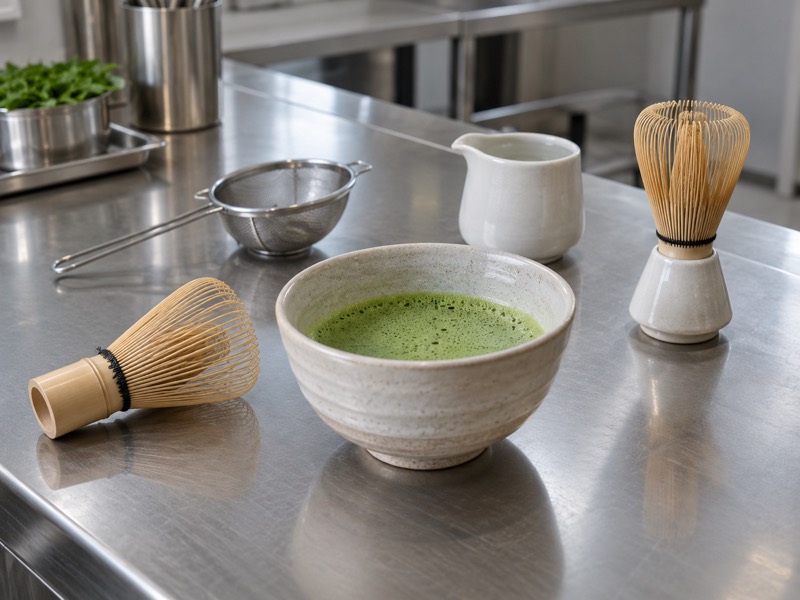
A chasen matcha whisk is a bamboo tool whose fine tines help suspend matcha powder in water and build a fine surface foam. For a café buyer, the question is whether staff can prepare repeatable cups without excessive breakage or cleaning time. Compare whisk and bowl combinations using the intended recipe, train operators on handling, and inspect tools during service. Those observable checks give procurement a sounder basis than a tine count or a decorative product photo.
Contents: 1 · 2 · 3 · 4 · 5 · 6 · 7 · 8 · 9 · 10
1. What is a chasen matcha whisk and what does it do?
A tool for suspension
Matcha is ground tea dispersed into liquid rather than leaves strained out after brewing. A bamboo chasen presents many fine tines to the liquid, helping break up powder pockets and move air across the surface when used in a suitable bowl. It does not dissolve tea particles. A smooth-looking cup can still settle later, and foam alone does not prove that the powder or recipe is good. A café should judge taste, texture, preparation time, and visible residue together.
Start with the drink. A tea-only bowl and a sweetened iced latte can demand different workflows. Some cafés whisk a small tea base before adding milk; others need an alternative tool for high-volume service. Define the finished drink and its serving window before selecting a chasen matcha whisk. Record matcha dose, water mass, bowl type, liquid temperature, and time to handoff so a tool comparison measures tool performance rather than a changing recipe.
| Service result | What to observe | Why foam alone is insufficient |
|---|---|---|
| Uniform cup | Dry specks and residue | Surface can hide clumps |
| Fine foam | Bubble size and persistence | Foam changes with recipe |
| Repeatability | Operator variation | One skilled cup may mislead |
2. Which construction details matter to buyers?
Inspect the working end
Look for intact, separated tines without rough splinters, cracks, or loose fragments. Check the handle for a secure grip and the whisk for a shape that allows movement in the intended bowl. Bamboo is a natural material, so minor appearance variation may occur; the purchase specification should distinguish cosmetic variation from a functional defect. Do not assume every item sold under the same name has identical dimensions or finishing. Request representative production samples rather than relying only on a styled image.
Make inspection repeatable. Set a simple incoming checklist and train one person to compare items against an approved reference. Record the count of visibly damaged units and the supplier lot or carton. Handle a sample gently before the drink trial; if tines shed or catch on the bowl, quarantine the suspect lot under the site’s procedure. A buyer may prefer a slightly more expensive whisk if it survives normal service and reduces replacements, but that decision needs observed usage rather than a claim from catalog copy.
3. How should tine count, shape, and bowl fit be compared?
Treat dimensions as a system
Tine count is easy to print on a product page, yet performance also depends on tine thickness, spacing, flexibility, whisk diameter, and bowl geometry. A whisk that reaches a broad, shallow bowl may move poorly inside a narrow mug. The bowl should allow the operator to whisk without crushing the tines against its wall or scraping its base. Compare candidate whisk and bowl combinations with the same matcha, water, operator instruction, and timing.
Test the whole motion. Ask operators to note whether the tool feels cramped, whether their hand contacts the rim, and whether the whisk can cover the powder resting near the bowl’s edge. Observe finished texture and residue rather than ranking models by tine count alone. A hypothetical procurement trial might screen three designs, but its pass criteria should come from the café’s drink and work rate. Keep a photo and measurements of the approved combination for reordering.
| Design variable | Potential effect | Fair comparison method |
|---|---|---|
| Tine layout | Liquid movement and fragility | Same recipe and operator |
| Whisk diameter | Reach and bowl clearance | Intended bowl, not display cup |
| Bowl shape | Movement and splash | Same fill level and time |
4. What preparation and handling reduce breakage?
Prepare the tool before service
Follow the supplier’s instructions for wetting a new whisk and for routine pre-service preparation. A brief gentle wetting step can help tines move as intended, but the café should validate its own workflow rather than impose an arbitrary soak time. Inspect for bent or broken strands before using a tool in a customer drink. Keep the whisk away from sharp utensils, heavy objects, and the edge of a busy sink where tines can be crushed.
Train the motion. Show staff how the whisk sits in the chosen bowl and where the tines should travel. Avoid pushing hard into the bowl floor or using the tool to scrape stuck powder. Prepare powder with a suitable wetting step instead of relying on force to crush dry lumps. At the end of a rush, a whisk left submerged or sealed wet can become a hygiene and durability problem. Assign a clean, ventilated place for washed tools and a simple inspection before the next shift.
5. How should operators whisk consistently?
Standardize the cup first
Weigh matcha and water during recipe development, then specify the permitted operating method. Sift or otherwise break up visible powder agglomerates if the approved procedure requires it. Add measured water, wet the powder, and whisk in a repeatable movement that keeps tines clear of hard scraping. The exact pattern and duration should come from tests with the chosen bowl, tool, powder, and service target. “Whisk until foamy” leaves too much room for differing operators and drink temperatures.
Measure a normal shift. Have several staff members prepare coded cups with the same ingredients. Record preparation time, visible clumps, foam appearance, taste, and residue after standing. If one operator makes consistently better cups, observe their method and turn useful details into training. A chasen matcha whisk should fit the service station and cleaning sequence; a beautiful cup that takes too long during peak demand may require a different station design or tool.
| Control | What staff record | What it helps isolate |
|---|---|---|
| Powder and water mass | Recipe inputs | Dose variation |
| Wetting method | Order and time | Dry cores |
| Finished cup | Foam, taste, residue | Tool and technique fit |
6. What cleaning and drying protocol supports reuse?
Clean without trapping water
Rinse the whisk promptly according to the supplier’s care guidance, removing matcha from the tines without pulling or twisting them. Avoid leaving powder to dry into the tool. Follow the site’s food-contact cleaning policy for utensils and check whether its sanitizing method is suitable for bamboo; do not assume a dishwasher or harsh chemical is safe for every model. If a required sanitation method is incompatible, the café needs another approved tool or process.
Give it airflow. A holder can support the whisk’s shape while it dries, provided the storage location is clean and ventilated. Do not close a damp bamboo whisk in a drawer or transport case. Set a routine inspection for odor, discoloration, cracks, and trapped residue. Staff should know when to remove a whisk from service rather than trying to wash a damaged one back into acceptance. Document cleaning responsibility by shift so the procedure survives a staff change.
7. When does a whisk need replacement?
Decide from condition and output
Replace a chasen when tines split, shed, snag, or lose a functional shape, or when the tool cannot be cleaned to the site’s standard. A fall in foam quality alone is not proof of tool wear: recipe, powder lot, water, and technique may have changed. Compare a suspect whisk with an approved reference under the same preparation before attributing a drink defect to age. Do not rely on a universal number of cups per whisk; service frequency and handling vary widely.
Track the reason. Record when a tool entered service, when it left, and why. Frequent breakage at one station may point to bowl mismatch, sink damage, or training rather than poor supplier quality. A lot with a high rate of early defects deserves supplier review. Include replacement stock in purchasing so operators are not pressured to keep using a damaged food-contact utensil during a rush.
| Removal trigger | Immediate action | Follow-up question |
|---|---|---|
| Splinter or loose tine | Remove from service | Supplier lot or handling issue? |
| Persistent residue | Hold for review | Is cleaning method adequate? |
| Poor performance | Compare with control | Tool, recipe, or operator? |
8. How does a chasen compare with an electric frother?
Compare service outcomes
An electric frother can be fast in a deep vessel, while a bamboo whisk offers direct control in a shallow bowl. Neither is automatically the right choice for every drink. Different motion, vessel shape, and air incorporation can change foam and texture. For a chain, tool selection also affects staff training, cleaning, electrical needs, noise, breakage, and backup stock. Run both methods at the same powder dose and finished drink target before making an equipment decision.
Include the last sip. A frothy top can conceal undispersed powder below. Compare residue, taste, service time, and the drink after an expected wait. Observe operator variation and cleaning time across several cups. A café may choose a chasen for tea-only service and another method for high-volume milk drinks, provided each recipe and procedure is separately approved. Product labeling and marketing should describe the actual preparation rather than imply a traditional method that staff do not use.
9. What should a supplier specification include?
Buy a reproducible tool
Ask for material description, dimensions, tine design, finishing standard, packaging, storage guidance, and food-contact information relevant to the destination market. Request production-representative samples linked to the offer. The specification should define unacceptable damage at delivery and explain how the supplier handles claims for broken or nonconforming units. A photo of a single display whisk cannot guarantee every carton meets the same standard.
Plan replenishment. Record minimum order, lead time, pack quantity, and how each lot or shipment can be identified. Discuss protective packaging because bamboo tines can be damaged in transit. A distributor needs to know whether replacement stock will match the approved design or whether a product change triggers a new café trial. Store incoming whisks in clean, dry conditions and inspect a sample before releasing them to outlets.
| Purchase requirement | Evidence to request | Buyer decision |
|---|---|---|
| Construction | Dimensions and sample | Bowl and hand fit |
| Food-contact suitability | Applicable documentation | Market approval |
| Delivery quality | Pack and defect criteria | Acceptance or claim |
10. How can a cafe pilot qualify a chasen?
Use real operators and service pace
Approve a recipe and bowl, then compare candidate whisks during timed trials with multiple trained operators. Record cup texture, clumps, foam, residue, preparation time, splash, and operator comfort. Clean and dry the tools as the café would after a shift, then inspect for damage. This gives buyers a view of cost per usable period, not merely price per whisk. A pilot should include both calm periods and realistic service pressure.
Set a reorder rule. Sign off the approved whisk model, supplier, bowl pairing, care procedure, incoming checks, replacement triggers, and training card. Keep an example unit for future delivery comparisons. If a supplier changes dimensions or tine design, rerun the relevant drink test before substitution. The next step is a small controlled purchase for several representative cafés. For background on the traditional tool, see the Global Japanese Tea Association’s chasen article; its page was inaccessible during this research, so its specific contents were not used as evidence.
Reference: Chasen – The Sacred Bamboo Whisk Behind Every Bowl of Matcha (Chasen Part 1). The source page was inaccessible during research, so its contents were not verified; its title supplied topic context only.
FAQ
Q1: What is a chasen matcha whisk?
It is a bamboo whisk with fine tines used to suspend matcha powder in liquid, typically in a bowl suited to its shape.
Q2: Does a higher tine count always make better foam?
No. Tine shape, bowl fit, recipe, and operator method also affect the cup. Compare tools in a controlled service trial.
Q3: Can a chasen be used in a deep mug?
Test the actual mug. A narrow deep vessel may restrict whisk movement or damage tines against its sides.
Q4: How should a café dry a chasen after washing?
Follow supplier and site hygiene guidance, then allow clean airflow and inspect before reuse. Avoid storing it wet in a closed case.
Q5: What should buyers inspect on delivery?
Check tine integrity, finish, dimensions, packaging damage, and match to the approved production sample.