
A ceramic matcha set is often bought first with the eyes. Its value in service depends on less photogenic details: interior room for the whisk, a stable foot, a finish that can be cleaned and packing that protects the bowl. Artisan d’Asie’s buying guide introduces the category. Wholesale buyers should test the specific ceramic pieces with the intended tea and tools, then write down the acceptable variation before ordering cartons.
Contents
- 1. Which ceramic pieces are in the set?
- 2. What material details should be documented?
- 3. Does the bowl fit the preparation method?
- 4. Are the rim and foot comfortable?
- 5. How should glaze and finish be assessed?
- 6. Does the whisk holder fit its whisk?
- 7. Can the pieces be cleaned as instructed?
- 8. How should breakage protection be tested?
- 9. What does ceramic weight cost in distribution?
- 10. What should the receiving standard include?
1. Which ceramic pieces are in the set?
Define the object before comparing prices
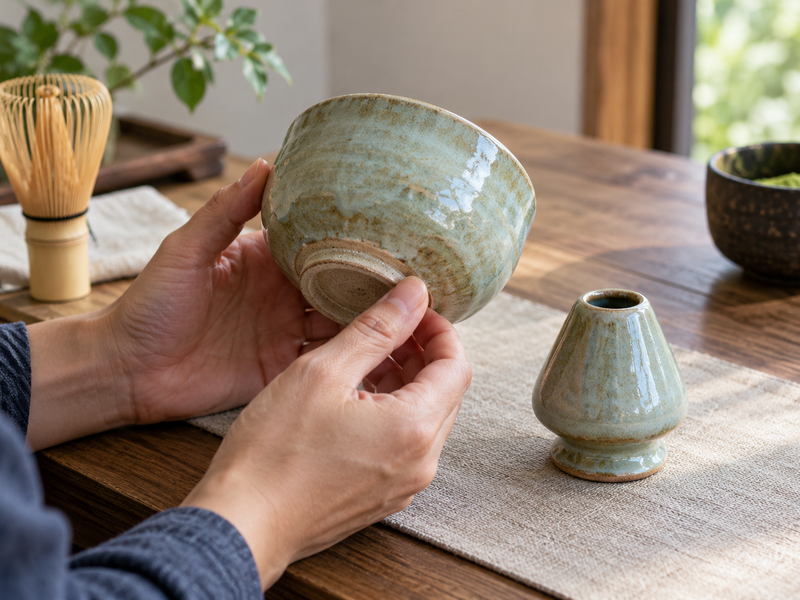
One seller may call a bowl and whisk holder a ceramic set; another includes a ceramic tea caddy, spoon rest and several bamboo tools. Write a component list before comparing quotations. Identify which pieces touch matcha or water and which are purely for storage or display. The bowl is usually the functional center, so its size and interior shape should lead the assessment. Extra ceramic pieces can add value, but they also add weight and breakage points.
Ask for exact dimensions, material descriptions, colors and item codes for each piece. Check how the pieces relate in use: does the holder support the supplied whisk, does a lid fit its caddy, and can a spoon rest be cleaned easily after powder spills? Prepare the intended drink with the full set. If a component never enters the routine or creates a storage problem, reconsider including it. A clear component definition also prevents a low-priced quote from quietly omitting a piece shown in the marketing photograph.
2. What material details should be documented?
Ask for records tied to the actual item
“Ceramic” describes a broad family of products, not a complete food-contact specification. Ask the supplier for the body and glaze description, decoration method and applicable food-contact documentation for the exact item codes and destination market. If the bowl has metallic decoration or an unglazed interior area, clarify which surfaces contact the drink. Do not infer suitability for every use from an attractive finish or a generic certificate for another product line.
Keep the submitted sample, item code and documents connected. A later change in glaze, kiln or supplier may warrant renewed review even if the finished color appears similar. Marketing copy should avoid unsupported promises such as “lead-free,” “microwave safe” or “dishwasher safe” unless the specific article has evidence for those claims. The buyer can also inspect the physical sample for obvious defects, but visual inspection does not establish chemical compliance. Request documentation early enough that artwork can be revised before a bulk order is placed.
| Material question | Supplier evidence | Buyer action |
|---|---|---|
| What contacts the drink? | Component and finish specification | Confirm bowl surfaces |
| What rules apply? | Market-specific food-contact records | Review for destination |
| Is there decoration? | Method and location description | Check copy and care |
| Can parts change? | Change-notice process | Retest revised items |
3. Does the bowl fit the preparation method?
Use the intended whisk, dose and liquid
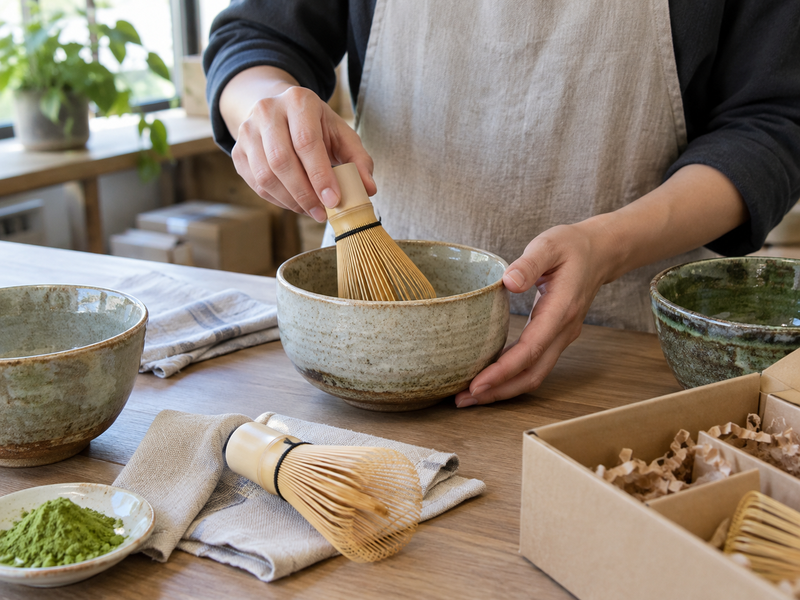
Measure useful interior space rather than relying only on outer diameter. The whisk needs room to move without scraping the walls, and the planned liquid level should leave space for mixing without spills. Test with the actual whisk, tea and recipe. A wide bowl can be comfortable for hand whisking but occupy more shelf and carton space; a narrow bowl may look elegant yet frustrate a beginner. Decide based on the use case, not a universal “ideal” measurement.
Observe how the bowl handles powder before water is added. Does powder collect in an inaccessible curve? Can the user see and break dry clumps? Then pour or drink from it as the product instructions suggest. For a café, repeat the process across several orders and check that staff can carry and clear the bowl safely. A home retail set should be tested by someone unfamiliar with the technique. The bowl’s performance is a relationship among form, whisk and recipe, so approve those items together.
4. Are the rim and foot comfortable?
Examine the contact points
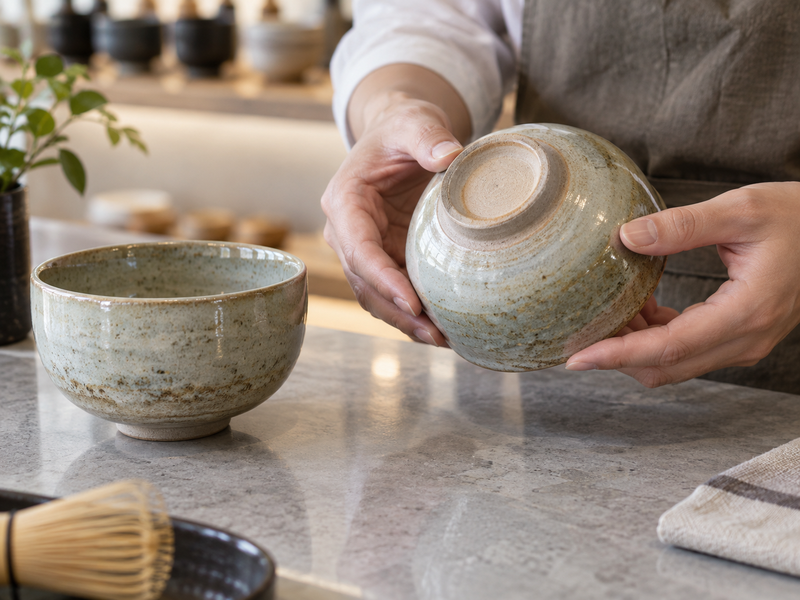
The rim meets lips or a pouring stream; the foot meets the counter and the user’s hand. Run a finger carefully around both on each sample, looking for sharp chips, rough glaze and unstable contact. Set the bowl on a flat surface and apply the gentle movements used in preparation. An intentionally irregular shape can be appealing, but it should not wobble enough to spill a drink. The buyer should state the acceptable variation rather than deciding case by case after cartons arrive.
Check whether the foot scratches a tabletop and whether the bowl can be held comfortably when filled to the planned level. A bowl that is heavy at the base may feel secure but add freight cost; a very light one may be less forgiving of hurried handling. For a café, watch staff carry, serve and clear several units. For a gift set, verify the rim and foot are protected in the insert. These simple handling checks often reveal more than studio photographs of the glaze.
| Contact point | Check | Reject when |
|---|---|---|
| Rim | Drink and pour from sample | Sharp or chipped area |
| Foot | Place on flat counter | Unstable or abrasive contact |
| Exterior | Hold with planned fill | Unsafe grip or discomfort |
| Interior curve | Whisk and rinse | Persistent trapped powder |
5. How should glaze and finish be assessed?
Define acceptable variation visually and functionally
Ceramic finishes can vary by production method and firing. Ask the maker which variations are intentional and which indicate a defect. Approve a range of physical samples or clear photographs under consistent lighting, then identify the unacceptable cases: exposed sharp areas, cracks, major pinholes in food-contact surfaces or finish changes that compromise cleaning. Do not rely on color words alone; two “sage green” production runs can look different on a retail shelf.
Inspect the inside under good light after making and washing a bowl. Stains, visible roughness or a surface that catches powder merit further review with the supplier. A visual defect standard should be paired with the relevant material and food-contact documentation, not treated as its substitute. If the set includes several ceramic components, check that their colors and textures look intentional together. For a café chain, decide whether sites may receive mixed finish lots or whether a site needs a matched group for table presentation.
6. Does the whisk holder fit its whisk?
Test storage rather than assuming compatibility
A ceramic whisk holder can help a bamboo whisk keep its intended shape between uses, but the two must be paired. Place the supplied whisk on the holder after rinsing according to its care directions. The holder should support it without forcing the tines outward or letting it collapse at an awkward angle. If the set has no whisk, name the compatible whisk dimensions or avoid claiming universal fit. A visually matched bowl and holder are not necessarily a functional match.
Inspect the holder’s base for stability and its curves for hard-to-clean grooves. Ask whether the inside is glazed and how it should be washed and dried. In a café, a rack may be more practical than a ceramic holder for many whisks; test the station layout before buying a holder for every bowl. In retail, protect the holder separately in the box because its narrow profile can be vulnerable to impact. A replacement holder specification helps when one breaks while the rest of the set remains usable.
| Holder detail | Use test | Packaging check |
|---|---|---|
| Top shape | Supports supplied whisk | Does not press against tines |
| Base | Stands on shelf | Protected from side impact |
| Finish | Cleans and dries | No sharp adjacent pieces |
| Replacement | Fits same whisk model | Separate item code available |
7. Can the pieces be cleaned as instructed?
Verify the routine on samples
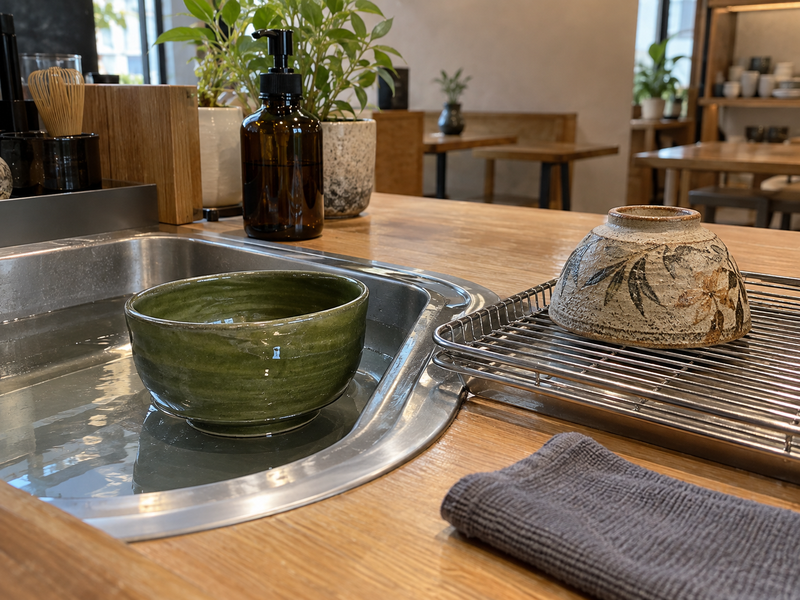
Request care guidance for each ceramic item, including any decoration or unglazed base. Then run the intended wash and dry routine repeatedly on production-like samples. Inspect the glaze, rim and foot afterward. Do not assume that all ceramics can tolerate a commercial dishwasher, microwave or sudden temperature change. If the seller wants to print such a claim, obtain evidence for the exact product and use conditions. For café service, check that the approved method fits the site’s food-contact cleaning process.
Look at storage after cleaning. Can bowls be stacked without abrasion, or should separators be used? Does the caddy lid dry fully before it is closed? Does a holder trap water where the whisk sits? These details affect daily handling and breakage. A retail care card should be short enough to read and specific enough to prevent obvious misuse. It should state which pieces are bamboo, ceramic or metal so customers do not apply one instruction to the whole mixed-material box.
8. How should breakage protection be tested?
Run a packed route trial
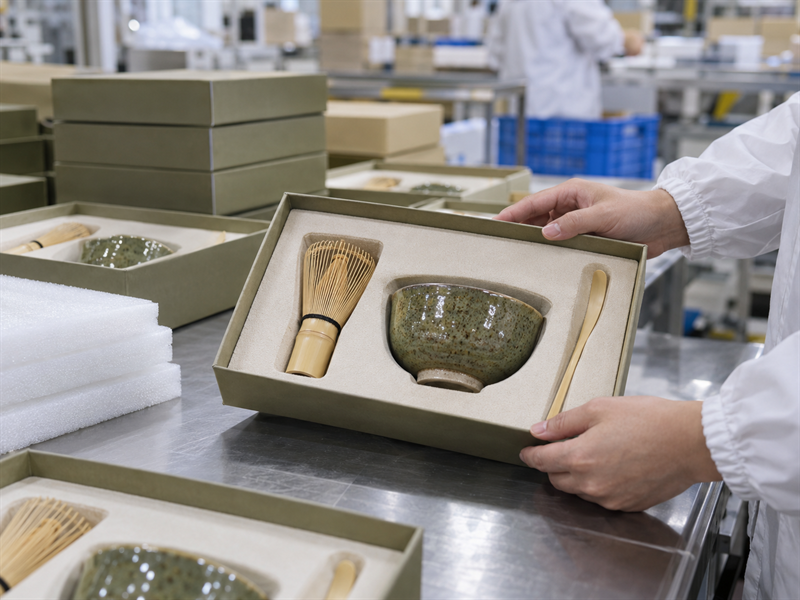
Protect the bowl rim, foot and any projecting holder profile from the outer carton and from each other. An insert that grips only the broad bowl body may leave the rim exposed to impact. Pack the actual tea, whisk, scoop and printed materials, then send sample units through the intended parcel or wholesale distribution route. Photograph the pack-out before dispatch and inspect each part on arrival. Count hairline cracks and chips as failures even when the outer box looks undamaged.
If damage appears, change the insert or component orientation and repeat the route trial. Do not solve every issue with more empty box volume; larger packages can increase freight and movement. Include the master packed sample, insert drawing, outer-carton quantity and handling marks in the purchase specification. Agree with the supplier how transit damage will be documented and replaced. A bulk-order quote without protective packing is not a comparable price for a ceramic set.
| Damage location | Likely pack question | Retest action |
|---|---|---|
| Bowl rim | Is there top clearance? | Add rigid rim support |
| Bowl foot | Does it contact another part? | Isolate the base |
| Holder neck | Can it flex in its cavity? | Add fitted support |
| Tea pack | Is ceramic rubbing its seal? | Separate compartments |
9. What does ceramic weight cost in distribution?
Compare delivered value, not shelf price
Ceramic pieces can make a set feel substantial, but they add unit weight, packaging volume and handling work. Request the packed dimensions and gross weight of the final configuration, not only the bowl weight. Price the intended shipping route and carton quantity, then include expected damage replacement and the space required in a shop or warehouse. A lower-priced bowl may cost more after protective materials and breakage are counted.
Weight can also change the customer’s experience. A large bowl may be enjoyable on a table yet awkward for a gift recipient with limited storage or for a café carrying many dishes. Compare a few credible configurations by making the same cup and shipping the same sample quantity. Do not treat “heavier” as an automatic quality signal. The best choice is the one whose handling, presentation and landed cost match the channel. Keep the calculation with the approved specification so future buyers know why that ceramic design was selected.
10. What should the receiving standard include?
Turn sample approval into a checklist
Write acceptance criteria for component count, dimensions that affect whisk fit, approved finish range, stable foot, sound rim, absence of cracks and correct protective packaging. Include item codes and photographic examples of acceptable handmade variation and unacceptable defects. Receive a small sample from each lot and compare it with the master unit. When a supplier changes glaze or bowl shape, require a complete-use check rather than judging a loose bowl in isolation.
The incoming test should make the planned drink, wash the bowl by the approved method and repack the set. If the tea or whisk changed, retest those as well. Track defects by type and production lot so a recurring rim problem can be addressed with the maker. Keep customer-facing copy aligned with what arrives: color descriptions, care claims and included pieces should be updated when the product changes. This prevents a carefully chosen ceramic set from drifting into an inconsistent assortment over repeated orders.
| Receiving item | Acceptance evidence | Escalation |
|---|---|---|
| Shape and finish | Master sample and approved range | Quarantine outliers |
| Rim and foot | Hands-on stability check | Reject chips or wobble |
| Tool fit | Make a sample bowl | Review changed dimensions |
| Packaging | Packed sample and route record | Retest changed insert |
FAQ
Q1. Is a heavier ceramic bowl always better? No. Evaluate stability, handling, preparation fit and shipping cost together.
Q2. Can a ceramic matcha set go in a dishwasher? Follow documented care for the exact pieces; the material category alone does not establish dishwasher suitability.
Q3. Are glaze variations defects? Some variation may be intended. Approve a clear range and reject defects that affect use, cleaning or safety.
Q4. Does any whisk fit any ceramic holder? No. Test the actual whisk and holder as a pair.
Q5. What is the key wholesale trial? Ship a complete packed unit through the intended route, then inspect and use every ceramic piece.
Buy the set as a working and deliverable object. A bowl that feels good in hand, cleans as instructed and arrives whole is a stronger wholesale choice than one selected from glaze photographs alone.