
A ceramic matcha bowl can look right in a product photo and still fail at the counter: the whisk hits a narrow wall, the rim drips, or the base rocks on the worktop. For a café or retailer, choose from a measured service brief rather than a glaze photograph. Ask for a sample, whisk the intended recipe, wash it as staff will, and inspect it after repeated handling. The ten checks below turn that trial into a buying decision.
Contents
- 1. What job must the bowl perform?
- 2. Which ceramic body suits the program?
- 3. How can you assess a food-contact glaze?
- 4. What dimensions leave room for whisking?
- 5. Does the rim serve tea without a drip?
- 6. Will the base sit securely on the counter?
- 7. How should you test handling and durability?
- 8. What cleaning method can staff actually use?
- 9. How much variation is acceptable in a reorder?
- 10. What belongs in the purchase specification?
1. What job must the bowl perform?
Start with the drink and the operator
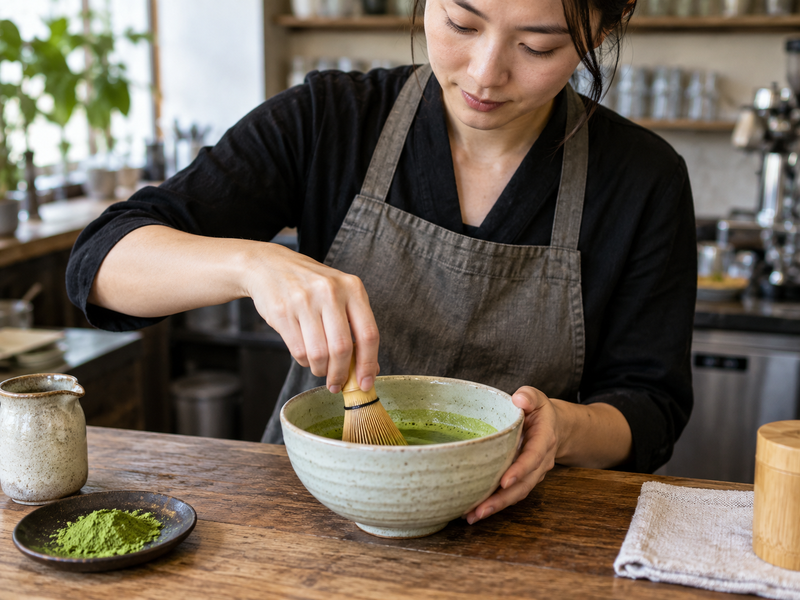
List the drinks prepared in the bowl. A tasting service may bring the bowl to the customer; a latte station may whisk concentrate and pour it into another cup. Those uses put different demands on weight, opening, and rim. Write down the usual liquid volume, whisk type, hand position, and whether staff hold the bowl or leave it on a mat. A beautiful deep chawan can work for a seated tea service while feeling awkward during a rush of takeaway orders.
Run a three-drink test with one trained operator and one new operator. Watch for whisk contact with the wall, splash onto the counter, and residue in the bottom curve. Record where each person grips the bowl after warm water has been added. The point is to find a ceramic matcha bowl that supports your actual movements, not to award an abstract quality score. The EdoMatcha bowl guide describes shape and use in tea preparation; a commercial station should add its own handling trial.
2. Which ceramic body suits the program?
Separate appearance from construction
Stoneware, porcelain, and other ceramic bodies can all make usable bowls. Their practical behavior depends on the particular clay, firing, wall thickness, and finish, so a material name alone cannot predict strength or service life. Ask the supplier what the body is, whether the interior and drinking rim are glazed, and whether a sample represents the production run. Compare samples at the same filled weight: an empty bowl can feel light until staff carry it with warm liquid.
For a retail set, customers may value tactile variation. For a high-volume café, a consistently balanced shape may matter more. Do not assume that a heavier wall is automatically more durable; it also adds handling effort and may take more shelf space. Order the candidate in the quantity needed for a realistic counter trial, then inspect breakage and chipping in the same way you inspect your existing cups.
| Body question | Why it matters | Sample check |
|---|---|---|
| Clay and firing description | Defines what the maker is actually supplying | Request written product specification |
| Wall and rim thickness | Changes weight and contact feel | Compare several units, not one hero sample |
| Interior finish | Affects wiping and visual inspection | Whisk, rinse, and inspect under task lighting |
| Production consistency | Affects reorders and nesting | Measure multiple bowls from one lot |
3. How can you assess a food-contact glaze?
Request evidence for the sales market
A glazed surface that looks smooth does not establish its suitability for food contact. Ask the vendor for material and food-contact documentation relevant to the destination market, identifying the tested product or product family, the method used, and the date. A generic claim such as “food safe” without a traceable report is not enough for an importer. The US FDA’s pottery guidance explains why lead in certain glazes can migrate into food; it does not certify any particular bowl.
Inspect the full food-contact area, including the rim and any decoration near it. Note pinholes, rough spots, crazing, and exposed edges. Ask whether the decorative version and plain version have the same glaze system before using one document for both. If the maker changes glaze, pigment, or firing process, request updated evidence. Keep the report with the SKU and purchase lot so the commercial claim remains tied to the item on the shelf.
4. What dimensions leave room for whisking?
Measure the usable interior
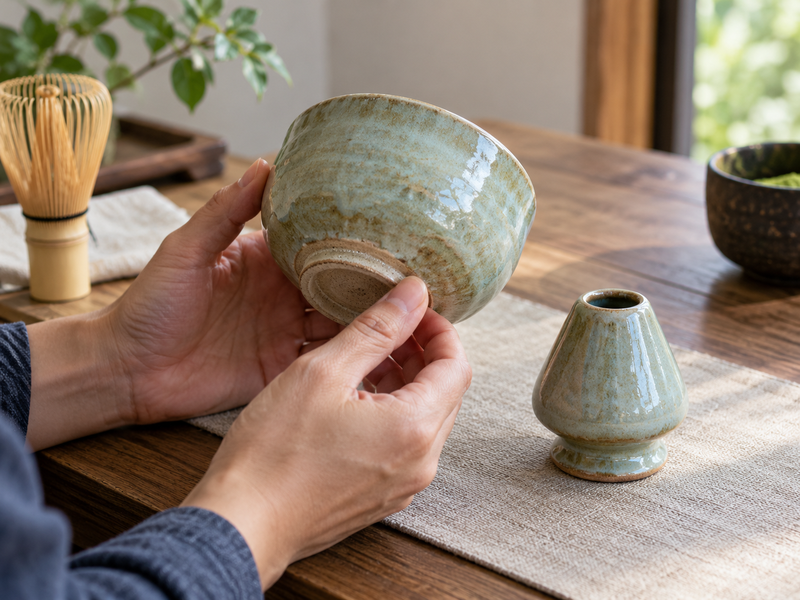
Overall diameter is a poor shorthand for working room. The Crane & Kiln ceramic bowl guide discusses body, glaze, and geometry as buying variables; verify dimensions against your own whisk and recipe. Measure the inner opening, the width of the relatively flat whisking area, and the depth from the base to the rim. Place your chosen whisk in the empty bowl and make the same fast wrist motion used in service. The tips need room to move without striking a steep wall; the bowl also needs enough height to contain the specified liquid and foam. The right combination depends on the recipe and operator, so record a successful sample rather than adopting a universal dimension.
Use a cardboard gauge or printed specification during receiving. A few millimeters of variation may be harmless in a retail assortment yet noticeable when hundreds of drinks use the same station setup. Test the bowl beside the scale, sifter, and cup in its real footprint. A wide opening that improves whisk clearance may occupy too much space on a compact counter. Decide which constraint is binding before ordering.
| Measure | Record on each sample | Service consequence |
|---|---|---|
| Inner rim diameter | Narrowest clear opening | Hand and whisk clearance |
| Working floor width | Area before wall rises sharply | Contact with whisk tips |
| Inner depth | Base to overflow edge | Splash margin for recipe |
| Filled mass | Bowl plus normal drink volume | Handling fatigue and stability |
5. Does the rim serve tea without a drip?
Test pouring with the real recipe
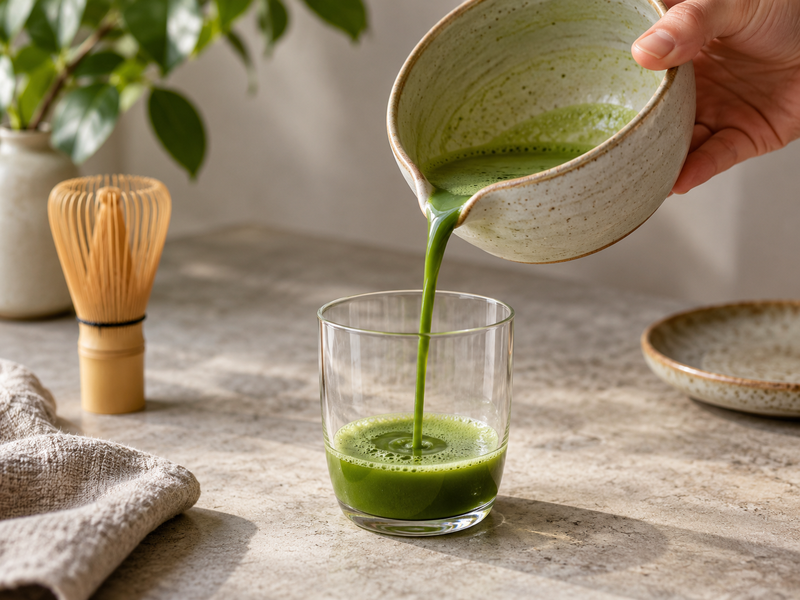
For direct tea service, the rim meets the drinker’s lips. For a latte station, it may become a pouring edge. Try both uses if the same SKU will serve both channels. Pour a measured volume into a transparent receiving cup at normal speed, then pause and return the bowl upright. Look for a clean break in the stream and for liquid running down the outside. Repeat with a thicker concentrate: water alone may behave differently from a whisked matcha mixture.
Check whether the rim is comfortable to hold and easy to wipe. A thick rolled edge may feel pleasant but retain a final drop; a fine edge may pour cleanly but chip in a crowded sink. Those are sample observations, not rules about every ceramic form. Photograph the best and worst pour from the same angle and write an acceptance criterion staff can recognize. If the bowl is for seated tea service only, prioritize a comfortable drinking edge rather than forcing a precise pour-spout requirement onto it.
6. Will the base sit securely on the counter?
Check the foot on actual surfaces
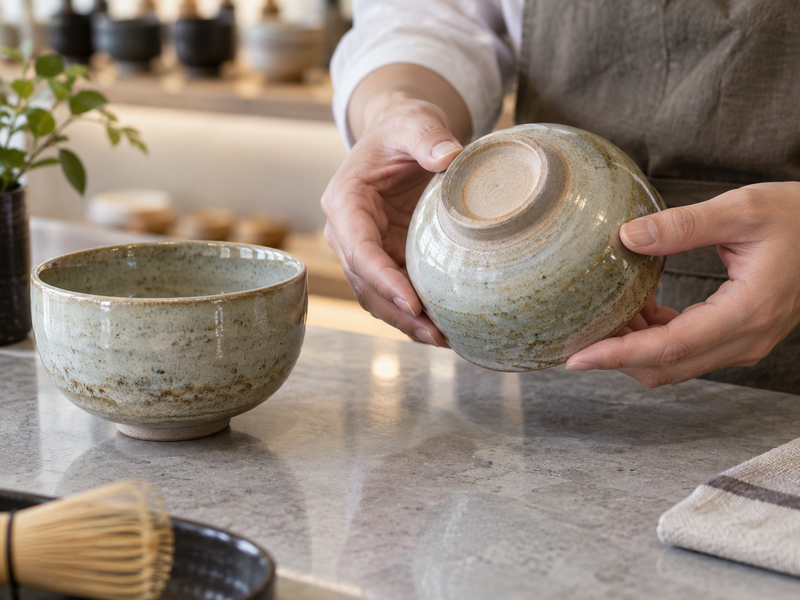
Place each empty sample on the station surface, a service tray, and the drying rack shelf. Push lightly at four points near the rim. Rocking can come from an uneven foot, a warped base, or a counter that is not level. Test several bowls before blaming the surface. Then repeat with the intended liquid volume, where a slip has a more consequential result. A bowl that settles securely on a display shelf may still slide on a wet preparation mat.
Inspect the underside for burrs that could mark tables or tear a towel. Ask whether felt pads, silicone rings, or mats are part of the service system and whether they interfere with cleaning. For retail, the foot should also sit flat inside the intended gift packaging. Document unacceptable rocking with a short video and a repeatable test surface, since “wobbly” is too vague to resolve with a supplier remotely.
| Surface | Test | Reject or investigate when |
|---|---|---|
| Dry worktop | Light four-point push | Bowl rocks visibly |
| Wet service mat | Normal whisk motion | Bowl shifts without deliberate force |
| Display shelf | Gentle tap near rim | Unit tips or twists |
| Packaging insert | Close and reopen pack | Foot abrades or strains insert |
7. How should you test handling and durability?
Use a normal service week as the trial
Put samples through normal preparation, carrying, washing, and shelving. Count uses and record damage by location: rim chip, foot abrasion, handle area wear, or glaze mark. Do not manufacture a dramatic drop test unless that reflects a real incident pattern. The goal is to learn whether the bowl tolerates routine contact with a whisk, rack, and neighboring ware. Assign each sample a number so notes can be traced to the individual unit.
Ask two staff members to lift the filled bowl with dry and damp hands. A broad rounded profile can be comfortable for one person and hard to grasp for another. If the bowl is a retail item, simulate packing and unpacking it several times. Keep a control sample unused to distinguish preexisting finish details from wear. Discuss observed defects with the vendor using photographs and lot identifiers, and do not turn one surviving sample into a general durability guarantee.
8. What cleaning method can staff actually use?
Verify the maker’s instructions
Ask for care instructions in writing: hand wash or machine wash, allowed detergents, temperature limits, and any restriction on soaking or abrasive tools. A smooth glaze may be quick to rinse, but a rough foot and deep inner corner can trap residue. Prepare matcha at the normal concentration, wait the normal interval before washing, and then inspect under the light used by the team. Also check whether the maker permits commercial dishwashing; do not infer it from a home dishwasher icon.
Food businesses must follow their applicable cleaning and sanitizing requirements. The FDA Food Code is a useful US model for equipment and utensils, but local rules and approved methods govern the actual operation. If a decorative or porous bowl cannot be cleaned by your established process, reserve it for retail or a different service format. Train staff using the selected bowl, not a generic warewashing slide.
| Cleaning checkpoint | Trial observation | Supplier question |
|---|---|---|
| Interior curve | Residue after normal wash | Any prohibited brush or detergent? |
| Rim and decoration | Staining or surface change | Is decoration in the food-contact area? |
| Foot ring | Trapped water or rough debris | How should it be dried? |
| Machine cycle | Appearance after approved cycle | Is commercial machine use permitted? |
9. How much variation is acceptable in a reorder?
Define a range before the second purchase
Handmade appearance can be a selling point, but it must be described honestly. Ask whether dimensions, glaze placement, shade, and foot shape are expected to vary. Set two tolerances: functional variation for café use and visual variation for retail presentation. A slight color shift may be welcome in a handmade assortment; a narrower opening that blocks the chosen whisk is not. Show the vendor a reference sample and the measurements that matter in use.
For multi-location cafés, buy enough approved units for one launch phase or agree on a replenishment process. Do not promise identical replacements if the supplier makes small batches. For retail, photograph representative variation on the product page rather than showing a single idealized bowl. At receipt, inspect a defined sample from the lot and record exceptions. A clear variation policy protects both the buyer and the maker from disputes built on an unspoken expectation of perfect sameness.
10. What belongs in the purchase specification?
Turn trial results into an order sheet
The purchase specification should name the SKU, intended use, body and glaze description, dimensional range, filled handling result, care method, packaging, and evidence required for the destination market. Include photographs of an approved sample from above, side, interior, and base. State the acceptance method for chipped rims, rocking, glaze defects, and size outliers. A vendor can respond to those criteria; “premium ceramic” gives neither side a workable standard.
Keep price separate from fitness for purpose. Calculate cost per serviceable bowl after freight, packaging, and expected replacement, using your own recorded breakage rather than an invented market average. For a retail line, add the cost of protective packaging and the time needed to inspect variation. Request a production sample before a large order and confirm that its documentation covers the ordered configuration. Then schedule a receiving check, so the approved sample is more than a photograph in an email.
| Order field | Required entry | Evidence to retain |
|---|---|---|
| Product identity | SKU, color, finish, origin | Approved sample photographs |
| Service fit | Opening, depth, mass ranges | Trial sheet and gauge readings |
| Food contact | Applicable documents for market | Report tied to product and lot |
| Care | Permitted cleaning method | Maker’s written instructions |
| Acceptance | Defect definitions and sampling plan | Receiving record |
FAQ
Q1. Is a ceramic matcha bowl better than glass for café prep? It depends on the station. Compare whisk clearance, stability, cleaning, breakage experience, and visual service with both materials in your own setup.
Q2. Does a heavier bowl always last longer? No. Wall thickness, body, firing, handling, and impact points all matter. Judge a sample under ordinary use rather than weight alone.
Q3. Can a handmade bowl be used in a chain café? Yes if the working dimensions, food-contact evidence, cleaning method, and reorder variation meet the chain’s documented requirements.
Q4. How many samples should a buyer request? Ask for enough to see normal unit variation and to run the planned service trial. One display sample cannot reveal lot consistency.
Q5. What is the first question for a supplier? Ask for the bowl’s intended food-contact use, material specification, care instructions, and documentation for the country where it will be sold.
Make the sample earn the order
Choose the ceramic matcha bowl that passes a real whisking and cleaning trial, then write the observed dimensions and acceptance limits into the purchase order. Its glaze and form should support the drink and the operator every day; attractive photography is only the start of that decision.