
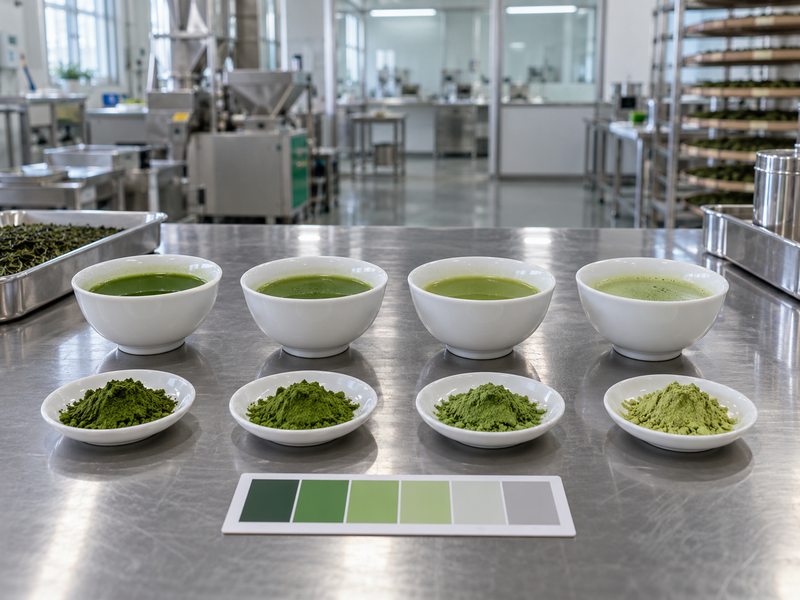
A supplier sends three vivid green matcha samples, and the purchasing team likes all of them. That does not tell a café chain which powder will work in milk or whether a second shipment will match the first. A useful matcha tasting controls dose, water, temperature, order, and the language used to describe each sample. It then checks the leading candidates in the finished application. The process can be simple enough to repeat and strict enough to support a buying decision.
Contents
- 1. What decision is the tasting meant to support?
- 2. How should samples be prepared fairly?
- 3. What should tasters record?
- 4. How do you make a useful reference sample?
- 5. Why must matcha be tested in the final application?
- 6. How many people need to taste?
- 7. Which documents should accompany the sensory test?
- 8. How should price enter the decision?
- 9. What happens when a new lot tastes different?
- 10. What should a final matcha tasting report contain?
1. What decision is the tasting meant to support?
Name the application first
A straight-water tasting can reveal aroma and bitterness clearly. It cannot by itself select a powder for a sweet iced latte, cookie, or packaged drink. Write the decision before opening sample bags: approve a supplier, compare two grades, check a new lot, or investigate a complaint. Specify the end product, target price, and sensory attributes that matter. A premium retail tin may need a gentle finish in water; a bakery may need flavor that survives heat.
Ask purchasing, product development, and quality to agree on a pass/fail line. Taste for the job. A sample that impresses one tea enthusiast may be too delicate for a milk drink or too costly per serving. The tasting should narrow candidates, not crown an abstract “best matcha.” Keep the source code and lot number hidden from panelists until they record observations. After the blind round, review supplier documents and commercial terms alongside sensory results.
| Tasting purpose | Primary test | Follow-up |
|---|---|---|
| Straight tea product | Water cup | Retail pack trial |
| Café latte | Water screen | Milk recipe |
| Bakery ingredient | Water screen | Pilot bake |
| Lot approval | Reference comparison | Release decision |
2. How should samples be prepared fairly?
Fix the variables
Use identical vessels, accurate scales, one water source, and a written dose and mixing procedure. Record water temperature at the point of preparation rather than trusting a kettle setting. Prepare samples within a short window so the first cup does not sit much longer than the last. A fixed cup volume and whisking time reduce avoidable differences. If a sample has a different recommended method, run that as a separate supplier demonstration rather than mixing it into the controlled comparison.
Code each sample with a neutral number. Randomize serving order when several panelists participate, because the first or strongest cup can influence later judgments. Rinse the palate with water and allow enough time for aftertaste notes. Weigh the powder. A visual scoop can vary enough to make one tea seem more intense or bitter for the wrong reason. Keep a duplicate of every sample in its original sealed packaging until the decision is complete.
3. What should tasters record?
Replace vague scores with descriptions
Color, aroma, umami, sweetness, bitterness, astringency, body, and finish can be useful categories, but words should describe what the panel actually senses. “Bright green with a mild seaweed note and short bitter finish” is actionable; “high quality” is not. Ask tasters to write their own notes before group discussion. Otherwise the most confident person in the room can set the vocabulary for everyone else. A short five-point scale may help comparison if each point has a defined anchor.
Separate defects from preferences. A buyer may dislike a strong vegetal note that another concept wants. A stale or foreign odor is a different concern. Keep uncertainty on the sheet. If a panelist cannot distinguish two cups, that is useful information; do not force a winner. Record whether appearance changes as the cup stands and whether sediment or foam differs. Photographs under fixed light support, but do not replace, sensory records.
| Attribute | Plain-language note | Why a buyer cares |
|---|---|---|
| Color | Hue and intensity | Visual product standard |
| Aroma | Tea, roasted, stale, other | Acceptance and defects |
| Taste | Sweet, umami, bitter, astringent | Formula fit |
| Finish | Duration and aftertaste | Repeat drinking |
| Texture | Smooth or gritty | Mouthfeel |
4. How do you make a useful reference sample?
Keep the approved lot identifiable
Once a candidate is approved, retain a sealed portion of the exact production lot in appropriate conditions. Label it with product code, lot, date received, and application. Also keep the preparation sheet and the finished-product reference. A dry powder color card is not enough if the buying decision depended on latte flavor or baked performance. Set a review date and replacement policy for the retained material so an old reference does not become the standard for freshness.
When a new lot arrives, prepare the reference and candidate side by side with the same method. Look for a meaningful difference, not a perfect clone of every leaf. Compare blind first. Panelists who know which cup is the new shipment may search for problems that are not apparent to customers. If a difference appears, test the product in the finished recipe and decide whether it remains within the agreed range. Record the decision and any corrective action with the supplier.
5. Why must matcha be tested in the final application?
Water is a screen, not the finish line
Milk, sugar, acid, fat, heat, and freezing can change the way matcha looks and tastes. A soft straight-water cup can vanish in a sweet latte. A more assertive tea can work well in ice cream but seem harsh on its own. Select the top two or three water-tasting candidates and run them in the intended formula at the same dose. Use the commercial milk, sweetener, or baking process whenever possible. A supplier's suggested use can inform the test but should not replace it.
Define acceptance by the product: tea visibility in milk, balanced bitterness in a cookie, or stable color in a chilled beverage. Test the second sip. Strong first impressions can fade as a drink warms or ice melts. For a baked product, taste after cooling and during the planned sales period. Include the cost per acceptable serving. A powder that performs at a lower dose may change the economics even if its kilogram price is higher.
| Application | Extra test | Hidden failure |
|---|---|---|
| Iced latte | After ice dilution | Tea disappears |
| Bakery | After cooling | Color browns |
| Frozen dessert | After storage | Aroma weakens |
| Acidic drink | Through service window | Color dulls |
6. How many people need to taste?
Use the smallest credible panel
A panel does not have to be large to improve a supplier decision. It should include people who understand the final product: development, quality, and someone responsible for serving or selling it. Train them on the scoring sheet with a reference sample. If a major purchase depends on a subtle distinction, consider more repetitions and formal sensory support. Do not treat a casual vote from a noisy meeting as a precise measurement.
Ask each person to note samples independently and then discuss disagreements. If one person detects a possible defect, investigate it rather than averaging it away. Repeat the close call. A second blind session on another day can show whether the first ranking was stable. Record dates, panelists, preparation details, and sample codes. The goal is a decision trail that can be revisited when a lot changes, not a ceremonial tasting event.
7. Which documents should accompany the sensory test?
Match the cup to the lot
Request an ingredient statement, product specification, lot-linked certificate of analysis, origin information appropriate to the claim, packaging specification, allergen statement where relevant, and change-notification terms. Match the sample code to these records. A beautiful anonymous powder cannot be approved for commercial supply. ISO's matcha technical report covers cultivation, manufacture, and sensory characteristics of matcha tea in trade and helps teams ask clearer identity questions.
Check which documents are required by the destination market and intended use. A café purchase may need different files from a retail packaged food ingredient. Do not lose the code. Samples can be relabeled in transit or during a tasting. Keep an intake log and photograph the original packaging before dividing the powder into blind containers. That small step prevents a supplier from receiving feedback for another supplier's sample.
8. How should price enter the decision?
Cost the accepted recipe
Wait until sensory and application tests identify acceptable candidates, then compare landed cost per serving or per finished unit. A lower powder price may require a larger dose to reach the same flavor. Include waste from open packs, minimum order, freight, packaging size, and lead time. If a powder is excellent but cannot be supplied consistently at commercial volume, its sample score is not enough.
Show the trade-off explicitly. A retailer may pay more for a delicate straight-drink profile; a chain latte may prioritize repeatability and cost at a strong but not premium dose. Keep quality and price visible together. Hiding prices from the first blind tasting reduces bias. Bringing them back for the buying decision makes the final choice commercially honest. Record why a candidate was rejected even if it scored well in water.
| Candidate | Sensory pass | Application pass | Landed cost | Supply pass |
|---|---|---|---|---|
| Sample A | Record result | Record result | Per serving | Record result |
| Sample B | Record result | Record result | Per serving | Record result |
| Reference | Current standard | Current standard | Baseline | Current terms |
9. What happens when a new lot tastes different?
Investigate before changing the recipe
Confirm the sample code, preparation method, water, dose, and storage conditions first. A different operator or stale reference can create a false alarm. If the difference remains, compare lot documents and speak with the supplier about raw material, processing, and packing changes. Test the new lot in the finished product to understand business impact. A minor difference in water may be invisible in milk; a small color shift may be unacceptable in an unsweetened drink.
Do not blend away a problem without recording it. Keep a decision log. Accept within tolerance, accept with a documented recipe change, hold for further analysis, or reject. Each path has a commercial consequence. If a recipe changes, product development and labeling teams may need to review the finished product. Establish how quickly the supplier must notify you of changes before the next order arrives.
10. What should a final matcha tasting report contain?
Make it possible to repeat
Include the purpose, application, sample codes, supplier and lot identifiers, preparation method, panel notes, photographs under controlled light, finished-product results, cost comparison, and decision. A one-page summary can sit above the raw sheets. Note what was not tested; a water tasting cannot establish shelf life, safety, or performance in every formula. Sign off with clear owners for purchasing, quality, and product development.
Set requalification triggers: new powder lot, supplier substitution, processing change, new application, or a complaint about flavor or appearance. Leave a usable reference. Retained powder and a written recipe help the next team decide whether the new shipment is comparable to the approved one. A tasting is valuable when it leads to a controlled purchase and a repeatable product, not merely a favorite cup.
Keep the tasting blind until scores are locked
Code the cups and collect written notes before revealing supplier names or prices. Then compare sensory results with documentation, application performance, and cost. This order reduces the temptation to describe a favored supplier's sample as better than it tasted. Keep the coded sample map and the approved reference for the next lot review.
| Blind code | Water result | Application result |
|---|---|---|
| Sample A | Sensory notes | Finished-product notes |
| Sample B | Sensory notes | Finished-product notes |
| Control | Reference target | Known performance |
FAQ
Q1. Is a matcha tasting useful for a bakery buyer?
Yes, as an initial screen. The final choice should also be baked in the intended product because heat, fat, and sugar change performance.
Q2. Should panelists know supplier names?
Blind codes reduce brand and price bias during the first sensory round. Supplier information belongs in the later document and commercial review.
Q3. Does a greener powder always taste better?
No. Color is one attribute. Evaluate aroma, taste, finish, texture, and performance in the intended recipe.
Q4. How often should a supplier lot be retested?
Set a policy based on product risk, variability, and customer requirements. At minimum, check lot identity and relevant release documents for every shipment and compare sensory performance when the approved standard could be affected.
Q5. Can an old retained sample remain the reference forever?
No. Retained material can change during storage. Label it, store it appropriately, review it on a schedule, and replace it under a documented policy.