
A Muscat café can find plenty of attractive matcha photos online. The practical challenge is getting the same powder into a crowded morning shift, in a size the bar can finish while fresh, at a cost the menu can carry. Results for matcha supplier oman include shops, distributors, and overseas brands. Before choosing one, a buyer should know who will deliver the product, how the lot will be identified, and whether its cup performance survives ordinary service.
One article in the first ten organic results was Wholesale Matcha Supply in Oman: A Guide for Café Owners. It explains why cafés consider bulk supply; the more useful next step is a written trial that tests a real recipe and a real delivery route. These ten questions are designed for a café buyer or small distributor in Oman. Any import or label detail should be checked by the local importer against current official guidance for the actual product.
1. What is the café actually buying matcha to make?
Begin with the menu item and its service constraints
Write a short product brief before collecting quotes. Name the main drink, cup size, whether it is hot or iced, water and milk quantities, sweetness, target dose, and expected cups per week. A café serving mostly iced lattes may care about dispersion and colour through milk. A tea bar serving straight matcha may give more weight to aroma and finish. A bakery using powder in cake should run a separate trial. One vague request for “premium matcha” invites samples that cannot be compared fairly.
Include the tools staff already have. If every cup would require a slow ceremonial whisking demonstration, the method may fail during a queue even if a training video looks beautiful. Ask the bar lead how much preparation time the menu can bear. The brief should also state whether pure tea is required or whether a sweetened mix is acceptable. Those are different ingredients with different serving costs and claims. The buyer’s first job is to decide which product the business is even willing to sell.
| Menu use | Most revealing trial | Record |
|---|---|---|
| Iced latte | Normal milk and ice | Clumps and colour |
| Hot latte | Usual steam process | Balance and speed |
| Straight tea | Fixed water and dose | Aroma and finish |
| Bakery item | Actual production recipe | Flavour after processing |
2. Should a small Oman buyer use local stock or import directly?
Compare route, minimum order, and responsibility
A local distributor can be attractive when the café needs a modest quantity quickly and wants one delivered price. Direct importing can be attractive when demand is stable, the café has a qualified importer, and the chosen overseas product is worth the extra coordination. Ask both sellers for the same details: net pack weight, exact product code, lot traceability, lead time, and where the quoted delivery ends. If a distributor cannot identify the powder behind its label, the convenience may not be enough to protect a signature menu item.
For an overseas quote, name the importer of record and the person who will review documents before the order. Ask who pays freight, local charges, inspection or testing, and last-mile delivery. A seller’s “shipping included” line can cover different things depending on the route. A café opening a new drink should probably value a quick corrective response more than a small saving on its first few kilograms. Use a pilot order to learn which model works under real conditions.
3. How can the team tell whether a sample suits its drink?
Run blind, repeatable cups in the normal bar
Ask for two or three coded samples with a product specification and lot code. Prepare each in the same cup, with the same dose, water temperature, milk, and sweetener. Taste the plain tea and the actual menu drink. Record what staff notice without supplier names or prices attached. Watch the drink after the normal handoff time; some powders settle or lose visual appeal in a way a fresh photograph will not show. Repeat on a second day to avoid choosing a winner because of one unusual shift.
Once the team has a favourite, adjust the dose within a sensible range and calculate the cost of the accepted recipe. Invite a second barista to make the drink without coaching. If the result changes sharply, write a clearer preparation method before approving a bulk order. Keep the winning sample sealed alongside the record. Ask whether the commercial powder will come from the same grade and processing specification. A tasting result that cannot be linked to a purchase order is too fragile for an ongoing café menu.
| Sample check | Same for every powder | Useful result |
|---|---|---|
| Blind cup | Recipe and tools | Clear sensory notes |
| Queue test | Normal service staffing | Preparation time |
| Held cup | Pickup delay | Settling and colour |
| Second barista | Written method | Repeatability |
4. What exactly is inside the supplier’s pouch?
Check origin, recipe, and the lot code separately
Ask where the leaves were grown, where they were milled, and where the final pack was filled. A product may move through several countries without changing the origin of the tea; the distinction matters when a café tells customers where its matcha comes from. Request a full ingredient list. Pure matcha and a latte mix containing sugar or flavour should not be compared by the same dose or nutritional assumptions. If a supplier claims a special grade, ask for its measurable specification and a sample of that exact item.
Find out how pouches and cartons are coded. The code should let the seller identify a batch, relevant test record, and the recipient if there is a quality issue. A business buying from an Oman distributor may be one step removed from the processor; ask how that distributor preserves the lot link. Written origin and product details are useful only when they survive repacking and repeat orders. Record changes in blend, source, or pack before accepting a new lot as equivalent.
5. Which pouch size protects quality at the bar?
Match opened stock to real turnover
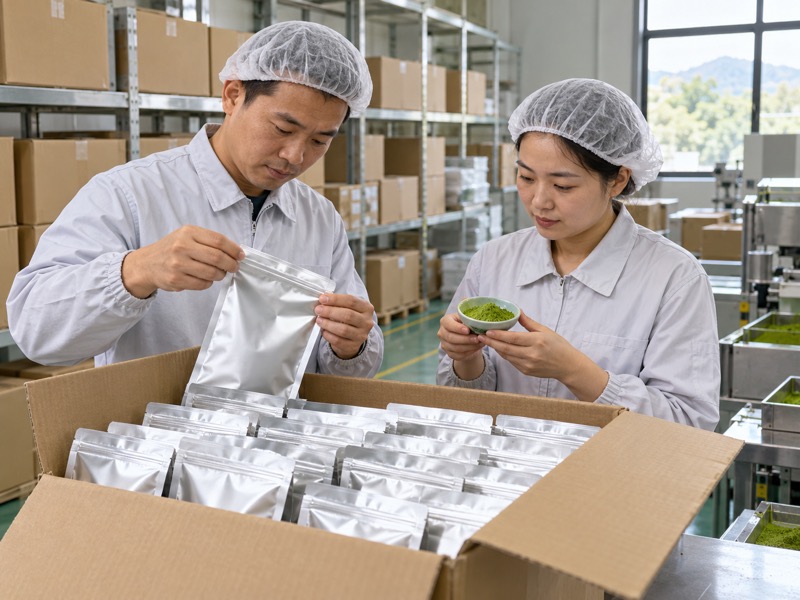
Ask for a filled example of the proposed commercial pack. Check the seal, light and moisture protection, ease of closing after opening, and the supplier’s storage advice. A café using one kilogram over many weeks may expose a large open bag repeatedly. Several smaller sealed pouches can cost more upfront but keep unopened stock protected. Do not make this choice from packaging cost alone. Run a short in-store trial and compare the first and last cups from an opened pouch using the same recipe.
Think about receiving too. Are the pouches packed so they will not be crushed or punctured? Does the outer carton identify the product and lot clearly? Can staff find storage space away from heat and direct light according to the product guidance? A beautiful retail tin may not be the right working pack for a busy café. The best format is one that staff can use cleanly, count quickly, and finish while it still makes the approved drink.
6. Which documents and label details should be checked before shipping?
Let the named Oman importer review the actual product
Ask for a current product specification, ingredient statement, pack proof, lot-linked quality record where applicable, and drafts of the invoice and packing list. The local importer should confirm current Oman requirements for the exact food category, pack, claims, and delivery route with official guidance and its broker. Avoid copying a regulatory claim from a seller’s marketing page into a purchase order. What worked for another pack or buyer may not fit this one.
If the supplier offers an organic, halal, or origin claim, ask for the actual supporting record and its scope. A logo alone does not tell the café whether the document covers the product, facility, period, and market involved. The importer should also review any local-language information it needs on the final pack. Confirm the product name, ingredients, net weight, dates, and lot on the pouch, carton, invoice, and tests match one another. Solve discrepancies while the order is still at the supplier.
| Before dispatch | Who reviews | What must agree |
|---|---|---|
| Product specification | Buyer and quality lead | Approved sample |
| Pack and label proof | Local importer | Actual sales channel |
| Lot record | Quality lead | Pouch and carton codes |
| Commercial documents | Importer and exporter | Product and quantity |
7. What is the real cost of the matcha menu cup?
Calculate on accepted servings, not just kilos
Put all offers on one sheet showing net kilograms, currency, pack size, minimum order, lead time, delivery point, and included charges. The importer or local distributor should provide current route-specific costs. Add any testing, storage, and local delivery charges. Then divide by the number of drinks the team can actually make at the accepted dose. If a cheaper powder needs more grams or causes more remakes, its apparent discount can disappear.
Keep milk, cup, labour, and other drink costs visible as separate lines rather than hiding them inside the powder comparison. Run a slow-week scenario as well as the forecast. If the MOQ locks cash into stock the bar cannot use while fresh, include that risk. A small venue may be better served by a dependable local supply at a higher kilogram price. The goal is a consistent finished drink at a cost the menu can sustain.
8. When should an Oman café reorder?
Use measured consumption and an observed route time
Start with drinks sold multiplied by the tested grams per cup, then add actual training and remake waste. Record how many days each order takes from approval to usable stock at the café. For direct imports, separate supplier preparation, transport, entry, and final delivery. For a distributor, record the time from placing an order to receipt, including weekends or stockouts. A single promise of “fast shipping” is not enough to set a stock trigger.
Set a minimum stock quantity in sealed pouches that covers the measured replenishment period plus a sensible buffer. Revisit it when the menu, outlet count, or supplier route changes. Ordering earlier does not mean ordering more: smaller planned shipments can protect freshness when the seller supports them. If the café has seasonal events or promotions, share the forecast with the supplier before demand spikes rather than expecting the next shipment to arrive overnight.
| Planning number | Where it comes from | Use |
|---|---|---|
| Grams per cup | Approved recipe | Demand estimate |
| Cups per week | Point-of-sale data | Order rhythm |
| Waste | Bar record | Safety allowance |
| Days to usable stock | Past receipts | Reorder trigger |
9. What should the receiving team check on arrival?
Protect the approved lot before it reaches the bar
Compare the arriving carton count and pouch sizes with the purchase order. Inspect seals, damage, visible moisture, date coding, and lot numbers. Keep any damaged units separate and tell the seller promptly with photographs and the affected code. Store sound stock according to the supplier’s written guidance. A new bag should not be opened on the bar until its identity and condition have been checked, especially if an older approved lot is still in use.
Prepare the approved cup from the new lot and compare it with the saved reference. If flavour, dose, or colour has shifted, document it before adjusting the menu recipe. Ask the supplier whether there was a planned change in origin, blend, or process. A one-off difference may be solvable; an unexplained pattern is a supplier risk. This receipt check creates a useful history of real-world consistency instead of relying on a sales sample from months earlier.
10. What happens if the supplier cannot deliver the next lot?
Qualify a backup before the menu depends on one route
Keep a second candidate’s sample and its tested recipe on file. The backup may be a local distributor if the main source is overseas, or another producer with a similar cup profile. It does not have to be identical, but staff should know the dose and preparation adjustments needed before it appears on the menu. A sudden substitute bought under pressure is likely to be judged only by availability, with no chance to test taste or cost properly.
Review the main supplier after each of the first few orders: product identity, lot quality, pack condition, delivery time, document fit, and how problems were handled. Give the supplier clear feedback and a reasonable chance to correct a fixable issue. If repeated failures threaten service, use the qualified alternative and update the menu or purchasing plan openly. Reliability is something the business observes over several orders; it cannot be inferred from one promising brochure.
| Failure signal | Immediate response | Longer fix |
|---|---|---|
| Late shipment | Check remaining stock | Rework reorder point |
| Damaged seals | Hold affected pouches | Improve pack and route |
| Cup drift | Retest against reference | Agree lot tolerance |
| Missing papers | Pause dispatch or receipt | Assign document owner |
Frequently asked questions
Q1: Can a small Muscat café buy matcha wholesale?
Yes, if the order size, pack, delivery method, and actual use rate fit. A local distributor may offer the more practical first route.
Q2: Should I buy the cheapest 1 kg bag?
Test the cup first. Dose, remakes, transport, and time after opening determine the cost of usable drinks.
Q3: Does a sample guarantee the next lot?
No. Keep the approved sample and product code, then check the first commercial lot against them.
Q4: Who confirms current Oman import and label rules?
The named local importer should confirm requirements for the exact product and route using current official advice and its broker.
Q5: What is a sensible backup plan?
Qualify a second powder in the actual menu drink before supply is interrupted, and keep its recipe and cost on file.