
Matcha sourcing is the work of finding a tea powder that meets a product’s taste, appearance, safety, volume, and cost needs across repeated orders. A buyer may be tempted to choose the greenest sample or the lowest kilogram price, then learn that the powder fails in a latte or cannot be supplied during a launch. This guide lays out a sourcing process for brands, cafés, and manufacturers: write the application brief, build a short supplier list, run controlled samples, examine supply risk, and agree a reference standard. Matcha Village is one possible manufacturing partner; the method is meant to help buyers compare any candidate on evidence rather than on country stereotypes or grade labels.
1. What should a matcha sourcing brief decide first?
Name the product the buyer intends to sell. Matcha for a whisked drink, an oat latte, a baked cookie, and a canned beverage can require different tea flavor, particle behavior, and color. State the target market, expected volume, pack format, intended recipe, and acceptable price per sellable unit. Include a sensory reference if one exists. A brief that asks for “premium matcha at a competitive price” gives suppliers no reliable way to choose a sample.
Separate required conditions from preferences. Food-safety documents needed for an import market may be mandatory; a particular shade of green may be a target to test; an origin preference may reflect brand positioning. Write the reason for each. If the brand wants a Japanese-origin claim, traceable Japanese sourcing is part of the product definition. If the business mainly needs a bakery ingredient, samples from more than one origin may be worth testing. Clear priorities prevent the sourcing team from rejecting an otherwise useful supplier for an unexamined assumption.
| Brief field | Example decision | Who should approve? |
|---|---|---|
| Application | Hot latte or baked product | Product development |
| Market documents | Required tests and labels | Quality and regulatory |
| Commercial target | Forecast and cost per unit | Procurement and finance |
2. How should origin influence supplier selection?
Origin can shape story, price, supply route, and documented claims, but it should not stand in for a product trial. A buyer should ask where tea was grown, processed, milled, and packed; those steps may occur in different places. Compare candidate powders in the same recipe and score the result blind. A Chinese-origin matcha and a Japanese-origin matcha can be evaluated fairly for a beverage application while their origin claims remain stated accurately. The brand may still choose a particular origin for positioning, but that is a separate decision from sensory fit.
Ask for traceable records when origin appears on a retail pack or menu. Do not infer origin from a Japanese-sounding product name or a landscape photograph. Consider logistics: transit time, freight mode, minimum order, and backup supply can change the true cost of an origin choice. A sourcing brief should state whether the origin is fixed, preferred, or open. That single line saves time and prevents suppliers from offering material the brand could never label as planned.
3. How can buyers build a useful supplier shortlist?
Begin with companies that can identify their product, manufacturing role, commercial contact, and actual route to supply. Ask whether each is a grower, miller, blender, exporter, importer, distributor, or some combination. A distributor can be valuable for local stock and smaller orders; a manufacturer may offer tighter customization. The buyer needs to know who controls quality decisions and whom to contact if a lot fails. Verify that the candidate can serve the destination market and forecast volume.
Use a short request for information before a full tender. Ask for product catalog, sample policy, specification, packaging options, current certifications relevant to the planned claim, capacity range, lead time, and reference markets. Do not ask every candidate for a complex custom quote before it has passed basic fit. Keep a written reason when excluding a supplier. A sourcing team that can explain its shortlist is less likely to restart from scratch when a salesperson changes or a current supplier misses a delivery.
| Supplier route | Possible advantage | Question to resolve |
|---|---|---|
| Manufacturer | Custom grade or blend discussion | Minimum run and export support |
| Importer | Local stock and entry handling | Lot traceability to producer |
| Distributor | Smaller, frequent deliveries | Change notice and stock depth |
4. What should a matcha sample scorecard include?
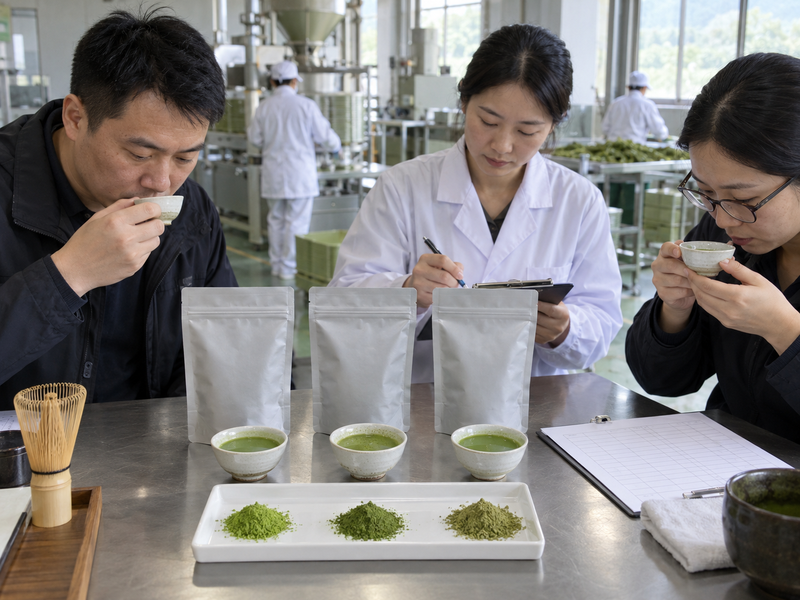
Use the same preparation method for all samples: weighed powder, defined water or milk, fixed temperature, same cup, and the same tasting time. Score color, aroma, tea intensity, bitterness, mouthfeel, and visible settling. Add the attributes that matter to the product, such as foam for a whisked drink or color after baking. Blind the samples when practical. Keep one approved reference sample so later production lots have a fair comparison point.
Write observations, not only numbers. “Grass aroma with a dry finish after five minutes” is more useful to a supplier than a score of seven. Photograph samples under the same light and label files by sample code, not by supplier name during blind review. Include more than one evaluator from product development and operations. A sourcing choice made by one person on a quiet morning may fail when staff prepare the powder in a different store or machine. The scorecard should travel with the product brief.
5. Why should the finished application decide the grade?
Grade names are vendor language rather than a universal performance standard. A delicate tea may be excellent in water but disappear behind milk and syrup; a stronger powder may perform well in a cookie while tasting rough as a plain whisked cup. Test the intended formula first, then ask which supplier option meets the target at a sensible dose. Keep ingredients, equipment, and preparation order constant while comparing teas. If the team changes the recipe for one sample, document the change and cost it.
Run a small production-style trial after the bench tasting. Look for clumps, sediment, color shifts, labor time, and finished-product consistency. For a packaged beverage or dessert, include the planned hold and shelf-life work. A promising sample is not automatically a launch-ready ingredient. Agree an acceptance range and retain the successful lot. The supplier should quote the exact product code used in the trial; a similarly named grade can be a different material.
| Application | Highest-value test | Common blind spot |
|---|---|---|
| Whisked drink | Water cup at service time | Judging powder color only |
| Milk latte | Final sweetened recipe | Tea disappearing behind base |
| Bakery | Finished item after cooling | Raw batter appearance |
6. How should supply capacity be checked?
Ask what the supplier can produce or allocate at the planned grade and pack size, how lead time changes with volume, and what happens during peak demand. Request a sample of the order process: forecast, purchase order, production confirmation, quality release, and shipment notice. A stated annual capacity is less useful than a realistic lead time for the exact product code. If the buyer expects growth, discuss a ramp plan with pilot, normal, and high-volume scenarios.
Check whether the supplier can repeat the sensory target across lots. Ask how reference samples are used and how changes in raw tea, milling, or packing are communicated. A business may start with a small order and later require pallets; the packaging and lot program should scale with it. Do not treat factory size alone as proof of consistent delivery. Keep performance records from actual orders: on-time rate, document completeness, lot deviations, and response time to complaints.
7. What supply risks should a buyer map?
Map risks that could interrupt the product or alter its customer promise: one origin, one mill, long freight route, seasonal raw material, certification dependency, custom printed pack, or a grade with no approved alternative. Rate each by likelihood and business impact using the buyer’s own experience. Then assign a practical control. A second approved supplier may help with continuity, but only if its matcha has passed the same application and document gates.
A backup cannot be approved from price alone. Keep a small reference stock or a documented switch procedure where the business model requires resilience. If two suppliers use different grades, the recipe may need separate approved doses. Track which lot went to which customer or product batch. Ask the primary supplier how it handles a quality hold and whether it can replace affected material in time. Risk planning should be concrete enough to guide a buyer during a missed shipment, not a list of generic worries.
| Risk | Early signal | Control |
|---|---|---|
| Single-source grade | Lead time lengthens | Qualified alternate sample |
| Custom pack | Printer delay | Approved plain-pack fallback |
| Lot drift | Reference-cup change | Hold and supplier review |
8. How should sourcing economics be compared?
Compare landed cost per usable kilogram and cost per sellable serving or finished unit. Include dose, freight, import charges, pack size, labor, waste, inventory, and returns where relevant. A low supplier price can lose once a higher dose or greater reject rate is included. Keep the sensory acceptance standard alongside the cost sheet. If a cheaper tea fails the product brief, it is not a valid financial alternative.
Model a pilot quantity and the likely steady-state order separately. Small trial shipments may use expensive freight, while volume discounts can tie up cash. Check whether the business can use the minimum order within the validated quality period. If a distributor charges more per kilogram but offers local weekly delivery, the lower inventory risk may matter. Use current quotes rather than a general market price claim. Sourcing is a portfolio decision: quality, supply continuity, and economics need to fit the same product.
9. What should an agreement lock down?
Record the approved product code, specification, reference sample, packaging version, lot documents, testing responsibilities, minimum order quantity, lead time, delivery term, price review method, and change-notice process. If a private-label product is involved, add artwork approval and ownership of custom materials. Define what happens when a delivered lot differs from the reference or arrives damaged. A brief email saying “same quality as sample” is too vague for a growing business.
Agree a communication rhythm for forecasts and deviations. The supplier needs time to plan raw material and packaging; the buyer needs notice before a process change affects its product. Keep an escalation contact for urgent quality questions. The contract cannot prevent every variation, but it can make evidence and decisions faster. A sourcing program works when routine orders do not require the founder or head baker to repeat the entire sample search each time.
| Agreement item | Why it matters | Review trigger |
|---|---|---|
| Reference sample | Anchors sensory target | Lot drift |
| Pack specification | Controls handling and quality | Material change |
| Forecast and lead time | Supports stock planning | Demand shift |
10. When should matcha sourcing be reviewed?
Review performance after the pilot, after several regular orders, and whenever the product, route, market, or supplier process changes. Update the sample scorecard with actual customer and operator feedback. Compare forecast with consumption, rejected lots, complaint rate, delivery time, and landed cost. A supplier that won the initial tasting may still need a new pack or better document turnaround. Give specific feedback and a clear correction deadline before assuming a full supplier change is required.
Matcha Village offers matcha grades, blends, and OEM formats through its website. Buyers can use the same application brief and scorecard when requesting its samples. Matcha sourcing should end with an approved product and a repeatable reorder process, not just a promising first cup. Keep the records current so a buyer can explain why the tea was chosen and when that choice should be reconsidered.
Frequently asked questions
Q1: Should a business choose matcha by origin alone? No. State any origin requirement, then test quality and verify the claim separately.
Q2: How many supplier samples should be compared? Compare enough relevant candidates to see trade-offs, using one controlled method.
Q3: Is ceremonial grade required for a latte? Grade labels vary; the finished latte and cost per serving decide fit.
Q4: When is a backup supplier useful? When continuity risk justifies the work of approving an alternate product and recipe.
Q5: What should be kept after approval? Specification, reference sample, scorecard, lot records, and agreed change controls.
Keep matcha sourcing tied to a brief suppliers can answer and a product customers will buy. The next order can then follow evidence rather than a memory of one good sample.