
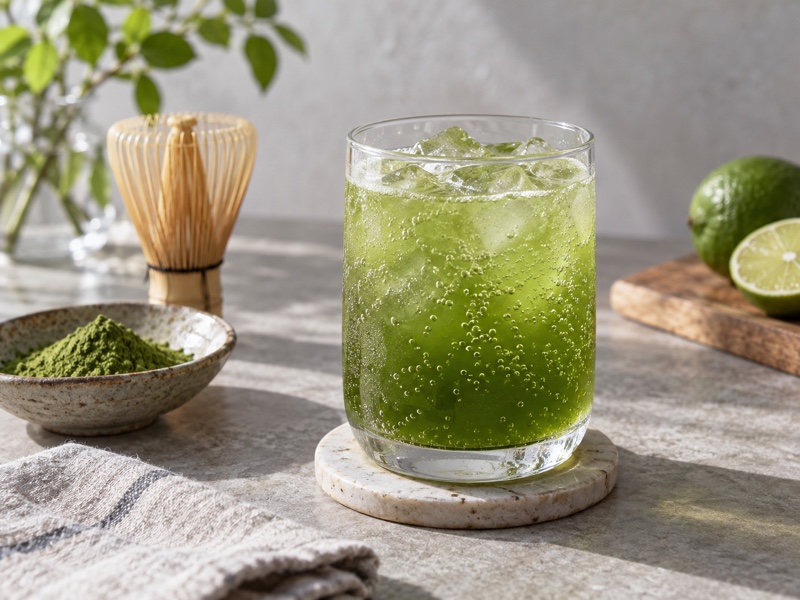
Matcha soda is a carbonated drink built around suspended green tea powder. Its simple ingredient list hides a difficult production question: how long can tea particles remain appealing in a fizzy, often acidic drink? A café can make it to order, while a bottled product needs a separate process and shelf-life study. The home-style matcha soda example from Dash of Jazz establishes the flavor concept. The checks below help beverage buyers compare tea, mixing, carbonation, cost, and package performance without treating a home recipe as a commercial specification.
1. What product is the team actually developing?
Decide whether the proposal is a freshly poured café soda, a syrup plus sparkling-water system, a fountain beverage, or a sealed ready-to-drink product. All four can be called matcha soda, but each demands different controls. A café glass can be stirred before serving. A sealed bottle has to endure filling, shipment, display, and opening. A fountain version may use a concentrated base whose powder settles in a line or bag. Write a one-sentence product definition with serving size, channel, sweetness position, and intended appearance before buying ingredients.
Specify appearance honestly
Matcha particles make perfect optical clarity unlikely. A naturally cloudy green drink can be appealing if its cloudiness is uniform and its last sip is not gritty. Define an acceptable visual band by photographing a fresh sample and the same sample after a normal wait. If the team wants a crystal-clear green liquid, matcha powder may be the wrong ingredient format. Do not quietly replace it with green dye while retaining the same ingredient story. Product format and naming should match what customers actually receive.
| Format | Main advantage | Main technical question |
|---|---|---|
| Made-to-order glass | Fresh tea impression | Service repeatability |
| Concentrate plus soda | Faster service | Settling in held base |
| Fountain | Chain throughput | Line behavior and ratio |
| Sealed can or bottle | Wider distribution | Shelf life and package stability |
2. Which matcha grade belongs in a carbonated matrix?
Sample tea in the finished carbonated system rather than in hot water alone. Acidity, sweetness, and bubbles change the perception of bitterness and astringency. A bright color in dry powder does not guarantee a pleasant cold beverage. Ask suppliers for the actual ingredient specification and a representative sample of the grade proposed for purchase. Evaluate its aroma on opening, dispersion, color after mixing, and sediment after standing. Repeat with a second lot before locking a large order if continuity matters for a chain or brand.
Run a blind comparison
Label three candidate powders with codes. Keep dose, water, sweetener, acid, ice, and carbonation source identical. Have tasters assess the first sip and the settled last sip; record graininess separately from flavor. A grade that wins a hot-water tasting may lose when the soda’s acidity sharpens its edge. Matcha Village’s pure matcha range provides a relevant starting point for a grade discussion. Approval should depend on the exact lot and beverage trial, not a broad grade name or product photograph.
3. How should a base concentrate be mixed?
Matcha is a suspension. Whisking spreads particles through water, but it does not dissolve them. For a fresh drink, make a measured concentrate with potable water, use a mixer that reaches the whole vessel, and add carbonation only after the tea base is smooth. A dry powder dumped into soda can form floating islands and release carbon dioxide violently. For a prebatched base, record shear method, batch size, hold conditions, and the amount of sediment that forms before service.
Compare handling methods
Run a fresh-whisked sample and a held-base sample at the same finished recipe. Gently invert or stir the held base according to a written method, then compare the first and last portions dispensed from its container. If the first portion is weak and the last is dense, the holding system needs redesign. A stabilizer might change the texture or label and should be evaluated as an actual formulation decision, not as a reflex. For packaged drinks, mixing and homogenization choices belong in a formal pilot plant trial.
| Method | What to test | Release decision |
|---|---|---|
| Hand whisk | Clumps and labor | Works in a busy shift |
| Small rotor mixer | Foam and heat | Smooth without flavor damage |
| Prebatched concentrate | First-to-last dose | Uniform after intended hold |
| Powder added to soda | Foaming and specks | Usually a poor control benchmark |
4. What sweetness and acid balance makes tea readable?
Carbonation adds a sharp sensory edge even without fruit acid. Start by testing matcha in plain sparkling water, then add sweetener and acid in separate steps. This shows what each ingredient does. If the drink tastes thin, more sugar may add body, but it may also hide the tea. If it tastes dull, a measured acid adjustment may brighten it, but excessive acidity can make vegetal notes seem metallic or bitter. Avoid changing tea dose and acid in the same round because the reason for any improvement becomes unclear.
Use a simple triangle tasting
Prepare three coded versions around the current preferred sweetness. Ask tasters which differs and which they would buy again. Record the recipe by weight, not a label such as “lightly sweet.” For a commercial package, measure pH and soluble solids with appropriate equipment and validate the finished formula through your food-safety process. These measurements help control batches; they do not independently prove a drink safe or shelf-stable. A café test can use taste as an early screen but must still handle ingredients under local rules.
5. How much carbonation survives the build?
The most visually lively prototype may go flat before the customer receives it. Chill soda water and the cup before assembly where practical. Add a tea base gently and minimize transfer steps. Compare a direct pour, a stir, and a shaken preparation using identical volumes and timing. Shaking a carbonated drink in a closed vessel is unsafe and can create an uncontrolled release, so the trial should mix the noncarbonated base first. Observe the cup immediately, after a normal queue delay, and once ice has begun to melt.
Separate cup and package testing
A retail can or bottle introduces pressure, fill, seal, and distribution questions that a café glass cannot answer. Use a competent co-packer or beverage laboratory for pilot filling, carbonation measurement, and container compatibility. Establish the beverage’s microbiological and sensory shelf life with a process authority appropriate to its formulation and market. Do not infer room-temperature stability from low pH alone. For café service, a shorter quality window may be acceptable if the drink is made only after an order arrives.
| Carbonation check | Café trial | Packaged trial |
|---|---|---|
| Initial fizz | Visual and tasting panel | Dissolved CO₂ measurement |
| After waiting | Timed tasting | Accelerated and real-time studies |
| Foam during fill | Cup headspace | Filler and seam or closure trial |
| On opening | Customer experience | Pressure and package assessment |
6. What does sediment tell the development team?
Some settling is inherent to ground tea. Decide whether a gentle swirl restores an attractive suspension or whether a compact sludge layer forms. Use transparent test vessels and inspect the base at fixed intervals. Photograph the side and bottom against a white background. Pour off the upper liquid and taste it, then taste the remaining portion. If tea flavor changes dramatically between them, the beverage needs better particle management or a different format. A green ring around the inside of a can or bottle may also damage perceived quality even if taste is acceptable.
Sediment depends on powder properties, concentrate method, liquid viscosity, and time. Change one factor per trial. A finer powder might stay dispersed longer but could also produce a more persistent cloudy look. A stronger syrup can slow settling yet make the beverage too sweet. A printed “shake gently” instruction must itself be tested with the actual package; customers will not follow a complicated ritual to drink a soda. If sediment remains unacceptable, sell the concept as a made-to-order beverage while continuing packaged-product development.
7. How should color be judged over time?
Judge color under the lighting customers see: the café counter, a refrigerated retail shelf, and a glass after pouring. Take photos with a reference card and fixed exposure instead of relying on memory. Matcha’s green appearance may shift during holding as particles settle or the beverage changes chemically. A sealed product also needs testing under its intended light, temperature, and oxygen exposure. A single bright pilot can is not enough evidence for a sell-by date.
Keep a realistic acceptance window
Define a fresh reference and a maximum acceptable drift at the intended end of quality life. Use trained sensory review and instrument readings if available. Record package type, fill date, storage condition, and tea lot with every sample. Reject any version that gains off aroma even if its green color remains attractive. If a natural color claim or a specific ingredient statement is planned, have the target-market label reviewed before packaging is printed. The FDA’s overview of food label claims is a US reference, not a substitute for destination-market review.
8. What must a bottled or canned product validate?
A packaged matcha soda requires more than a recipe and a carbonation setting. Formulation, process, container, seal, storage conditions, and shelf-life target work together. A co-packer should assess whether the powder clogs valves or creates uneven fill. Quality staff should check batch uniformity from start to finish. The team must identify applicable rules for acidified beverages, preservatives if used, and package labeling in each market. Do not borrow a shelf-life number from another drink with different ingredients and packaging.
Build a pilot release file
Retain formulation version, lot codes, process record, finished-product tests, and sensory observations. Test samples from early and late in a fill run. Include transport stress because vibration can redistribute sediment and cause visible rings. If the product is meant for warm distribution, test that condition; refrigerated-only data cannot validate it. A qualified food-safety specialist should sign off the process before sale. Early development can compare flavor and appearance, but commercial release needs validated safety and stability evidence.
| Pilot question | Evidence needed | Responsible team |
|---|---|---|
| Uniform fill? | Start/middle/end samples | Production and QA |
| Safe process? | Validated controls | Food safety lead |
| Package sound? | Closure and pressure checks | Co-packer |
| Stable quality? | Real-time shelf-life data | R&D and sensory |
9. What does each serving really cost?
Calculate tea, sweetener, acid or fruit, sparkling water, cup or package, labor, and expected loss. For a café, record how many cups staff remake because of foaming or clumps. For a packaged drink, include filling loss, test samples, freight, and stock kept beyond the quality window. Divide by saleable units rather than theoretical formula yield. A premium tea may still be worthwhile if it works at a lower dose, but verify that claim in tasting before entering it in a margin sheet.
Compare the drink against the menu slot it would occupy. If it replaces a simple lemonade, added preparation time and tea cost need a price customers accept. If it enters a retail shelf, distributors may require a different margin structure and case configuration. Ingredient cost alone cannot determine viability. Document the assumptions so procurement can rerun the calculation when tea or packaging quotes change.
| Cost input | Café evidence | Packaged evidence |
|---|---|---|
| Tea | Weighed powder per cup | Powder per saleable fill |
| Carbonation | Soda-water usage and loss | Fill loss and gas cost |
| Container | Cup, lid, straw | Can, label, case |
| Rework | Flat or clumped cups | Rejected units and returns |
10. Which decisions should be fixed before launch?
For café service, lock tea lot or approved alternatives, concentrate preparation, liquid weights, carbonation source, ice, cup, pour order, and maximum service delay. Teach staff to recognize a clumped or flat drink and remake it. For a packaged version, lock the validated formula and process with the co-packer; use change control for ingredients, can liners, closures, and fill conditions. A new powder lot can alter settling even when the ingredient name stays the same.
The launch should also answer how the customer is expected to drink it. If a gentle swirl is needed, show that on the package or service card and confirm it works. If the drink must stay cold, state the storage requirement clearly. Give buyers a sample that has experienced the intended storage and transport rather than only a freshly mixed bench glass. The right decision may be to launch the fresh format first and keep the shelf-stable format in development.
FAQ
Q1: Does matcha dissolve in soda? No. It remains suspended, so mixing and settling tests are part of product development.
Q2: Can a café use its latte matcha? Yes, if the powder tastes clean in a carbonated, possibly acidic matrix and its cost and sediment are acceptable.
Q3: Does a low pH guarantee a safe bottled drink? No. A qualified process review must consider formula, process, package, and distribution conditions.
Q4: Is a cloudy soda defective? Not necessarily. Uniform cloudiness can be the intended look; hard sediment, graininess, or uneven dosing are different issues.
Q5: What should a supplier sample include? Ask for the proposed grade, lot identification, specification, and enough powder for repeated finished-drink trials.
Make the fresh drink and the packaged drink separate development decisions. For either one, approve the tea only after it passes a timed taste and sediment test in the real formula. A written specification for mixing, carbonation, and appearance will do more for repeat purchase than a vivid first-day photograph.