
Japan’s matcha production regions give buyers useful places to search, but a prefecture name cannot predict the taste, price or availability of an offered lot. The query “matcha production regions Japan” is a starting point, not a purchasing specification. The Japanese Ministry of Agriculture identifies Kagoshima, Kyoto and Shizuoka among major tencha areas; Nishio City documents its own Aichi tea industry. Build a regional shortlist around your product’s sensory target and origin claim, then compare coded powders and their supplier records. The selection belongs to a SKU, not to a map. Use the matcha supplier Japan guide alongside a region-specific supplier comparison.
Contents
- 1. What should a regional shortlist help decide?
- 2. Which origin definition will the buyer use?
- 3. How should Kyoto or Uji candidates be assessed?
- 4. What should buyers ask about Nishio in Aichi?
- 5. How should Shizuoka and Kagoshima offers be compared?
- 6. Should other tea regions enter the search?
- 7. Which sensory trial distinguishes the candidates?
- 8. What evidence supports each regional claim?
- 9. Can the selected region support repeat supply?
- 10. How should the buyer choose a region?
1. What should a regional shortlist help decide?
Begin with the product brief
Choose a region only after stating what the powder must do. A straight-tea brand may need an aroma and mouthfeel that stay recognizable with minimal formulation. A café chain may need a grade that disperses consistently in milk at its service speed. A dessert manufacturer may care about color and flavor after processing. These are product questions. Regional names can help buyers find suppliers, yet the same region can produce multiple grades and blends for different uses.
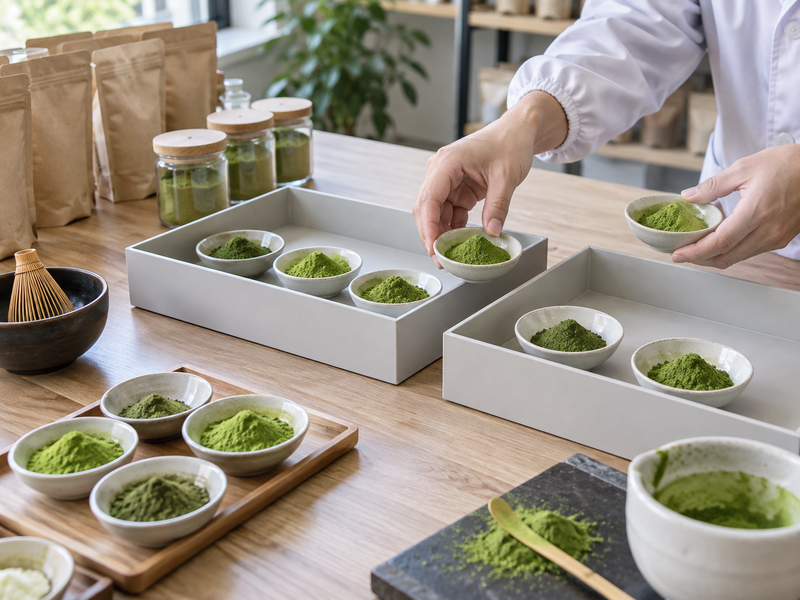
Set the buying boundary. Decide whether origin is a required label claim, a preferred story or merely one factor among cost and supply. Record the pack format and order pattern, because a limited lot may suit a seasonal release while a permanent menu needs replenishment. Ask every candidate for a coded sample of the grade it would actually sell. Do not build a ranking from generic tasting notes. The best region for your business is the one whose specific product meets your target and can be documented and bought on terms you can use.
2. Which origin definition will the buyer use?
Separate leaf, process and seller location
“From Kyoto” might refer to a leaf source, a tencha processor, a finishing company or a sales office. Ask each supplier to state cultivation, tencha preparation, milling and packing locations. Regional product names sometimes follow specific industry definitions that reach beyond a single city boundary. The agriculture ministry’s Uji tea page, for example, describes a wider leaf sourcing area and Kyoto processing context. Avoid turning a familiar regional name into an unsupported single-field assertion.
Write a testable claim. If artwork will name a prefecture, state what records must support that claim. Request a source definition and lot trace for the candidate, including blend inputs. If source flexibility is allowed, specify its limits. Let your market specialist review final wording and any use of regional marks. A supplier address and an image of a local field are useful context, not proof of a specific lot’s origin. The origin definition should survive the next order, when the original sales representative may no longer be involved.
| Claim component | Question | Supporting record |
|---|---|---|
| Leaf area | Where cultivated? | Source lot |
| Tencha | Where prepared? | Transfer record |
| Milling | Which site? | Run code |
| Packing | Where sealed? | Finished lot |
3. How should Kyoto or Uji candidates be assessed?
Ask beyond the famous name
Kyoto and Uji have a documented tea history, and the agriculture ministry describes tencha and matcha within that tradition. For procurement, ask the candidate supplier which leaf sources, processing sites and blending rules apply to its proposed grade. A product named after Uji may have a defined regional practice more nuanced than “every leaf grew in Uji.” Have the supplier explain its wording and provide the source trail for the coded sample. Do not infer quality from history alone.
Taste the offered lot blind. Use the same preparation as other candidates and record what matters in your product: aroma, bitterness, color, body and handling. If the powder will enter a latte or dessert, test it there rather than only in water. Ask whether the grade is a stable blend or a finite lot and how the seller manages variation. The regional story may be valuable to your customers, but purchasing should know whether that story can remain true at the volume and frequency you plan to buy.
4. What should buyers ask about Nishio in Aichi?
Verify the individual route
Nishio City’s tea information describes a strong local tencha and matcha tradition. A buyer can use that fact to identify potential suppliers, then ask each seller how its grade is sourced and made. Does the proposed lot use leaves from the area named in its product claim? Where is tencha prepared and powder milled? Does a packer elsewhere handle the final unit? Request an origin statement tied to the sample and a clear process map.
Check any special mark separately. A regional name, a trademark and a geographic indication are not interchangeable. Japan’s agriculture ministry records cancellation of an earlier Nishio Matcha GI registration in 2020. If artwork proposes a logo or protected wording, ask for current authorization and destination advice. A buyer can still source good Nishio-area tea without making an obsolete certification claim. Keep the discussion grounded in the product’s actual lot, sensory result and available pack format.
| Nishio question | Why ask? | Owner |
|---|---|---|
| Source area | Support origin | Supplier quality |
| Mill site | Trace product | Supplier production |
| Regional mark | Check permission | Brand/legal |
| Repeat grade | Plan supply | Purchasing |
5. How should Shizuoka and Kagoshima offers be compared?
Compare products rather than stereotypes
Japan’s agriculture ministry names both Shizuoka and Kagoshima among major tencha producing prefectures. Its Kagoshima tea profile also notes production responding to tencha demand. Those facts justify searching there. They do not establish that every powder from either prefecture has one flavor, price or grade. Ask suppliers for named SKUs, source definitions and coded samples. Let the recipe decide how the candidates compare.
Hold trial conditions steady. In a milk drink, use identical dose, milk and mixer. In a bakery product, use the same recipe and heat cycle. Record the sample’s lot and the quotation’s product code. A powder from one prefecture may meet a particular color target while another suits a different flavor balance; neither observation should become a claim about the whole region. Ask how each supplier keeps its chosen grade consistent and what happens when a specific tencha stream changes. This gives purchasing a real comparison, not a travel-guide impression.
6. Should other tea regions enter the search?
Keep the shortlist open to evidence
Other Japanese tea regions may offer powders suitable for your application. The agriculture ministry’s regional beverage overview names several tea traditions, including Yame in Fukuoka and others. That is a prompt to investigate a supplier, not proof that a particular region has unlimited matcha stock. Ask what tea material the proposed powder uses and whether the site makes tencha, buys it or mills finished material. A supplier outside the best-known names may provide the exact functional grade you need.
Avoid an exhaustive tour. Set a screening threshold: product identity, origin route, pack suitability and willingness to provide a coded sample. Invite a manageable number of candidates and reject offers that cannot meet hard requirements. If an unfamiliar region gives the best recipe result, let quality and compliance review its claim on equal terms. If an established region fails your budget or supply pattern, record that honestly. Procurement is selecting an ingredient, not settling which tea area deserves the most attention in a consumer guide.
| Shortlist test | Pass condition | If missing |
|---|---|---|
| SKU | Named commercial grade | Clarify offer |
| Origin | Written source route | Hold claim |
| Sample | Coded production link | Request new sample |
| Supply | Usable pack and plan | Keep as trial only |
7. Which sensory trial distinguishes the candidates?
Make taste notes reproducible
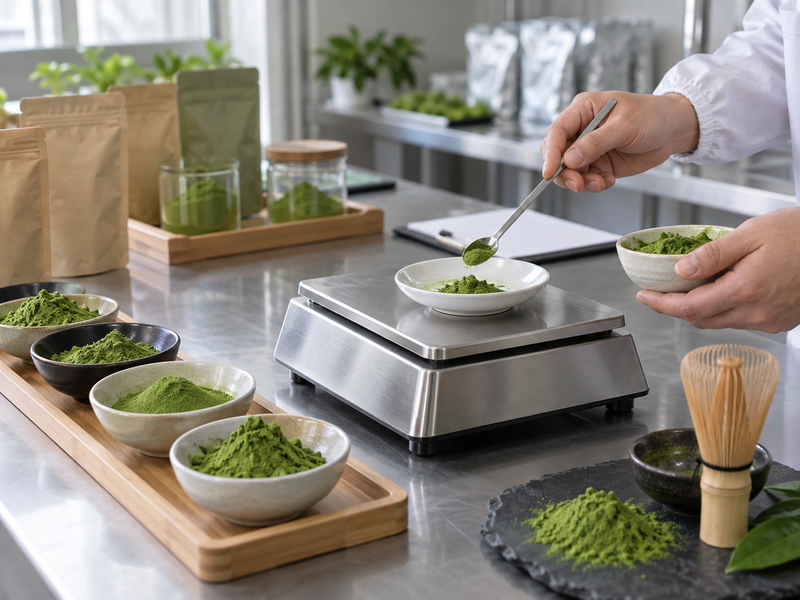
Use a blind code for every region and prepare all candidates with the same method. Record powder weight, liquid or recipe, temperature, mixing time and hold point. Ask evaluators to describe color, aroma, bitterness, body, texture and aftertaste in concrete terms. “Better” means little without a product target. A café buyer should include the milk and service process used by staff. A straight-tea brand should include a water preparation that resembles customer use.
Run a repeat check. Test at least one later lot for the leading candidate before committing to a long program. A retained sample can help detect drift, provided storage conditions are recorded. If a candidate requires a different dose to achieve the target, test that recipe separately and calculate its cost. Do not attribute every difference to climate or soil; cultivation, tencha processing, blending, milling and storage also affect the powder. The trial records what your team observed without pretending it proves the cause of every sensory note.
8. What evidence supports each regional claim?
Build one record set per candidate
For each proposed SKU, request a source statement, site map, specification and lot-linked report. Trace a finished code back to material. Check whether a certificate or regional mark applies to the entity, site, activity and product offered. Have your label specialist review destination wording. A regional association page may describe a standard, but only the supplier’s own records can show whether this lot meets it. Do not copy unverified percentages, output ranks or tasting claims from a consumer article into a B2B product page.
Keep scope visible. Mark each record as received, reviewed or still open. An attractive sample may pass operations while origin evidence remains incomplete. A precise origin trail may pass brand review while the powder fails a latte trial. Those are distinct outcomes. Ask who will notify you if the leaf source or milling site changes. A traceable claim has value only if the supplier’s ordinary order process preserves it after the initial sampling conversation.
| Record | Claim it can support | Limit |
|---|---|---|
| Source lot | Leaf area | Needs finished link |
| Mill record | Processing site | Does not prove cultivation |
| Lot report | Tested batch | Does not prove next lot |
| Current authorization | Mark usage | Check scope and date |
9. Can the selected region support repeat supply?
Ask about the approved grade
An area’s tea production volume cannot tell you whether one supplier can replenish the exact powder you selected. Ask if the quoted grade is a limited harvest lot or an ongoing blend. Discuss expected order cadence, allowable sources and how the seller would manage a shortfall. If your label demands a narrow place, agree on what happens when that material runs out. A backup product from another region may require new artwork or a separate SKU.
Plan the first repeat order early. Ask for a second lot sample and compare it with the retained approval sample in the same recipe. Confirm whether the supplier can hold the same pack and specification. Request notice before a source, blend or milling change that could affect your product. A region can be part of the buying rationale without becoming a guarantee of constant stock. Your supply file should tell purchasing whether a substitution is allowed, who can approve it and which trial must be repeated.
10. How should the buyer choose a region?
Make a product-level decision
Compare each candidate on the same rows: claim evidence, sensory fit, specification, site route, pack, availability and current offer. If a regional origin is mandatory for marketing, mark it as a pass/fail requirement before scoring taste or price. If the origin is a preference, show its commercial value alongside other criteria. Keep one owner for each decision so a price negotiation does not accidentally waive a quality or label condition.
Record the winner and the limits. Approve a named SKU and sample code, not a prefecture in the abstract. Store the source statement and current quote with trial notes. If the preferred product cannot support routine volume, consider a seasonal release or a separately approved everyday grade. Matcha Village’s supplied company profile describes Chinese sourcing and manufacturing; it is not evidence for a Japanese regional claim. Any Japanese supplier should be evaluated from its own product records. This turns regional interest into a purchasing choice that another colleague can understand and maintain.
When presenting the decision internally, show two short columns: what the tested lot did in the recipe and what the supplier can document about origin. Keeping those results side by side prevents a strong regional story from concealing a weak application result, or a good tasting from being marketed with a claim that the source records do not support.
| Decision row | Evidence | Owner |
|---|---|---|
| Origin | Source and site route | Brand/compliance |
| Product fit | Coded trial | Operations |
| Quality | SKU and lot records | Quality |
| Supply | Offer and forecast response | Purchasing |
FAQ
Q1: Which Japanese region produces the best matcha? The answer depends on the offered lot and your application. Compare coded powders against a defined target.
Q2: Does a Uji product mean every leaf grew in Uji City? Do not assume so. Ask for the supplier’s source and processing definition.
Q3: Are Shizuoka and Kagoshima relevant to tencha sourcing? Japan’s agriculture ministry lists both among major tencha areas; verify each proposed supplier and grade.
Q4: Can a regional logo appear on any pack? Check current authorization and your destination’s label requirements before printing.
Q5: What if the selected regional lot sells out? Use an approved alternate or treat the next lot as a new trial, with claim wording reviewed as needed.
Final thought
Regional names can help you find suppliers and explain a product’s story. They cannot approve the product. Choose a coded powder with a supported origin, a successful application trial and a realistic plan for the next order.