
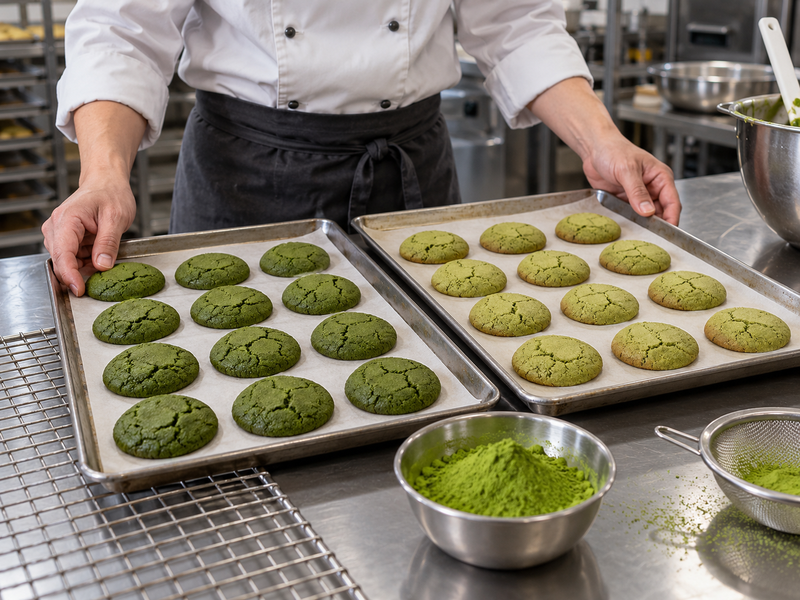
Two trays of matcha cookies can leave the oven with the same recipe and look unrelated. One stays green; the other turns olive. A powder that tastes lively in tea may taste faint under butter and sugar. For a commercial bakery, matcha powder for cookies is an ingredient choice that has to survive mixing, baking, packaging and the next production shift. This guide is a test plan for bakery buyers and product developers. It focuses on powder selection and production controls rather than another small-batch cookie recipe.
Contents
- 1. What should matcha contribute to a cookie?
- 2. How should a bakery compare powder samples fairly?
- 3. How much powder should a test batch use?
- 4. Why does the cookie’s green color change in the oven?
- 5. How do butter, sugar and other ingredients affect matcha flavor?
- 6. Should a bakery sift the powder into dough?
- 7. What does shelf-life testing need to capture?
- 8. How should a buyer calculate matcha cost in a cookie?
- 9. Which supplier controls matter for repeated production?
- 10. What proves a matcha cookie is ready for scale?
1. What should matcha contribute to a cookie?
Decide what the customer should notice before choosing a powder. A shortbread cookie may need a clean tea finish and a visible green crumb. A white-chocolate cookie may need stronger matcha flavor because sugar and fat compete with it. A sandwich cookie has filling that changes the balance again. Write the target as a sensory description a panel can evaluate: green without looking artificially dyed, tea aroma after opening, and bitterness that complements the sweetness rather than lingering harshly.
The powder also acts as a dry ingredient. Adding more can change dough hydration, spread and texture. That is why the strongest-looking powder is not automatically the best. Try several grades at a fixed dose before increasing any one of them. Note whether you sell the cookie fresh, wrapped for retail, or distributed across stores. A cookie that is attractive on the cooling rack may lose color or aroma while sitting under store lights. The intended sales format belongs in the ingredient brief.
| Cookie format | Tea target | Extra test |
|---|---|---|
| Butter shortbread | Clear aroma, restrained bitterness | Texture after storage |
| Chocolate chip | Matcha visible beside chocolate | Flavor after full bite |
| Sandwich cookie | Tea stands up to filling | Filling migration |
| Wrapped retail cookie | Stable appearance and aroma | Packaged shelf-life trial |
2. How should a bakery compare powder samples fairly?
Request samples that represent commercial production lots. Code each powder so the panel does not judge the package or the claimed grade. Bake a control dough and change only the powder. Keep the recipe, mixing time, portion weight, tray position and oven settings fixed. Measure powder by weight. A kitchen teaspoon gives poor precision when a small difference in dose changes the color of hundreds of cookies.
Evaluate powder before baking and the finished cookie after cooling. Record the dry powder’s color and aroma, then compare dough color, baked surface, broken crumb and flavor. Taste cookies the next day as well. Some powders look convincing in raw dough yet turn dull in the oven. Others retain color but leave astringency after the sugar fades. Keep photographs under the same light and record the lot code; casual phone pictures taken in different rooms are a weak comparison. The test should let purchasing and production understand why one sample won.
| Comparison point | Standardize | Record |
|---|---|---|
| Dough | Batch size and mix time | Color and handling |
| Baking | Oven, tray and position | Surface and spread |
| Cooling | Rack time | Aroma and crumb |
| Next-day tasting | Packaging and room conditions | Flavor change |
3. How much powder should a test batch use?
Begin with a small range of doses around the bakery’s current formula or a pilot recipe. Keep each candidate dose documented as a percentage of flour weight so it can scale with batch size. A statement such as “add a little more green” cannot guide a production operator. Make three versions rather than chasing a perfect number in one bowl: a lower, middle and higher dose. Blind-taste them after baking and compare color against cost per cookie.
Watch what the additional dry material does to the dough. A higher dose can affect spread, edge texture or perceived dryness; different powders can behave differently. If more matcha makes the cookie bitter without improving recognizable tea flavor, change the powder or the companion flavors rather than continuing to increase the dose. Record any adjustment to liquid, fat or baking conditions separately. Otherwise, the team may attribute a better cookie to the new powder when it actually came from a changed bake.
4. Why does the cookie’s green color change in the oven?
Heat, mixing and the surrounding formula can change how green the finished cookie appears. A pale dough can look darker after baking, while a vivid raw dough may lose brightness. Test the powder in the exact cookie style and oven program rather than judging it in a glass of water. Photograph the broken center as well as the top. Surface browning can hide a green crumb that customers will still see after the first bite.
Check process differences across the line. A tray near the back of an oven may brown faster than one near the door; a longer hold before baking may also change the result. Bake at least two trays from the same dough under the intended production conditions. If color varies substantially, solve the process variation before buying a more expensive powder. Do not promise a precise shade based on a supplier photograph. Agree on an acceptable range using retained cookies and normal production lighting.
| Stage | Possible color issue | Investigation |
|---|---|---|
| Powder receipt | Lot differs from approval sample | Side-by-side retained sample |
| Mixed dough | Uneven green streaks | Sifting and mix sequence |
| Oven exit | Excess surface browning | Time, temperature and tray position |
| Wrapped display | Dull appearance | Packaging and light exposure |
5. How do butter, sugar and other ingredients affect matcha flavor?
Butter and sugar soften tea bitterness, which can help a cookie taste balanced. They can also hide the matcha so thoroughly that the product relies on color alone. Test the whole bite, including chocolate, nuts, filling or frosting. A supplier sample that wins in plain shortbread may lose in a loaded cookie. Product developers should use the actual branded ingredients and inclusion rates planned for sale, not convenient substitutes from the test kitchen.
If the cookie tastes flat, consider the sweetness and companion flavor before increasing matcha. White chocolate, vanilla and salt each change how tea is perceived. Make one controlled change per round and keep a record. For a packaged product, taste after the expected distribution period, not only on bake day. The best matcha powder for cookies is the one customers can still recognize under the entire formulation. The purpose of a trial is to find that result with predictable cost and production behavior.
6. Should a bakery sift the powder into dough?
Matcha is fine but can form small clumps, especially after a pack has been opened near moisture. Dry blending or sifting it with another dry ingredient can improve distribution. Test the method on the bakery’s real mixer and batch size. A hand whisk in a small bowl does not show whether green specks remain in a production dough. Cut several cookies from different points in the batch to check uniformity.
Write the order of addition into the process sheet. If the powder goes into fat first, document that route and compare it with a dry blend. Do not let operators choose based on preference from shift to shift. Keep opened packs closed and dry, and follow the supplier’s storage instructions. A clump problem that appears only on humid days may be a handling issue rather than a defective lot. Retain examples and lot information so quality staff can investigate without guessing.
| Mixing approach | Possible advantage | Check before adoption |
|---|---|---|
| Sift with flour | Fewer visible specks | Dust loss and handling time |
| Dry preblend | Easier larger-batch dosing | Even distribution |
| Mix into fat | May disperse differently | Texture and color uniformity |
| Add late | Shorter exposure to mixing | Streaks and batch variation |
7. What does shelf-life testing need to capture?
Follow the cookie from cooling to the point of sale. Pack samples in the intended wrapper or box, then store them under realistic conditions. Inspect color, aroma, taste, texture and visible breakage at planned checkpoints. A matcha cookie may still be safe to sell under the product’s validated food-safety program while its tea aroma has faded enough to disappoint customers. Quality and commercial teams need both kinds of information.
Compare a retained sample from the first approved batch with later production. Use the same tasting method and lighting. If a new film or windowed package exposes more cookie to light, repeat the appearance trial. Shelf-life should be established through the company’s actual testing and local requirements, not copied from another bakery’s label. The ingredient supplier can provide storage guidance, but the final cookie’s shelf-life belongs to the finished product and its packaging.
8. How should a buyer calculate matcha cost in a cookie?
Calculate matcha cost from the approved dose and the powder’s landed price, then divide by sellable yield. Include dust loss during dosing, normal dough scrap and broken cookies. A low-price powder may require a higher dose or produce more rejected batches if color varies. A high-price powder might deliver the same taste at a lower dose, but only a controlled trial can show that. Compare cost per acceptable cookie rather than price per kilogram alone.
Run a small sensitivity exercise. What happens if the pack size changes, a supplier increases the minimum order, or the bakery’s seasonal volume falls? Open powder has a handling and freshness cost. Smaller packs may be worth more to a low-volume bakery; large packs may fit a central line with fast turnover. Keep recipe and cost sheets linked so a dose change triggers a new margin calculation. Purchasing should not approve a cheaper ingredient while production quietly adds more of it.
| Cost factor | How to measure | Why it matters |
|---|---|---|
| Powder dose | Grams per dough batch | Primary ingredient cost |
| Yield | Sellable cookies per batch | Spreads loss across units |
| Rejections | Broken or off-color cookies | Hidden cost of variation |
| Pack size | Open-pack turnover | Waste and freshness |
9. Which supplier controls matter for repeated production?
Ask for a product specification, ingredient declaration, packaging format, storage guidance and lot identification. If the cookies make an organic, kosher or other claim, request the relevant current documents for the supplied material and have the label team review them. A broad marketing statement cannot replace documents tied to the product. Agree on the color and sensory range the bakery can accept, then keep a retained sample from an approved lot.
At receipt, compare new lots using the standard test bake before switching a large line where practical. If a powder fails, record the lot and exact difference: darker crumb, bitter finish, clumps or unexpected spread. That makes a supplier discussion specific. Matcha Village supplies B2B matcha products and can discuss application requirements, but a bakery should still approve its own formula against an actual sample. A smooth supply relationship depends on a written standard both sides can test.
10. What proves a matcha cookie is ready for scale?
Run a pilot on the equipment and batch size intended for regular production. Measure dough handling, portion weight, bake spread, color across tray positions, sellable yield and preparation time. Let a normal shift produce the cookies using a written process sheet. If the pastry developer must stand beside the mixer to achieve the approved result, the process is not ready. Record where workers make judgment calls and turn those into measurable cues.
Hold pilot cookies in their intended packaging and taste them through the planned sales window. Ask a small panel what flavor they perceive without telling them which powder was used. Compare that response with the target written before development began. Launch when the cookie remains recognizable as matcha, meets the bakery’s appearance and quality standards, and can be made again from a new lot. Keep the pilot record and approved sample for the next production review.
FAQ
Q1: Is culinary grade matcha always best for cookies? Grade names vary. Compare powders through a controlled bake for taste, color, texture and cost.
Q2: Why are green specks visible in the dough? Clumps or poor dry distribution may be involved. Test sifting and mix order on the real equipment.
Q3: Can more powder fix weak cookie flavor? Sometimes, but a higher dose may add bitterness or change texture. Trial a dose range and another powder.
Q4: Should a bakery assess color before baking? Yes, and after baking and storage. Raw dough alone does not predict the sold cookie.
Q5: What should purchasing retain after approval? Keep the lot code, specification, process sheet, cost calculation and a properly stored reference sample.
A home-batch cookie example is available in this matcha cookie recipe. For commercial sourcing context, see our matcha grade guide.