
For a buyer searching “matcha meaning,” the short answer is powdered tea. A purchase needs more precision than that translation. Different green powders can look similar while differing in leaf material, process, origin, and performance. Define the intended ingredient, ask how it was made, and verify the specific lot in the finished product. Japan’s Ministry of Agriculture, Forestry and Fisheries describes traditional matcha as powder ground from tencha, made from shaded tea leaves that are processed without rolling. That is a useful process reference; a purchase still depends on documented identity and application tests.
Contents: 1 · 2 · 3 · 4 · 5 · 6 · 7 · 8 · 9 · 10
1. What does matcha mean in a product brief?
Define the material being purchased
A product brief should state more than ‘green tea powder’. It should identify the tea material, expected production route, ingredient declaration, origin statement, intended application, and finished-product target. That gives sourcing and R&D a common standard. Without it, two suppliers can quote different powders under the same familiar word, and the lower price may reflect a different material rather than a better offer.
Use a working definition. For a brief anchored in the traditional Japanese process, describe matcha as fine powder made from tencha derived from shaded tea leaves. The Japanese agriculture ministry sets out this broad route. A supplier may offer other finely ground green tea powders; ask for transparent naming and process details instead of assuming equivalence. If marketing uses ‘matcha’ on packaging, regulatory staff should review the claim for the sales market.
| Brief term | Clarifying question | Evidence |
|---|---|---|
| Matcha | What tea material was ground? | Ingredient and process description |
| Origin | Where did leaf and processing occur? | Traceability declaration |
| Intended use | Which finished product? | Application trial |
2. How is matcha different from other green tea powders?
Process matters more than color alone
A green tea powder may be made by grinding various processed tea leaves. The traditional matcha route uses tencha, with leaf preparation that differs from rolled green teas. Shade management, steaming, drying, removal of stems and veins where practiced, and grinding can influence appearance and flavor. A powder’s bright green color does not prove which process produced it; photographs are especially unreliable because light and editing alter shades.
Ask for the route. Request a plain-language description of the raw leaf, processing steps, grinding, and packing. The answer should match the supplier’s ingredient declaration and lot record. If the offer is a blend, ask which components it contains and whether that mix can change. A broad category name can remain useful for procurement, but the product code and specification must identify the actual material approved.
In the pilot, compare candidate powders at the same dose in water and in the intended matrix. A different green tea powder may deliver a different aroma, sediment level, or heat response even when it appears similar dry. The appropriate choice depends on the product and how it will be described to customers.
3. Where did the name and practice develop?
Keep history separate from a current origin claim
Powdered-tea practices have histories across East Asia. Matcha is strongly associated with Japanese tea culture and the development of tencha and tea-ceremony preparation. That cultural context can help explain why consumers recognize the word. It does not make every powder sold today Japanese in origin. Modern brands may source from several countries, and the origin of a finished blend can differ from the origin of its components.
Make the timeline useful. History belongs in brand education when it is accurately sourced and proportionate to the product being sold. A short explanation of tea preparation is often clearer than an elaborate heritage claim. Avoid implying a particular farm, region, or traditional mill when the batch file does not support it. The Japanese agriculture ministry’s overview offers a public process reference for readers who want more detail.
For procurement, the current lot matters most. Record where leaf grew, where it was processed into the material used for grinding, where grinding happened, and where the powder was packed. Historical meaning and present-day provenance answer different questions, so the documents should keep them separate.
4. Which process steps shape the powder?
From leaf to packed ingredient
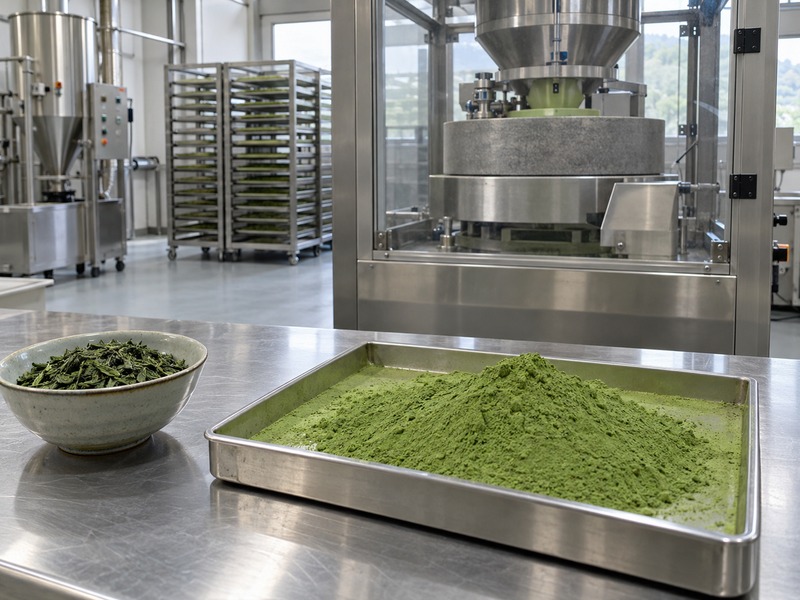
Leaf selection and shade management affect the raw material that enters processing. Steaming, drying, sorting, grinding, and packing then shape the powder’s physical and sensory properties. The traditional tencha route is described by the Japanese agriculture ministry. For a specific commercial lot, ask which steps were used and which details can be verified. A romantic process description cannot replace a lot-specific specification.
Follow the handling. Fine powder has a large exposed surface compared with whole leaf, so moisture, oxygen, light, and strong surrounding odors can affect product quality during storage. Buyers should ask for the proposed pack barrier, seal type, storage guidance, and open-pack handling. They should then test those instructions under their actual warehouse and line conditions.
| Stage | Buyer question | Practical check |
|---|---|---|
| Leaf preparation | What material enters processing? | Supplier process statement |
| Grinding | What size and handling result? | Sample dispersion trial |
| Packing | How is powder protected? | Seal and storage review |
The right process question depends on the intended product. A café cares about a smooth cup; a dry-mix maker also cares about flow and reconstitution.
5. What can appearance and flavor reveal?
Observe, then verify
Color, aroma, flavor, mouthfeel, and sediment can tell a team whether a lot fits its product target. They cannot independently prove geographic origin or food safety. Prepare samples under controlled light and with a repeatable water, dose, temperature, and mixing method. Taste immediately and after the normal service hold. Record attributes separately rather than giving a sample one vague score for quality.
Look inside the matrix. Milk can mute some tea notes, sweetener can alter bitterness perception, and heating can shift flavor or color. A powder that wins in water might lose in a pastry cream or frozen dessert. Run a finished-product pilot before assigning a grade or price premium. Keep a retained sample from the approved lot so a later delivery can be compared with a physical benchmark.
| Observation | Useful interpretation | What it cannot prove |
|---|---|---|
| Green shade | Fit with visual target | Origin or safety |
| Tea aroma | Sensory fit | Ingredient identity alone |
| Sediment | Dispersion behavior | Total product value |
Unexpected damp clumps or off-odor should trigger a quality hold and investigation, not a quick recipe adjustment on the production floor.
6. How should buyers test ingredient identity?
Combine documents with a material trial
Start with a supplier specification naming the ingredient, plant source, processing route, origin, and lot code. Compare it with the sample label, quotation, and any certificate of analysis. Ask whether the powder is pure tea or a blend with sugar, color, flavor, or other ingredients. That distinction controls both the formula calculation and the customer-facing ingredient statement. If an independent identity method is needed, quality staff should choose a suitable laboratory approach for the market and risk.
Do not let a certificate drift. A report for a grade family or older lot may describe a supplier’s normal process, but it does not automatically release the lot on offer. Ask the supplier to link documents to the current batch. Verify the material again at receipt using the agreed identity and sensory checks. A routine receiving test should be feasible, with a clear action if a result falls outside range.
For an OEM blend, define who owns the ingredient declaration and who approves any component replacement. Matcha meaning in a procurement file is operational: the word should map to a controlled code, approved composition, and testable standard.
7. What origin claims need documentary support?
Trace more than a shipping address
A carton dispatched from one country can contain tea grown in another. Ask suppliers to distinguish leaf origin, processing location, grinding location, blending location, and final packing location. If a package or menu names a region, the claim should match the relevant material and be supported by documents. The exact claim rules vary by destination market, so involve regulatory reviewers before artwork is printed.
Make blends explicit. A multi-origin blend can be commercially sensible, but its origin statement needs careful wording and change control. Request a signed declaration that links to the offered lot and says how source substitutions are handled. A current certificate of analysis may contain useful test results, yet it often does not answer every geographic question. Keep safety and provenance evidence in separate columns in the approval file.
| Claim | Document question | Change trigger |
|---|---|---|
| Country of leaf | Where was tea grown? | New source |
| Regional tea | Which portion supports region? | Blend change |
| Packed in country | Where was final pack made? | Packing-site change |
An origin statement should survive a routine supply change. If it cannot, the artwork and procurement plan need a revision path before launch.
8. How does matcha behave in food and drinks?
Powder particles remain part of the product
Matcha is a finely ground leaf ingredient, so a beverage contains suspended particles. It will not behave like a clear tea extract that dissolves completely. Mixing order, liquid temperature, shear, fat, sugar, and holding time all affect clumping, foam, and settling. In a baked or frozen product, heat and matrix composition affect the finished sensory result. Test in the exact product format rather than assuming a supplier’s general use suggestion applies unchanged.
Build a fair comparison. Fix the finished-serving denominator, base formula, process, and assessment time while comparing candidate lots. A hypothetical café test might use equal grams per finished 250 mL drink, then adjust each lot to the same tea intensity. That is a trial starting method, not a universal serving recommendation. A factory trial should use its actual mixing and thermal process under quality supervision.
| Product | Main behavior to assess | Trial endpoint |
|---|---|---|
| Café latte | Clumps and tea presence | Served cup after hold |
| Dry mix | Flow and reconstitution | Prepared drink |
| Bakery filling | Flavor and color after heat | Finished filling |
The resulting dose and process instructions belong in the specification. A powder is only useful if operators can reproduce the intended outcome.
9. What should a commercial specification include?
Define acceptance before the order
A purchase specification should state identity and composition, origin declarations, sensory reference, pack size, storage conditions, and applicable food-safety limits. Add test methods for color, particle behavior, moisture, or other characteristics only when they serve a product decision. Ask which results are routine and which require extra testing. A well-written specification also says how samples are taken and how deviations are resolved.
Link every document. The sample, quotation, certificate, shipment, and receiving record should share a lot code or another reliable chain of reference. Ask for change notice when the supplier modifies raw material, blend, process, pack, or test method. The team can then decide whether a short application test or full requalification is needed.
Price should be compared per accepted finished unit, using the dose established in a controlled pilot. Add freight, duties where applicable, material loss, and any special testing. A cheaper powder per kilogram can become expensive if it requires a higher dose or produces more rejects. Keep measured costs and planning estimates in different columns so finance can update them without rewriting product history.
10. How can a brand explain matcha accurately?
Write from the approved ingredient file
A useful customer explanation says what the powder is, how it is used in the product, and where the specific ingredient comes from when that origin is verified. Keep the language aligned with the actual formulation. If the product uses matcha plus sugar and milk powder, call it a blend or mix where appropriate rather than presenting the entire product as pure matcha. Avoid health promises unless the claims team has evidence and market approval.
Give operators a short version. Café staff can explain that matcha is finely powdered tea used in the drink, then answer ingredient or allergen questions from the approved product sheet. Procurement and marketing should use the same lot-linked origin statement. If supply changes, the copy may need to change too.
The next step is to write a one-page ingredient definition and test two traceable lots in the intended application. For process background, read the Japanese agriculture ministry’s explanation of matcha.
Reference: Matcha Meaning: Exploring the History of Stone-Ground Tea. The article is topic context; the commercial checks above are independently written.
FAQ
Q1: What does matcha mean on an ingredient list?
It should identify the tea powder actually used. Ask for composition and processing details from the supplier.
Q2: Is all green tea powder matcha?
Do not assume so. Confirm the leaf material and process behind the offered powder.
Q3: Does matcha dissolve completely?
No. Fine tea particles remain suspended, so mixing and hold behavior need testing.
Q4: Does Japanese packing prove Japanese leaf origin?
No. Trace leaf, processing, grinding, and packing locations separately.
Q5: What should a brand verify before making an origin claim?
Check lot-linked provenance documents and have regulatory staff approve the exact wording.