
Matcha latte calories come from the complete cup. The powder may contribute a small amount, but milk, syrup, sweetened foam, and toppings change the total far more. A matcha versus latte calorie article appearing in search results makes that distinction. A café needs something more specific than a typical number: a calculation tied to its recipe and serving size. Here is a way to build one, check it against real service, and update it when ingredients change. The examples are arithmetic illustrations, not nutrition values for a product the reader has not measured.
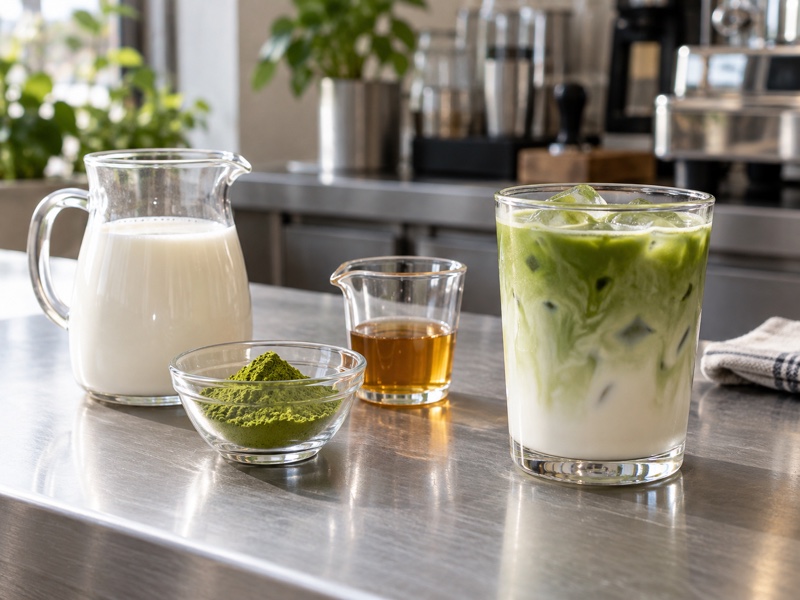
1. What is included in a matcha latte serving?
Define the standard cup first. Record matcha powder, water, milk, sweetener, ice, toppings, and the finished fill. Water and ice add no energy, but they affect how much room remains for milk and syrup. A hot latte and an iced latte may have the same nominal cup size yet different milk quantities. A small and large version may use the same powder dose or different doses. Each standard recipe needs its own calculation.
Use the exact ingredients bought for service. “Oat milk” is not one nutrition value; brands and formulations vary. “Vanilla syrup” needs a brand, a label basis, and a measured pump dose. If a customer can add cold foam or extra syrup, calculate those additions separately. The FDA’s Nutrition Facts guidance emphasizes serving size because a number without its serving is easy to misread.
| Recipe line | What to measure | What to save |
|---|---|---|
| Matcha | Grams of dry powder | Lot and nutrition source |
| Milk | Actual grams or labeled volume | Brand and product label |
| Syrup | Milliliters or grams per pump | Pump check and label |
| Foam or topping | Finished serving mass | Preparation formula |
2. How can ingredients be converted to calories?
Put each ingredient on the same basis. If a milk label reports 60 kcal per 100 ml and the recipe uses 180 ml, the milk contributes 108 kcal before any other ingredient. The equation is stated calories × amount used ÷ label amount. If a syrup reports calories per tablespoon, measure how many tablespoons the approved pump actually dispenses or use the supplier’s per-volume data. If the matcha label reports per 100 g, convert from the powder grams in the cup. Keep unrounded working figures until the end of the calculation.
Do not mix grams and milliliters casually. A kitchen scale gives repeatable service weights, but a label may be based on volume. Use reliable product information for conversions when necessary. Density differs between syrup and water. A menu operator can make a simple workbook with ingredient name, label unit, calories in that unit, recipe amount, calculated calories, and review date. Another person should be able to reproduce every line from the saved labels.
3. What does a worked example look like?
Consider a hypothetical 12 oz iced latte built with matcha contributing 5 kcal, a measured milk serving contributing 90 kcal, and syrup contributing 40 kcal. The total is 135 kcal before toppings. If cold foam adds another 65 kcal, the served version becomes 200 kcal. Those inputs are invented for demonstrating the method; the values for any real café must come from its actual ingredients and amounts. A customer who orders the foam version is buying a different nutritional serving.
Make the example visible to the team in rows. When a supplier switches milk, staff can change one input and see the total move. When a promotion adds flavored foam, it cannot be silently ignored because the base latte calculation already existed. For formal menu declarations, have a qualified reviewer check data sources, rounding, recipe tolerance, and rules in the destination market. A spreadsheet is a working record, not automatically a compliant label.
| Illustrative ingredient | Example calories |
|---|---|
| Matcha in measured dose | 5 |
| Milk in measured serving | 90 |
| Syrup in measured serving | 40 |
| Base latte total | 135 |
| Optional cold foam | 65 |
| Latte with foam | 200 |
4. Why does milk choice change the result?
Milk is usually a large part of the cup. Dairy milk at different fat levels, unsweetened oat drink, sweetened oat drink, soy, and almond products can have very different energy values. Even within one category, two brands may differ substantially. Read the product label for the exact milk used and measure the portion in the actual cup. If an iced drink gets less milk because of ice, calculate that amount; do not copy the hot-drink result.
Milk substitutions may affect taste and texture as well as energy. A café can offer alternatives without promising that each is “lighter.” An unsweetened option might lower the total in one recipe, while a richer barista formulation might not. If the menu shows a standard calorie value, say which milk it assumes. Where local rules require information for options, follow those rules. Staff should be able to identify the base used for the published number.
5. How much can syrup and powder dosing drift?
Pump labels are not enough. Weigh or measure ten pumps from the actual bottle and average them; note the spread. A partially blocked pump or a different bottle neck can change volume. Similarly, a heaped matcha scoop can differ from a level scoop. During recipe development, weigh every cup. Once a service tool is approved, spot-check it on a schedule. This improves taste consistency and makes the nutritional calculation closer to what customers receive.
Syrup drift can be particularly expensive because it changes sweetness and calories together. If staff add an extra pump to a dull tea cup, the right fix may be powder quality or mixing, not more sugar. Train the intended taste with a control cup. Record authorized customizations separately in the point-of-sale system if they affect a published value. The aim is a stable standard drink with transparent options, not a number that applies only when one careful manager is on shift.
| Service tool | Check | Action if variable |
|---|---|---|
| Matcha scoop | Weigh ten fills | Use scale or retrain fill |
| Syrup pump | Measure ten strokes | Calibrate or replace |
| Milk fill line | Weigh in actual cup | Mark correct line |
| Foam portion | Weigh finished topping | Standardize tool |
6. What about hot versus iced lattes?
Calculate them separately. Hot cups often contain more milk for a given nominal size because there is no ice. Iced cups may have sweetened cold foam or a larger cup to accommodate ice. They can also use different water volumes to disperse matcha. Water itself does not change calories, but it displaces milk, which does. A café should build each drink from its own measured card and confirm the finished cup volume before publishing nutrition information.
Observe several staff members. A hot latte may vary with steaming loss and the amount of foam held back in the pitcher. An iced drink may vary with ice scoop size. Calculate from the amount that reaches the customer, not just the amount poured into a pitcher. If the service method generates predictable waste, keep it in the costing sheet; nutrition depends on what is served. The two spreadsheets are related but answer different questions.
7. Do toppings and cold foam need their own calculation?
Yes. A dusting of matcha and a spoonful of sweet cream are not equal additions. For a prepared cold foam, calculate the complete batch from its milk or cream, syrup, and other ingredients, then divide by the number of measured portions or portion mass. Check how much foam staff actually serve. A batch can yield fewer portions than expected because some remains in the pitcher. That changes both cost and calories in each real cup.
If toppings are optional, show the base drink and add-ons clearly where nutrition information is offered. If the menu image always shows a topping, the standard recipe should include it or the image should identify it as an option. A customer may reasonably assume the pictured drink and listed calories refer to the same item. Keep the product description, visual, point-of-sale choices, and calculation aligned.
8. Can a lower-calorie version still taste good?
Possibly, but test the flavor. Lowering syrup may reveal a harsh tea powder; switching milk may make the cup thin. Begin with the approved drink and change one factor at a time. Compare a smaller syrup dose, then an alternate milk, then a different serving size. Taste blind after the drink is stirred and after a normal holding interval. Choose a version people will actually order again, not merely a lower number in a workbook.
Do not imply that a lower-calorie latte is automatically a better choice for every person. Customer needs and dietary circumstances differ. For menu development, a useful approach is to offer a clear standard and a lighter customization whose ingredients and size are specified. Be careful with regulated claims such as “low calorie.” A comparative description needs an appropriate basis and review under the market’s labeling rules.
| Change | Potential calorie effect | Taste check |
|---|---|---|
| Less syrup | Usually lower | Is tea too sharp? |
| Different milk | Product-specific | Does texture hold? |
| Smaller cup | Usually lower total | Is value acceptable? |
| Remove foam | Depends on foam | Does menu image still fit? |
9. How often should the number be updated?
Review the calculation whenever the recipe, ingredient brand, supplier formulation, cup size, service tool, or standard topping changes. Save the date of each ingredient label used. A supplier can reformulate a syrup without changing the product name. A café can switch milk for availability and forget that its menu number was calculated with the previous one. Assign an owner to approve changes before new cards or web copy go live.
Spot checks can reveal serving drift. Weigh a few cups on another shift every month or after training changes. If the average syrup or milk amount is materially different from the recipe, fix service or revise the formula. Do not adjust nutrition copy alone to accommodate untrained free-pouring. The goal is a repeatable drink whose published information describes what customers receive most of the time within applicable rules.
10. What records support a trustworthy menu figure?
Keep the standard recipes, current ingredient labels, calculated line items, calculation method, sign-off, and an archive of earlier versions. Record whether figures describe hot or iced service, cup size, standard milk, and toppings. If a customer asks why two latte sizes differ, the team can answer from the recipe rather than guessing. The FDA’s calorie page is helpful background; it does not calculate your specific café cup.
Start by making and weighing three normal servings, not a laboratory ideal. If the amounts vary, standardize service before publishing a number. Then calculate the complete cup and have the result reviewed for the relevant market. That practical sequence makes matcha latte calories a verifiable product fact rather than a borrowed average.
FAQs
How many calories are in a matcha latte? The answer depends on the measured powder, milk, sweetener, cup size, and toppings. Use the actual recipe.
Does ice reduce the calories? Ice adds no energy, but it may replace some milk in an iced recipe. Calculate what is actually served.
Is oat milk always lower in calories than dairy? No. Compare the exact products and amounts; oat formulations vary.
Should cold foam be counted? Yes, if it is part of the served drink or selected add-on.
Can a café copy a competitor’s calorie number? No. Their ingredients and serving may differ from yours.