
Matcha cake pops give bakeries a small, portable dessert, but the format is less forgiving than it looks. A center that crumbles, a stick that loosens or a coating that hides the tea flavor can turn an attractive sample into costly service waste. This guide helps bakery, café and private-label buyers define the finished product, test a repeatable process and select matcha for the actual cake and coating. Matcha Village is a China-based matcha manufacturer that can discuss ingredient options for that application; finished-product validation remains with the food business.
Table of contents
- What product should the cake pop deliver?
- Which cake base suits repeat production?
- Where should matcha go in the formula?
- How much binder keeps a center intact?
- How can you portion and mount each pop?
- What makes a coating workable at scale?
- How should cake pops be held and packed?
- What is the cost of a saleable pop?
- How should a bakery approve its matcha ingredient?
- What belongs in a supplier and production brief?
1. What product should the cake pop deliver?
Define the occasion and the eating experience
Matcha cake pops can be sold as a café counter treat, an event dessert, a retail multipack or a component in a gift set. Each route changes the target size, decoration, packaging and time between production and consumption. A pop that works on an open display tray may need a different coating and support when it is wrapped individually. Decide the sales route before choosing a cake recipe.
Write a short finished-product description: cake flavor, matcha intensity, coating thickness, desired color, portion weight and acceptable visual variation. Specify whether the customer should taste tea in the cake, the coating or both. White chocolate can provide a pale coating that shows green clearly, while dark chocolate gives a different flavor and hides that color. Neither choice should be made only for a photograph. Taste the complete bite at the planned serving temperature.
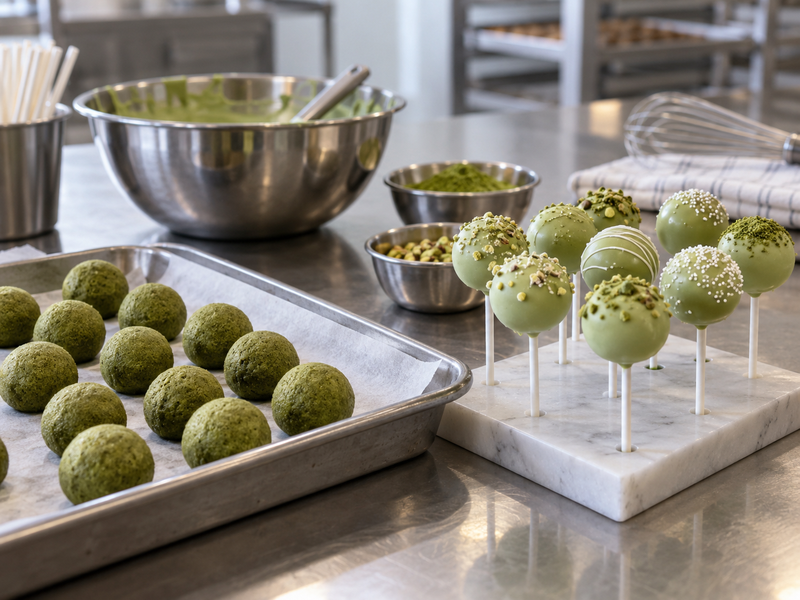
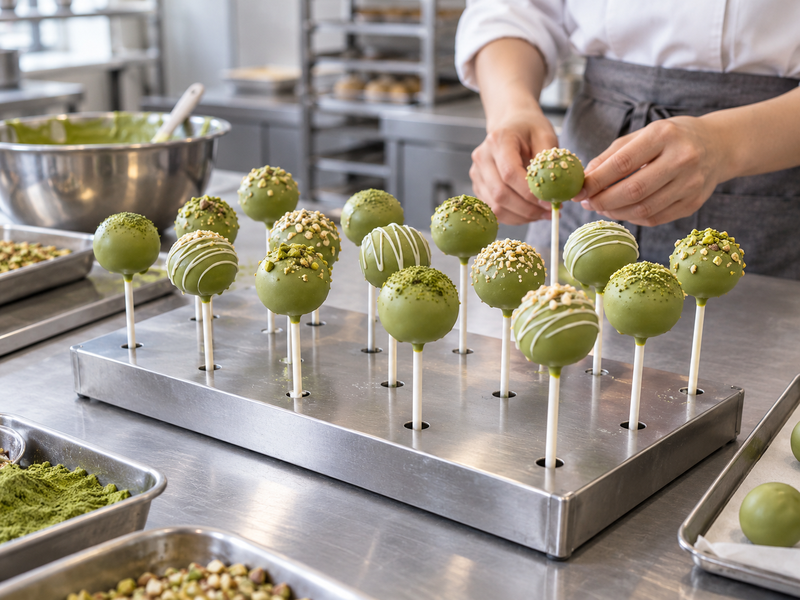
For chains, define a shape that employees can form repeatedly. Elaborate decorations may look good in one kitchen but slow production and increase breakage. Keep a photograph of an approved pop next to a cut view that shows center and coating. This reference helps product development, purchasing and store operations discuss the same item without treating every green cake bite as equivalent.
2. Which cake base suits repeat production?
Choose a base by crumb behavior and flavor
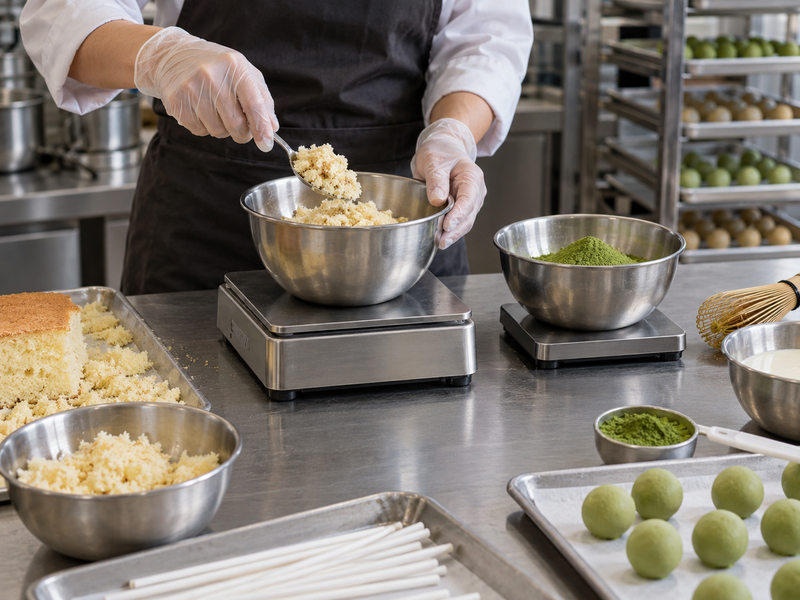
A cake pop center starts with cake crumbs bound into a shapeable mass. The base must taste good after binding and coating, even when its fresh slice tastes fine. A light vanilla or plain sponge gives matcha room to speak. A rich chocolate cake may suit a marbled concept but can mask tea and darken the cut face. If a bakery intends to use surplus cake, it still needs a defined source and quality standard; inconsistent leftovers are a poor basis for a contracted product.
Test cake from the same process that will serve commercial production. Measure baked weight, cooling time, trim loss and crumb size. A very dry cake can demand more binder, making the center sweet or heavy. An overly moist cake may form quickly but lose shape during dipping. Break down a cooled sample and assess whether it crumbles evenly without hard pieces. Record whether edges are used or removed. Those details change yield.
| Base option | Useful trial question | Commercial check |
|---|---|---|
| Light sponge | Does matcha remain identifiable? | Crumb uniformity after cooling |
| Butter cake | Does fat soften tea flavor? | Binder demand and handling |
| Chocolate cake | Is tea still a deliberate flavor? | Cut-face color and sweetness |
| Controlled cake trim | Are input batches consistent? | Traceability and variability |
3. Where should matcha go in the formula?
Compare cake, binder and coating as separate routes
There are several ways to make a matcha cake pop. Tea can enter the cake batter, the binder, the coating or a combination. Each route changes how much heat the powder encounters and when customers taste it. Powder baked into cake should be evaluated after baking. Powder added only to a pale coating may give a strong first impression but little tea character in the center. A combined route can work, though it also complicates dose control and cost.
Prepare a small controlled set using the same cake size and total sweetness target. Record grams of matcha per batch and per saleable pop. Do not rely on a vague instruction such as “add two spoonfuls”; scoop density varies. Sift powder where it enters a mixture and inspect for dark specks or unmixed pockets. If adding matcha to a fat-based coating, test the chosen mixing method without assuming a water-based pre-dispersion belongs in that system.
4. How much binder keeps a center intact?
Find the smallest workable amount in your formula
Binder gives the crumb mass enough cohesion to roll, hold a stick and survive dipping. Cream cheese frosting, buttercream or a suitable confectionery spread may all be considered, but each changes sweetness, allergens, handling and finished shelf-life questions. Do not choose the binder solely because it makes forming easy. Taste the finished pop and assess whether the center feels like cake rather than sweet paste.
Run a binder ladder using one batch of cooled cake crumbs. Add measured increments, form equal-weight centers and record how each version behaves during rolling, chilling, mounting and dipping. The lowest amount that survives the complete process may give a lighter bite. If one batch fractures, check crumb size and cake moisture before adding unlimited binder. An inconsistent cake base can make an otherwise sound ratio seem unreliable.
| Trial observation | Likely process question | Next check |
|---|---|---|
| Ball cracks while rolling | Is crumb too coarse or dry? | Compare crumb size and binder dose |
| Center slides off stick | Is mass too soft or heavy? | Check weight and mounting method |
| Coating tears the surface | Has center set enough? | Compare cooling interval |
| Finished bite feels pasty | Is binder excessive? | Reduce dose in a controlled batch |
5. How can you portion and mount each pop?
Set a weight and a repeatable sequence
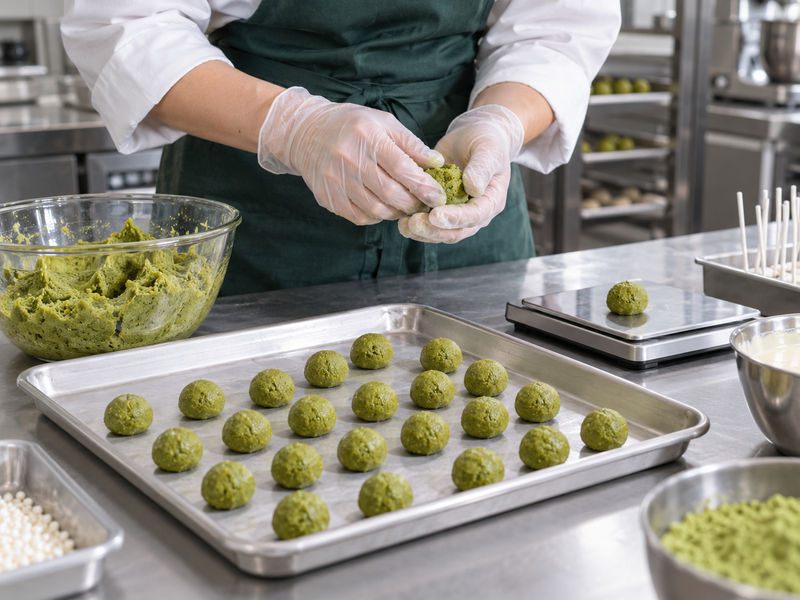
Uniform portioning helps cake pops coat evenly and makes cost calculations credible. Weigh several centers from each operator, not just the first. A scoop or forming tool may improve consistency, but it must work with the actual crumb mixture. Check shape before cooling. Specify stick type and insertion depth. A lopsided center can draw too much coating on one side and may pull against the stick.
Put the process on a station card: crumble, bind, weigh, form, cool, mount, dip and set. Record where checks occur and who rejects damaged pieces. During a small pilot, count centers that survive each stage. A high final yield is more useful to a buyer than a perfect photograph of one pop. The measured losses will feed the cost model and help identify which station needs improvement.
6. What makes a coating workable at scale?
Evaluate flow, coverage and flavor together
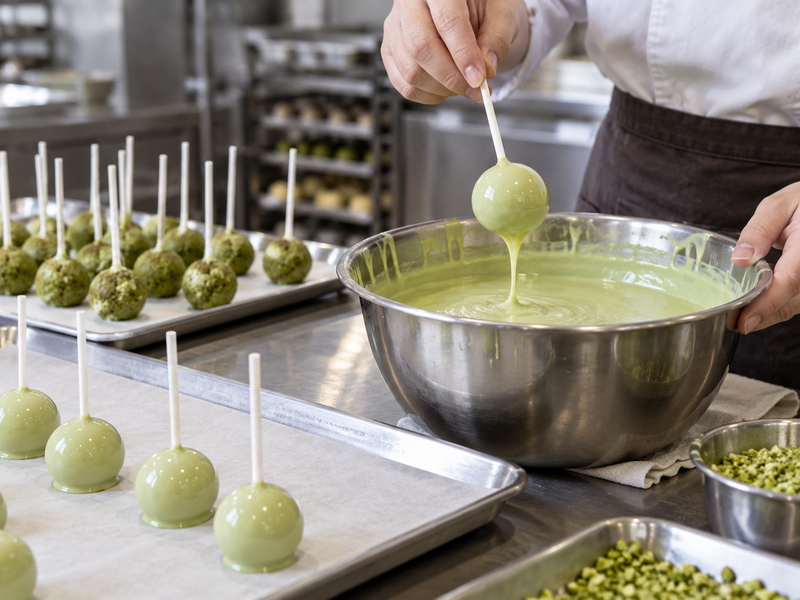
A coating must cover the center without leaving a thick shell that dominates the bite. White chocolate or an appropriate confectionery coating can carry matcha, but their composition and handling differ. Set a target for coating weight per pop and the appearance after setting. Record the temperature and method used by the bakery; a coating that behaves well in a small bowl may become harder to manage across a long production run.
Check whether matcha disperses uniformly in the chosen coating. Sift the powder before mixing if the trial shows specks. Watch for color change during holding and repeated reheating, and avoid treating a visually green liquid as proof that the final shell will taste right. Do not add unplanned water to a fat-based coating to thin it. Any formulation change should be tested for setting and eating quality in the exact coating system.
| Coating check | What to record | Buyer decision |
|---|---|---|
| Flow during dipping | Dwell time and excess drip | Practical throughput |
| Shell weight | Grams per finished pop | Flavor and cost balance |
| Green uniformity | Specks, streaks, set color | Mixing method or powder trial |
| Set surface | Tackiness, cracks, pooling | Pack and handling suitability |
7. How should cake pops be held and packed?
Test the complete item through its sales route
An open display, an individual sleeve and a multi-pop gift box place different demands on the stick, coating and center. Determine the intended route and evaluate the finished pop in that pack. Look for coating scuffs, condensation, stick movement and transfer of decoration. A wrapper that works for a dry confection may stick to a glossy coating. The fit should protect the pop without crushing its shape.
The bakery must establish finished-product holding and shelf-life conditions from its own recipe, process, packaging and applicable rules. A consumer recipe’s storage note or the shelf life printed on a matcha bag cannot validate a commercial cake pop. Evaluate samples at several points in the proposed period. Include appearance, aroma, center texture, coating integrity and relevant food-safety checks determined by the responsible team.
Keep ingredient traceability through cake baking, binding, coating and final packing. If stores receive frozen or chilled centers for local dipping, that is a different process from shipping finished pops; validate it separately. Build a simple receiving check for pack integrity and lot identity. Matcha Village can supply ingredient documents and discuss bulk pack formats, while the finished-food operator decides how the completed item is handled and labeled.
8. What is the cost of a saleable pop?
Use actual production yield
Calculate the cost of the complete recipe divided by saleable units. Include cake ingredients, binder, coating, matcha, sticks, decorations and packaging. Add labor and operational assumptions according to the business’s normal costing method. Count trim, cracked centers, coating waste and broken pops observed during the pilot. A formula with a low powder price can still be expensive if it needs a higher tea dose or causes more rejects.
Compare candidate matcha products at a dose that meets the same finished flavor target. Price per kilogram alone cannot show cost per approved pop. If one powder performs well in cake but poorly in coating, decide whether the bakery wants one powder for both or separate SKUs. Two products can complicate storage and traceability; a single compromise product may alter quality. Put those choices into the cost sheet rather than making an unrecorded purchasing assumption.
| Cost input | Measurement basis | Common omission |
|---|---|---|
| Matcha | Grams per saleable pop | Higher dose needed for flavor |
| Cake and binder | Batch weight and accepted centers | Trim and forming loss |
| Coating | Purchased mass versus used mass | Bowl and drip waste |
| Pack and labor | Finished units and observed time | Breakage during packing |
9. How should a bakery approve its matcha ingredient?
Link the approved pop to the offered SKU
Request a product specification for the exact powder proposed for repeat supply. Identify its composition, stated origin, pack format and storage instructions. Ask for the quality documents relevant to the destination and finished application, and check what each record actually covers. A vivid sample is not evidence that a different commercial SKU will perform identically. Match sample codes and available lot references to the cakes and coatings used in trials.
Matcha Village offers culinary and other matcha options, plus blend and private-label cooperation. For cake pops, the useful question is which offered product delivers the intended tea flavor and color in the selected cake or coating at a workable dose. Keep a retained powder sample and a finished-pop reference where practicable. Agree what will happen if the offered powder, packing site or formulation changes before a repeat order.
10. What belongs in a supplier and production brief?
Send a brief that connects ingredient and finished item
Tell the supplier where matcha enters the cake pop: batter, binder, coating or more than one component. Describe the base cake, target flavor, color and serving conditions. Add estimated powder usage for a pilot and a plausible range for repeat supply. State the destination market and any required document or claim review. The bakery does not need to disclose every proprietary formula detail at the first enquiry, but a generic request for “bright green matcha” gives little guidance.
Request identified sample products, specifications, pack formats and a quotation with clear quantity and delivery terms. Ask how the supplier handles a proposed SKU or packaging change. When a branded retail pack or customized blend is requested, make that a separate project with labeling and artwork responsibilities. Do not assume a bulk powder offer includes finished cake-pop packaging or product validation.
After trial production, return observations tied to each sample code: measured dose, taste of a complete pop, cut-face and shell color, mixing behavior and yield. Include photos taken under consistent light. Decide which attribute needs another test, then lock the approved version in the bakery’s recipe and purchasing records. A useful next step is a controlled pilot using the offered commercial powder, the intended packaging and the people who will produce the item routinely.
| Brief item | Reason to include it | Buyer record |
|---|---|---|
| Matcha placement and target | Guides sample selection | Recipe version |
| Portion and coating weight | Supports cost and pack planning | Pilot yield sheet |
| Destination and claims | Directs document review | Quality checklist |
| Product code and pack | Identifies repeat material | Approved specification |
FAQ
Q1: Must matcha go into both cake and coating?
No. Compare separate routes in the complete pop and choose the one that meets flavor, appearance, handling and cost targets.
Q2: Can surplus cake be used for a commercial cake pop?
Only if its source, condition and crumb properties are controlled within the operator’s food-safety and quality system.
Q3: Which matcha grade works best in cake pops?
Test application samples in the actual cake or coating. Grade names alone do not predict finished color, flavor or cost.
Q4: Does an ingredient shelf life establish a cake pop shelf life?
No. The finished-food operator must validate its complete recipe, process, pack and distribution route.
Q5: What should a repeat order reference?
Use the approved matcha product code, pack format, quantity, commercial terms and agreed change or receiving requirements.