
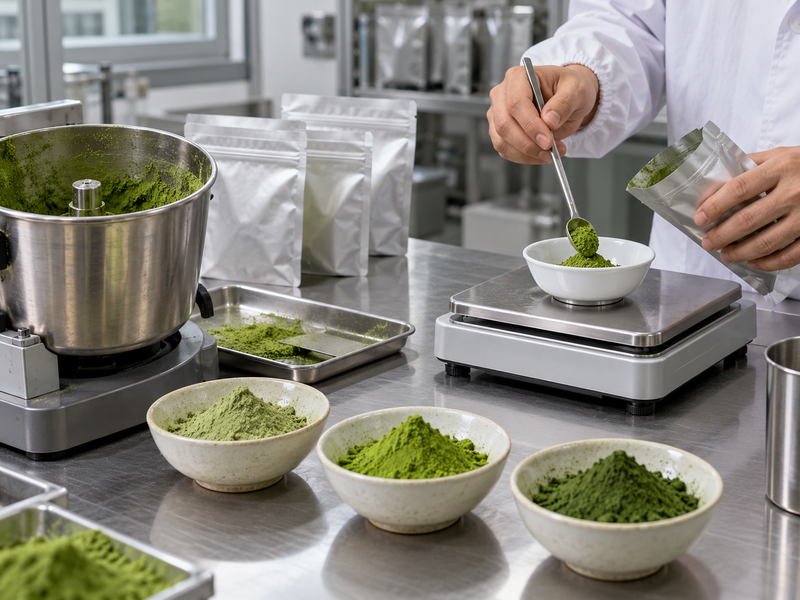
A matcha blend may mean several tea lots combined, a tea mixture or a sweetened drink powder. That ambiguity causes purchasing and label errors. Buyers need a written formula identity, a performance target and a change-control rule before approving any commercial blend.
Contents
- 1. What should the matcha blend specification actually cover?
- 2. Which powder performs in the buyer's product?
- 3. How should candidate formulas be compared?
- 4. Which preparation and lot checks prevent drift?
- 5. What does a blind tasting reveal?
- 6. How does the powder change after storage?
- 7. Which bulk or retail pack protects it?
- 8. Can the supplier repeat the pilot result?
- 9. Which claims need lot-linked evidence?
- 10. What belongs in the approval record?
1. What should the matcha blend specification actually cover?
Define the product before approving a sample
Clarify the word blend in the purchase order. It may mean multiple matcha lots, a matcha-and-tea blend, or a sweetened latte powder. These are different products with different ingredient statements and sensory targets.
The purchase order should say whether 'blend' means mixed matcha lots or matcha combined with another ingredient. A sweetened latte powder is not interchangeable with a pure tea blend, even if both are sold under a premium matcha name. State allowed components and composition ranges. Then define what the customer should notice in the finished cup: tea strength, sweetness, body and appearance.
For sourcing teams, the name on a sample bag must connect to a specification and an application. Do not let a loose grade adjective become the buying criterion.
2. Which powder performs in the buyer’s product?
Choose powder against the finished application
Write a performance specification before asking a supplier to blend. Include application, target color, flavor, particle behavior and permitted ingredients. A generic grade name cannot do the work of a finished-product test.
Ask the supplier to name every component category and its permitted range before sensory trials. Prepare the blend at the intended dose in water and in the buyer's finished product. A blend that appears stable in a straight cup can separate in milk if components differ in particle behavior. Record the formula revision, not only a marketing grade name.
A matched sample set should include the supplier's proposed commercial lot or a clear statement of how the sample relates to future production.
For a related production decision, see our matcha tea mix manufacturing guide.
| Candidate | Specific check | Keep if |
|---|---|---|
| Powder | Write a performance specification before asking a supplier to blend | Tea fits the finished application |
| Formula | Ask how components are weighed, identified and mixed | Dose stays practical |
| Tasting | Compare a candidate blend against an approved reference in blind tasting | Flavor remains clear |
3. How should candidate formulas be compared?
Change one variable at a time
Ask how components are weighed, identified and mixed. Keep a record of the component lots and blend batch. If a supplier changes the source lot, the buyer needs a defined notice and approval step.
Give a blender a written target and have each component weighed and coded before mixing. Test a small series of ratios in the buyer's final application. If a supplier changes one component to lower cost, the accepted ratio and sensory result may no longer apply. Keep the old control and compare the revised formula blind. A dry powder color match is not enough if dispersion or flavor differs.
Write the control's source and batch beside every trial. That single habit stops an apparently better formula from being credited to an unnoticed base change.
4. Which preparation and lot checks prevent drift?
Write a method another operator can repeat
Sample from multiple points in a commercial mixing run. A top-of-bin scoop may not represent the bottom. Check color and flavor in the actual application as well as dry powder uniformity.
In a production-sized blend trial, sample the mixer at several accessible points and compare early and late packed units. Record component lot weights, mixing time and how the bowl or hopper was emptied. If green shade varies, investigate segregation or poor mixing before adding more tea. The method must still work when a component lot changes within approved specifications.
A simple lot code and a consistent preparation sheet let quality staff compare future shipments without repeating the original sales presentation.
| Process point | Specific check | Record |
|---|---|---|
| Preparation | Ask how components are weighed, identified and mixed | Tool and dose |
| Production | Sample from multiple points in a commercial mixing run | Start and end samples |
| Finished unit | Compare a candidate blend against an approved reference in blind tasting | Sensory result |
5. What does a blind tasting reveal?
Taste the portion a customer receives
Compare a candidate blend against an approved reference in blind tasting. A better cup in water may underperform in sweet milk. The specification should state which application controls acceptance.
Taste first and last servings from a packed multiuse container. Components with different particle size can separate during shipment or scooping. Compare the blend in water and in the actual milk or food base. A panel should describe matcha recognition and any companion flavor separately. If the formula contains added sweetener, record how it changes the perceived tea dose and the label's serving size.
Invite purchasing and development to score separately before they reconcile results. A low quote cannot settle a sensory disagreement.
6. How does the powder change after storage?
Use the real shelf or counter conditions
Challenge the packed blend under normal shipping and storage. Components with different particle sizes may segregate; aromas can change with oxygen exposure. Inspect first and last portions from a retail pack.
Store a packed sample under normal conditions and compare it with a sealed reference. Look for color, aroma and dispersion changes, especially if the blend contains components with different particle size or flavor. A multiserve pack should be sampled from the top and near the bottom after realistic handling. The first scoop may not represent the last.
A sealed retain of each candidate makes later color or aroma complaints easier to investigate. Store it under the same documented conditions.
| Observation | Specific check | Action |
|---|---|---|
| Storage | Challenge the packed blend under normal shipping and storage | Compare with control |
| Pack | Choose packaging by how the buyer uses the blend | Inspect opened unit |
| Customer portion | Compare a candidate blend against an approved reference in blind tasting | Taste again |
7. Which bulk or retail pack protects it?
Test the actual selling format
Choose packaging by how the buyer uses the blend. Bulk foodservice bags face repeated opening, while retail tins may be exposed to light on shelves. Test reseal, fill consistency and label legibility.
Packaging should reflect the blend's components and the way customers use it. A bulk bag may be opened near steam; a retail tin may sit in bright display light. Test whether a scoop draws the same product from top and bottom after handling. If the mixture segregates, a tighter lid will not fix the blend method. Protecting the product starts with component choice, mixing and a pack that preserves the approved ratio.
Ask how packs will be opened and resealed by the actual operator. Bulk use can expose powder more often than a retail tasting suggests.
8. Can the supplier repeat the pilot result?
Measure yield and repeatability
Cost the finished formula at the approved component ratio and expected yield. A supplier can lower price by shifting component proportions, so commercial terms should tie price changes to formula approval.
Cost the approved blend at its specified component ratio and the actual serving dose. A low bid may be based on a ratio that delivers less matcha flavor than the accepted prototype. Tie commercial quotes and change notices to the formula revision. Hold a physical reference so a later buyer can judge a new lot without guessing what 'blend' meant in the first agreement.
The supplier's capacity claim should be tested against the specific grade and packaging format, not a company-wide tonnage number.
| Pilot measure | Specific check | Commercial use |
|---|---|---|
| Yield | Cost the finished formula at the approved component ratio and expected yield | Cost per saleable unit |
| Loss | Challenge the packed blend under normal shipping and storage | Set acceptance limit |
| Supply | Request the complete ingredient statement, matcha identity support, component specifications, lot-linked test documents and an agreed change-control… | Confirm lot evidence |
9. Which claims need lot-linked evidence?
Link claims and batches to documents
Request the complete ingredient statement, matcha identity support, component specifications, lot-linked test documents and an agreed change-control process. ISO's matcha report covers matcha tea itself and explicitly excludes flavored or blended matcha tea from its scope.
A supplier file is useful only when it refers to the material delivered. Match ingredient statement, specification and test report to the purchase code and lot on the cartons. Ask for an agreed notice before changes in source, formula or manufacturing site. The finished product team should separately review market-specific ingredient and allergen wording. Test a trace request. Pick one pilot pack and ask where its matcha came from and which finished units received it.
Records should show the material's actual identity and permitted ingredients. Brochures can support context but cannot replace a lot-linked document.
10. What belongs in the approval record?
Release against a written reference
Approve a named formula revision and a physical reference from a production-sized batch. Re-test any proposed component change in the intended product before release.
The approved version needs a name and a date. Store the physical sample, recipe revision, process sheet, pack artwork and reason for selecting the supplier. State what would trigger a new test: a tea lot change, a different milk or fat, a new sealing film or a shift in serving size. Make approval repeatable. A future buyer should be able to compare a new shipment with the reference rather than reopening the entire concept from memory.
The release file should identify a fallback material and the conditions under which that fallback needs a new application trial.
| Release item | Specific check | Owner |
|---|---|---|
| Formula | Approve a named formula revision and a physical reference from a production-sized batch | Development |
| Supplier | Request the complete ingredient statement, matcha identity support, component specifications, lot-linked test documents and an agreed change-control… | Purchasing |
| Pack | Choose packaging by how the buyer uses the blend | Quality |
A final production check
Ask the supplier to repeat the approved blend with a second set of component lots inside the agreed specification. Sample early and late packs, then prepare the buyer's final product from both. If flavor or color drifts, tighten component limits or mixing controls before signing off on volume. Keep the formula revision and a physical retain tied to the price quote, so a future substitution cannot quietly change the product.
Further reading
Use ISO/TR 21380:2022 on matcha identity for tea identity and FDA food allergen labeling guidance when the full recipe contains covered ingredients. Apply these sources to the actual product and selling market.
FAQ
Q1: What is matcha blend in a commercial product?
Clarify the word blend in the purchase order. It may mean multiple matcha lots, a matcha-and-tea blend, or a sweetened latte powder.
Q2: How should a buyer compare matcha for this use?
Write a performance specification before asking a supplier to blend. Include application, target color, flavor, particle behavior and permitted ingredients.
Q3: What usually causes the first quality failure?
Challenge the packed blend under normal shipping and storage. Components with different particle sizes may segregate; aromas can change with oxygen exposure.
Q4: Which documents should the supplier provide?
Request the complete ingredient statement, matcha identity support, component specifications, lot-linked test documents and an agreed change-control process. ISO's matcha report covers matcha tea itself and explicitly excludes flavored or blended matcha tea from its scope.
Q5: When should the formula be approved?
Approve a named formula revision and a physical reference from a production-sized batch. Re-test any proposed component change in the intended product before release.