
Is bulk matcha powder good for the product you plan to make? A low price, vivid sample photo, or “premium” label cannot answer that question. The buyer needs to inspect the actual lot, taste it in the intended recipe, review required quality records, and define a pass or reject decision. This guide is a practical acceptance method for one bulk matcha offer or shipment. It focuses on what a food brand, café chain, or ingredient distributor can verify before the powder enters production.
1. Is bulk matcha powder good if the price is low?
It can be, but price is not a quality test. A low quote may fit a bakery application where strong color at a measured dose matters more than a delicate plain-water flavor. The same powder may disappoint a premium retail tea customer. Define “good” as fit for the specific product, supported by an agreed specification and a repeatable supply. The buyer should be able to explain what the powder must do, how it will be checked, and what result would cause a lot to be rejected.
Start with a written use case: plain matcha, iced latte, confectionery, or another food. Add a target dose, process, pack, and destination market. Separate non-negotiable safety and identity gates from sensory preferences. A sample that tastes excellent but lacks required documentation is not ready for production. A fully documented powder that clumps badly in your line may also be wrong for the job. The decision should use both kinds of evidence.
2. What confirms the powder’s identity?
Ask for the ingredient statement and product specification. Plain matcha should be identified as a green tea powder rather than a sweetened blend or flavored premix. Verify the supplier’s product code, lot number, pack marking, and relationship between the sample and the shipment. If a sales sheet and pack label use different descriptions, resolve the mismatch before testing. A powder can be safe and still be the wrong ingredient for the claim on your finished product.
Traceability matters at receipt. Record where each lot is stored and which production runs use it. If the product is sold with an origin or organic claim, ask for evidence specific to that claim and market. A general company statement does not prove the exact lot qualifies. Do not infer cultivar, harvest, or processing detail from the word “matcha” alone; request the information your brand needs for its own label and customer questions.
| Item | Compare | Action on mismatch |
|---|---|---|
| Product code | Quote, spec, pack | Hold for clarification |
| Lot number | Pack and analysis | Request linked record |
| Ingredient statement | Sample and finished claim | Review formula and label |
| Pack condition | Seals and handling record | Segregate damaged units |
3. How much can color and texture tell a buyer?
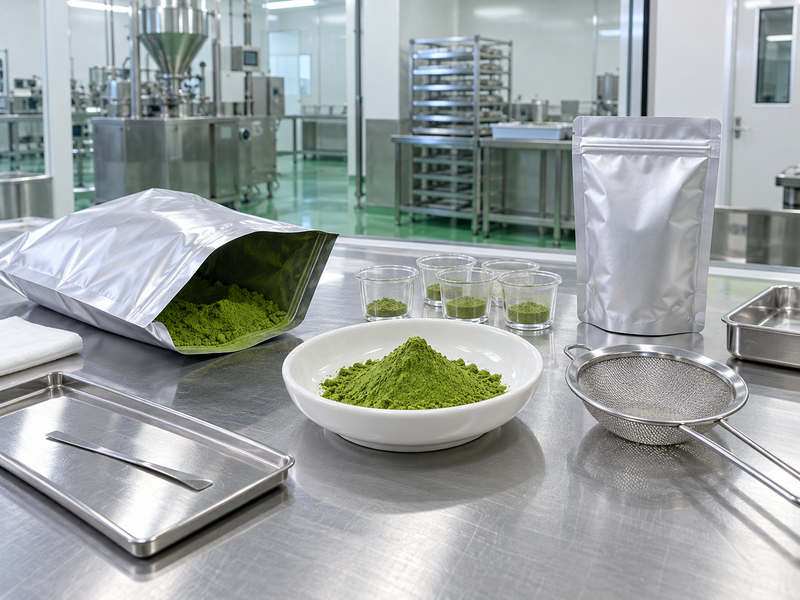
Dry color can help flag a change or damaged sample, but lighting, camera settings, powder depth, and package exposure can alter the impression. Compare candidates or lots in identical shallow dishes under the same light. Record a photograph with a neutral reference if your team uses one consistently. Do not accept or reject on a supplier’s edited product photo. A vivid powder may still taste harsh; a slightly less bright sample may perform better after milk or baking.
Look for unusual clumps, coarse particles, foreign material, or an appearance outside the agreed specification. A small sieve check can reveal lumps, though it should not replace formal particle testing if that is in the contract. Note whether clumps break apart with gentle handling or indicate moisture exposure. Keep the sample sealed after inspection and record when it was opened. Visual checks work best as a comparison with an approved retain sample, not a universal color rule applied to every grade.
4. What should the aroma check cover?
Smell the dry powder promptly after opening, then smell the prepared cup. Note tea character, freshness, and any stale, smoky, musty, or foreign odor. Use a clean container and avoid testing beside coffee, perfume, or cleaning products. The judgment should be made against the agreed product profile. Some matcha lots have stronger vegetal notes than others, and a bold profile may suit a latte while feeling too sharp for plain drinking.
Have at least two trained people record separate observations before discussing them. If an off-note appears, compare with a sealed reference and inspect the pack for damage or storage problems. Do not mask an odor with syrup and approve the lot for a sweet drink. A raw-material problem can remain detectable to customers or indicate an issue that quality staff should investigate. Record the observation and hold the lot while the supplier provides its own findings.
| Check | Controlled condition | Record |
|---|---|---|
| Dry color | Same light and dish depth | Difference from reference |
| Dry aroma | Clean, odor-free area | Tea and off-notes |
| Prepared cup | Fixed dose and method | Flavor and finish |
| Texture | Same whisking and time | Clumps, grit, sediment |
5. How should the powder be tested in a cup?
Weigh a fixed amount of powder and prepare it with a standard water volume, temperature, vessel, and mixing method. Taste at the start and after a normal sipping interval. Record aroma, tea taste, bitterness, astringency, mouthfeel, and finish. Compare the lot with an approved reference sample in blind or coded cups when possible. The same preparation reduces the chance that an operator’s whisking difference explains a perceived quality change.
Take notes rather than awarding a single “good” score. “Smooth first sip, coarse sediment after three minutes” identifies a problem that might matter in a plain tea product. “Strong but clean finish” could be desirable in a milk drink. If several tasters disagree, repeat the test on another day. A cup test does not replace a contaminant or microbiological result, but it catches sensory defects a certificate cannot describe.
6. Does it work in the product that pays for it?
Run the powder through the actual formula. For an iced latte, use the final milk, sweetener, ice, and service cup. For a bakery, use the intended batter and bake cycle. For a beverage plant, test dispersion and sediment under the planned process. A powder can pass a plain-water tasting yet fail after heating or fat dilution. A cheaper grade may be entirely suitable in a strongly flavored product if it meets the customer-facing target and required quality gates.
Measure dose and process yield. If the tea note is weak, test whether a modest dose change fixes it and calculate the cost. If powder leaves clumps or dust losses, record the amount and where it occurs. Avoid changing several ingredients at once; otherwise the team cannot tell whether the powder or recipe caused the result. Tie each application trial to the exact matcha lot. A passing result from a sample does not automatically clear a later shipment with a different identity.
| Channel | Trial | Reject signal |
|---|---|---|
| Plain tea | Water cup at selling dose | Harsh finish or grit |
| Café latte | Final milk, ice, hold | Tea disappears or clumps |
| Bakery | Actual bake and cool | Unacceptable color or taste |
| Packaged beverage | Validated pilot process | Sediment or instability |
7. Which laboratory and quality records are needed?
The quality team should define the tests and acceptance limits for the destination market and application. Request a current specification and lot-specific analysis that can be matched to the sample or shipment. Depending on the project, relevant records may cover microbiological criteria, contaminants, and other customer requirements. Do not copy a generic list of tests into a contract without knowing which methods and limits apply. A document is useful only when its scope, date, product, and lot are clear.
Review certification claims separately. Organic, food safety, or other certificates may apply to a facility, a process, or a particular product; one does not prove every claim. Ask the supplier how it handles an out-of-spec result and whether it can trace and isolate affected lots. Matcha Village describes quality and testing support in its company materials, but a buyer should request records for the exact powder and market being evaluated. Keep quality approval separate from the sales team’s sensory preference.
8. What can packaging and storage reveal?
Check seals, inner liner, lot marking, and any damage before opening a bulk pack. Matcha can change under moisture, heat, light, air, and strong odors, so an excellent powder in a damaged pouch is not the same product a supplier approved at packing. Use the supplier’s storage guidance, clean dry tools, and an open-pack procedure that fits your throughput. A large unit may reduce packaging cost while increasing waste if the operation uses it slowly.
Record storage conditions and opening date for retain samples and production stock. If a lot develops a different aroma or color after arrival, investigate handling before assuming the supplier changed the formula. Conversely, do not excuse an off-spec lot because the room was warm for one afternoon. The receiving and warehouse record helps identify where a change occurred. A product should be judged from a properly handled sample and then protected through use.
| Point | Evidence | Action |
|---|---|---|
| Seal | Intact, no leaks | Segregate damaged pack |
| Lot marking | Readable and linked | Hold unidentified pack |
| Storage | Conditions within plan | Investigate deviation |
| Open-pack use | Date and remaining mass | Control exposure and waste |
9. How should natural lot variation be handled?
Tea is an agricultural material, so a buyer should expect some variation and define an acceptable range. Keep a sealed approved reference, preparation method, sensory notes, and any measurable targets the team can apply consistently. Ask the supplier what changes in leaf selection, harvest, processing, or milling would trigger notice. A new lot should be compared before the previous lot is exhausted, giving the business time to test and decide.
Do not try to force every lot into an exact photograph. Set ranges that protect the finished product rather than meaningless precision. A slight dry-color shift may not be visible in a chocolate cookie; a small flavor change might matter greatly in a plain matcha tin. If a lot falls outside the range, hold it and seek a documented explanation or replacement. Blending a failed lot into approved powder without a controlled process and label review can create a larger quality problem.
10. What makes a lot good enough to release?
Release requires a confirmed identity, intact pack, required documents, acceptable sensory result, and a passing application trial where specified. The decision should be made against written criteria approved before the lot arrived. Record who reviewed each gate and whether the lot is accepted, held for investigation, or rejected. If the product is for retail packing, do not begin filling while a mandatory document remains unresolved.
Use a small production run when a sample has passed but the commercial shipment or process is new. Record yield and customer-facing appearance. If the lot passes, store the retain sample and release record for future comparison. If it fails, tell the supplier exactly which criterion was missed. That is how a buyer can answer “is bulk matcha powder good” with evidence tied to its own product rather than a generic grade promise.
| Result | Condition | Next step |
|---|---|---|
| Accept | All mandatory gates pass | Release to use |
| Hold | Document or test unclear | Investigate before use |
| Reject | Fails agreed criterion | Segregate and notify supplier |
| Conditional trial | Allowed by quality plan | Controlled pilot only |
Frequently asked questions
Q1: Does bright green color prove good matcha?
No. Test flavor, texture, documentation, and performance in the finished product.
Q2: Is bulk powder lower quality than retail tins?
Pack size alone does not determine grade; compare the actual product specification and lot.
Q3: Can a certificate of analysis replace tasting?
No. It addresses specified tests, while sensory and application fit need separate checks.
Q4: Should every new lot be reviewed?
Use a risk-based receiving plan and compare changes against the approved range.
Q5: What if a lot smells stale?
Hold it, compare with the retain sample, inspect handling records, and contact the supplier.
Share your intended use and acceptance criteria with Matcha Village when requesting a sample. A lot-specific trial gives the clearest answer to “is bulk matcha powder good” for your business.
The Aki Matcha bulk buying guide offers another checklist for judging powder quality at volume.