
A bulk matcha recipe can cut repeated whisking at a busy café, but scaling a single cup by fifty often creates a pitcher that settles, tastes uneven, or outlasts its approved holding period. Operators need weights, mixing steps, a portion rule, and a shift record. This guide uses large-batch iced matcha service as the working case. It explains the arithmetic and tests a café should run before replacing per-order preparation with a batch process.
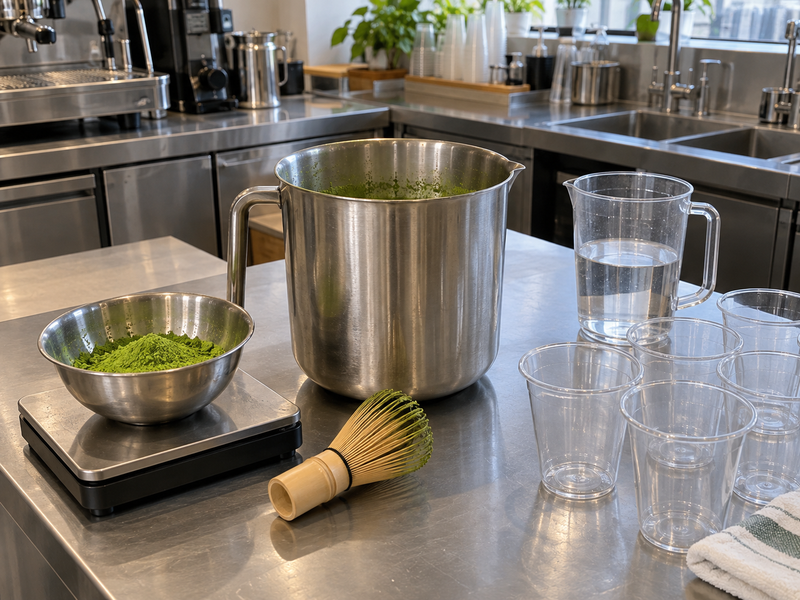
1. What should a bulk matcha recipe define per serving?
Start with one approved drink. Record matcha grams, water grams, milk or plant-based base, sweetener, ice, cup size, and final fill. Specify the mixing tool and order of addition. A “scoop” or “splash” cannot scale because different staff fill them differently. Weigh ten ordinary servings to see the actual variation before setting a master recipe. The bulk method should produce the same tea concentration and customer experience as the accepted single cup.
Define the portion of concentrate that will enter each drink. If the concentrate contains only matcha and water, the bar can adjust sweetness separately. If it contains sugar or milk, every portion carries those ingredients too, which affects substitutions and allergen controls. Make a clear decision about that composition. A development team may prefer a strong tea slurry for flexibility, while a high-volume counter may prefer a complete base. Neither is a universal answer; test the format against the store’s menu and speed target.
2. How should a café scale the formula by weight?
Multiply each ingredient by the intended number of sellable servings, then account for measured process loss rather than guessing. If the approved cup uses 2 grams of matcha, fifty cups require 100 grams in the product served. If a pilot shows 5% of prepared concentrate is left in the pitcher or dispenser, divide by 0.95 to estimate the starting matcha needed. That is roughly 105 grams, but the café should use its own measured loss. Do the same for water and other ingredients that remain in the concentrate.
Use mass rather than volume for the master batch wherever possible. A gram scale makes powder dosing more consistent, and it avoids confusion between a dense syrup and water. Write the target finished batch mass as a release check. Evaporation, spills, and excessive foam can change yield. Do not make a batch larger than the expected demand within the operation’s validated hold window. A small second batch may waste less than one oversized morning batch.
| Input | Per cup | For 50 sellable cups |
|---|---|---|
| Matcha | 2 g | 100 g served |
| Water in concentrate | 30 g | 1,500 g served |
| Measured process loss | 5% example | Divide target by 0.95 |
| Starting matcha | Based on loss | About 105 g in this example |
3. How can matcha disperse in a larger batch?
Matcha particles suspend in liquid; they do not dissolve like sugar. A large volume of water added directly to a dry mound can leave clumps. Test a measured pre-wet step: make a smooth slurry with part of the water, then add the rest while mixing. The right tool depends on batch size. A hand whisk may work for a small pitcher; a food-safe mixer may be more repeatable for larger batches. Avoid introducing more air than the service format can tolerate.
Record mixing time, equipment speed if applicable, water temperature, and visual acceptance criteria. Check for dry pockets at the bottom and sides of the container. If a strainer is used, measure the material retained; filtering out matcha particles can change the recipe’s strength. Take samples from the top and bottom of the finished batch. If they taste or look different, the mixing or holding method needs work before the recipe can be scaled further.
4. Which preparation sequence should be written down?
A practical sequence begins with a clean, identified container and weighed ingredients. Pre-disperse the matcha, add remaining liquid under the chosen mixing method, check finished mass, then transfer to the service vessel according to the café’s food safety procedure. Record the batch time and operator. If sugar or another ingredient is included, specify exactly when it enters. Adding a thick syrup before the matcha is dispersed can create streaks that take longer to correct.
Make the method simple enough for another trained worker to follow without the developer standing nearby. Run it twice with different staff and compare finished yield, color, and cup flavor. If the second batch is weaker, look for powder left on the scale pan, whisk, or transfer pitcher. If it is gritty, look at wetting and mixing. The process record should reveal these differences rather than hiding them behind an instruction such as “mix well.”
| Step | Record | Release check |
|---|---|---|
| Weigh | Ingredient masses and lot | Matches master formula |
| Pre-wet | Water portion and time | No dry clumps |
| Mix | Tool, speed, duration | Uniform appearance |
| Transfer | Finished mass and vessel | Expected yield |
5. How can staff portion a settling concentrate?
Test the dispensing method at the start, middle, and end of a batch. Matcha can settle while the pitcher waits, so the first cup may not match the last. A gentle, defined remixing step may restore uniformity, but staff need to know when and how to do it. If a pump or tap is used, weigh ten successive portions. A viscous or particle-rich concentrate may dispense differently from water.
Use a measured concentrate volume or weight per cup, then add the base and ice in a fixed sequence. Check the final drink after stirring and after a realistic customer wait. A batch can appear uniform in its container yet produce weak drinks if staff underportion it. Color alone is a poor cue because milk volume and lighting vary. A simple portion tool, written remix rule, and spot-check cup test are stronger controls than asking staff to “make it green enough.”
6. What should a holding trial measure?
Set a proposed service window and test it under the actual storage condition. Observe the concentrate at preparation, during service, and near the end of that window. Record settling, color, aroma, clumps, and the flavor of drinks made from top and bottom portions. Include the actual vessel, lid, and dispensing tool. A bench beaker does not recreate a busy bar where a pitcher is opened repeatedly and placed near equipment.
Distinguish a quality hold from a food safety limit. Appearance and taste tests can show when a recipe stops meeting the menu standard, but they do not establish microbiological safety. The café’s qualified food safety team should set preparation, temperature, date marking, and discard rules for the exact formula and operation. Never transfer an old remainder into a fresh batch to avoid waste. That obscures lot and time records and makes performance harder to judge.
| Time point | Quality check | Service decision |
|---|---|---|
| Fresh batch | Appearance and cup taste | Release or remake |
| Mid-shift | Settling and portion weight | Apply approved remix rule |
| End of approved window | Top/bottom cup comparison | Use or discard per plan |
| Next proposed window | Only in validation trial | Do not extend by guess |
7. Which food safety questions must be resolved?
A water-and-matcha concentrate, a sweetened syrup, and a milk-containing base have different handling needs. The exact formula, process, equipment, pack, and storage temperature determine the risk assessment. Follow the operation’s approved food safety plan and applicable local requirements. A recipe developer should not promise that a concentrate is safe for a set number of hours based solely on taste or internet advice. Retail bottling requires a separate validated process and shelf-life study.
Link the matcha lot and every added ingredient to the batch record. Clean and sanitize equipment according to the site’s procedure, and identify containers so staff know which batch they are using. If dairy or another allergen enters the concentrate, update the allergen controls and menu information. The simpler plain-matcha base may allow more flexible menu assembly, but it still needs controlled preparation and holding. Train staff to discard a batch that fails a release check rather than hiding it with extra milk or syrup.
8. What should a shift record show?
A one-page batch sheet can capture date, time, operator, ingredient lots, weighed inputs, finished yield, service vessel, release result, and discard time set by the approved plan. Staff can add a brief note when remixing or a deviation occurs. Do not make the record so elaborate that a rush-hour team stops using it. Focus on fields that help the store reproduce the product and investigate a complaint.
Review records after a pilot week. If every batch yields less than expected, the recipe math or transfer process needs adjustment. If one shift uses more concentrate per cup, check dispenser calibration and training. If waste peaks on slow days, make smaller batches or change production timing. The data turn “we think batching saves time” into a measurable operational decision. Keep the approved master formula and current batch sheet together so an old recipe does not linger in a store binder.
| Field | Example entry type | Reason |
|---|---|---|
| Inputs | Mass and ingredient lot | Traceability |
| Output | Finished mass and vessel | Yield check |
| Timing | Made, released, discarded | Approved handling |
| Deviation | Clumps, spill, failed cup | Corrective action |
9. Does batching improve cost and speed?
Measure rather than assume. Time the full batch process, including weighing, mixing, transfer, cleaning, and recordkeeping. Divide by sellable cups and compare with per-order preparation. Add ingredient loss and discarded concentrate. A batch can save service time but cost more if demand is unpredictable. It may still be worthwhile during a rush if it reduces queue time, while per-cup whisking remains better during quiet hours.
Use the approved recipe dose in the cost model. If staff make a stronger concentrate to hide settling, powder cost rises and customer experience may vary. Track cup remakes alongside waste from unused batch. A café chain can test different batch sizes by store volume instead of forcing one pitcher size everywhere. Ask the matcha supplier for a powder that disperses and tastes right in the chosen method, then compare its price at the actual dose and usable yield.
Plot demand by hour during the pilot. A store that sells most matcha drinks in a short afternoon window can batch close to that peak. Another store with scattered orders may benefit from two small preparations or per-cup mixing. The decision is operational, not a badge of sophistication. Use actual sales and discard records so the labor saved at the counter is not paid back through a full pitcher thrown away at closing.
10. What makes the bulk recipe ready for rollout?
Run a pilot across busy and slow shifts. Have different operators prepare the recipe from the written method, then compare drinks at the beginning and end of each batch. Record cup taste, preparation time, waste, and the frequency of remixing. Use the real serving cup and menu base. If an iced latte is the target, do not approve the concentrate solely from a plain-water test. Set pass criteria before the pilot starts.
Revise one variable at a time when the trial fails. A mixing problem calls for a process change; weak tea may require a different matcha or dose; excess waste may call for a smaller batch. After the recipe passes, freeze the master formula, train staff, and keep a retain reference for the powder lot. A bulk matcha recipe is ready when a different shift can produce the same cup within the approved handling and cost limits.
| Gate | Evidence | Owner |
|---|---|---|
| Cup consistency | Start/end blind comparison | Product team |
| Handling | Approved safety plan | Food safety |
| Speed | Timed shift trial | Operations |
| Economics | Usable yield and waste | Purchasing / finance |
Frequently asked questions
Q1: Can I multiply a single-cup recipe by fifty?
Use that as a starting calculation, then measure loss, mixing, portioning, and holding.
Q2: Does matcha dissolve in a batch pitcher?
No. Tea particles remain suspended and can settle.
Q3: Can old concentrate be topped up with new?
Avoid it; follow the site’s lot, time, and discard rules.
Q4: Is a café batch recipe a bottled-drink formula?
No. Packaged beverages need separate process and shelf-life validation.
Q5: What should a supplier know before suggesting powder?
Share the finished drink, batch size, mixing equipment, and target holding method.
Send your large-batch service brief to Matcha Village to request a matcha sample suited to the method. Validate the bulk matcha recipe with your own equipment and shift records before rollout.