
Learning how to brew hojicha for one fragrant test cup is easy. A café or beverage line needs that cup to taste the same at opening, lunch rush, and the next delivery. Hojicha is roasted green tea, and its leaf size, roast, dose, water, time, and holding method change the result. This guide gives operators a measured starting process, then shows how to adapt it for hot tea, iced service, concentrates, and powder without presenting one recipe as universal.
1. Does tea form change how to brew hojicha?
Leaves, stems, and powder need separate methods
Start by identifying the ingredient. Loose hojicha may contain broad leaves, cut leaves, stems, or a blend. Their surface area and roast can change extraction. Powder is normally mixed into a drink rather than steeped and strained, so it needs a different operating procedure. Japan’s Ministry of Agriculture, Forestry and Fisheries (MAFF) defines hojicha by its roasting of processed tea, not by one cut size or form. A supplier’s “hojicha” name alone therefore cannot supply a complete brew recipe. Record the actual product code and lot before running a trial.
Inspect the bag. Large pieces, fine particles, and stems can behave differently in a filter. Check the supplier’s directions, then write down the first controlled test. If the tea will become a retail pack, try a method customers can reproduce with ordinary home equipment. If it will be brewed at a chain store, test with the exact vessel and filtration system staff will use. A perfect cup from a laboratory kettle does little good if a store brewer makes it bitter or weak. Keep one approved material and recipe together as a service reference.
| Material | Preparation route | Main check |
|---|---|---|
| Loose leaf or stem | Steep and filter | Extraction and clarity |
| Tea bag | Steep in final cup | Bag fill and immersion |
| Ground powder | Disperse into liquid | Clumps and sediment |
2. Which tools make a brew repeatable?
A scale matters more than a decorative pot
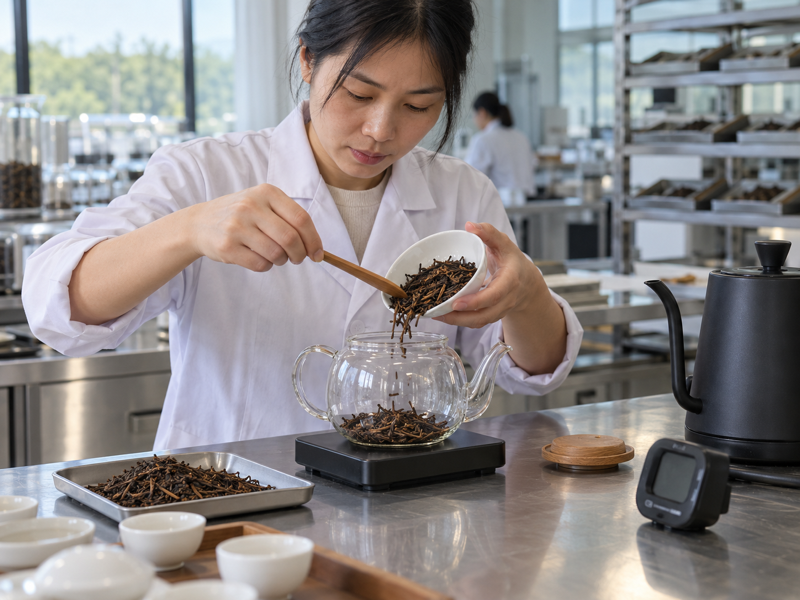
Use a gram scale for tea and water, a thermometer or controlled kettle, a timer, a brew vessel that leaves room for leaves to expand, and a consistent strainer. A graduated cup helps check final yield. For a large batch, use foodservice equipment that can be cleaned and calibrated under the site’s safety plan. A scoop is fast but its mass shifts with leaf size, settling, and how full the operator makes it. Weigh several scoops from a typical bag and the variability becomes visible. Standardize in grams even if a measured scoop is later adopted for speed.
Match the filter. A fine cut may pass through a coarse strainer, clouding the drink or creating a harsh finish as particles keep steeping. An overly fine filter may drain slowly and change contact time. Choose one strainer for the trial and record it. Preheating a vessel can reduce temperature drift, but it also adds a step and heat exposure for staff; only require it if the finished cup improves enough to justify it. Calibration, cleaning, and timing are as much part of the recipe as the leaf weight.
3. What tea-to-water ratio should you start with?
Use an initial ratio, then adjust from taste
There is no single dose for every hojicha and cup. A buyer can start with the supplier’s stated ratio, weigh both sides, and taste the result in the final serving volume. Japan’s food composition table uses 15 g leaf with 650 mL water for its analytical hojicha infusion. That defined ratio is useful for interpreting its caffeine number, not a mandatory café recipe. A retail tea may use a lighter or stronger dose depending on roast and leaf cut. Write the chosen grams per batch and filtered yield before comparing samples.
Change one variable. If tea identity is weak, increase tea mass or adjust time in separate trials. If the cup turns rough, do not immediately hide it with syrup. Record whether the issue appears in the hot infusion, cooled cup, or milk drink. A concentrate for iced lattes will need a different ratio from a plain hot tea because subsequent dilution is built into the product. Compare cost per accepted serving after filtration, not just grams placed in a pot. That way a stronger but wasteful brew does not win only because it looks dark.
| Trial field | Unit | Reason |
|---|---|---|
| Dry hojicha | g | Input and cost |
| Water | g or mL | Extraction ratio |
| Filtered yield | mL | Saleable volume |
| Final serving | mL | Customer experience |
4. What water temperature suits hojicha?
Hot water brings aroma, but record the actual temperature
Hojicha is often brewed with relatively hot water to bring out its roasted aroma. The Japanese composition-table method uses 90°C water, and Japan’s tea export guidance presents short steeping for ordinary bancha types that include hojicha. Neither document proves that 90°C is ideal for every commercial leaf. A light stem roast may show different balance from a dark leaf roast. Temperature at the kettle and temperature where water meets tea can also differ. Measure at a consistent point in your equipment and keep that point in the recipe.
Taste the finish. Compare a supplier-recommended hot brew with one nearby temperature while holding tea mass and time fixed. Note roast aroma, astringency, body, and clarity. If a lower temperature softens an unpleasant finish but removes most of the aroma, the material may be a poor fit for the intended drink. If a busy café cannot control a narrow temperature range, choose a product that performs acceptably within the real operating range. Practical tolerance matters more than a single idealized cup made by one expert.
5. How long should hojicha steep?
Short reference methods are starting points
Japan’s tea export guidance notes about 30 seconds as a standard steep for ordinary bancha, genmaicha, and hojicha, while the official analytical infusion also uses 30 seconds. A café should not assume the same time works for every leaf cut, roast, dose, and vessel. Start with the supplier method, then test a short range around it. Start the timer when water contact begins and stop extraction by fully separating liquid from leaf. Letting leaves sit in a warming pot continues the process and changes the later cups.
Test service tolerance. Make cups at the chosen time and with a realistic small delay. If fifteen extra seconds ruins the product, staff may struggle during a rush. A different leaf or ratio may offer a wider window. Taste after cooling too, because excessive extraction can show up as a dry finish once aroma fades. For batch brewing, record the time from fill to complete draining rather than the time someone presses a button. The relevant measurement is contact between water and tea, including slow filtration.
| Timing issue | Effect to assess | Control |
|---|---|---|
| Late timer start | Extra contact | Start on water contact |
| Slow drain | Uneven batch | Measure full drain time |
| Leaves left in pot | Continued extraction | Separate completely |
6. Can hojicha leaves be brewed twice?
Yes, if the second cup meets the product standard
A second infusion can extract remaining flavor, but it will not necessarily taste like the first. Japan’s Japanese Tea Association brochure includes second-brew guidance for teas, illustrating that repeat infusion is a normal practice in some settings. For a home or table-service product, that may be a welcome feature. For a chain recipe, mixing first and second infusions without a defined plan can create inconsistent cups. Evaluate aroma, strength, astringency, and yield separately for each pass.
Write the second method. Specify water mass, temperature, contact time, and whether the two infusions are served separately or blended. Do not assume a doubled time will restore the same flavor. If a central kitchen uses a second extraction for economy, assess it in the final product and include labor and energy in the cost calculation. Follow food-safety controls for wet leaves and holding. A cheap second brew that tastes thin may damage the menu more than it saves. Retain a sensory benchmark for whichever pass reaches customers.
7. How should hojicha be brewed for iced tea?
Design for the final diluted cup
Iced service can use a hot brew cooled under a safe process, a concentrate poured over measured ice, or another validated method. Each changes dilution, aroma, and labor. Prepare the drink exactly as served, including ice mass, cup size, sweetener, and any milk. Taste the first sip and a cup held for the expected time. A brew that is ideal hot may become weak as ice melts. Conversely, an aggressive concentrate can taste harsh before sufficient dilution. Record the final mass or volume rather than describing the recipe only as “strong tea over ice.”
Check cooling and holding. A café should use its food-safety plan for time and temperature control; a ready-to-drink manufacturer needs its own validated process and shelf life. Do not leave a large hot batch cooling casually on a counter. Taste refrigerated tea after the planned hold, and inspect cloudiness or sediment. If the item is sold unsweetened, the roast must remain pleasant without syrup masking a dry finish. A clear ice recipe lets a chain train staff and lets procurement compare candidate leaves on the same basis.
| Iced variable | What to record | Risk |
|---|---|---|
| Concentrate dose | Tea and water grams | Harsh initial sip |
| Ice | Grams | Variable dilution |
| Hold | Time and temperature | Flavor drift |
| Finished cup | Total mL or g | Inconsistent strength |
8. How can a café make hojicha concentrate?
Concentrate is a defined intermediate, not a finished drink
A concentrate can speed latte service when brewed tea is the chosen form. Set a batch ratio, brew and filtration method, target yield, holding conditions, and a fixed amount used per drink. Then evaluate the diluted latte. A concentrate that tastes powerful alone may disappear in milk; another may deliver bitterness at the serving dose. A measured formula allows the kitchen to separate ingredient problems from service errors. If the concentration changes through evaporation or inconsistent yield, baristas cannot fix it with a single standard pour.
Price the whole batch. Divide tea input by accepted concentrate yield, then include losses, labor, cleaning, and shelf-life controls. Compare against hojicha powder if the menu can tolerate a suspended tea product. Powder may reduce brewing labor but create settling; concentrate may be clean but require cold storage and discard rules. Test during a normal shift, not only at a quiet demonstration. The preferred route is the one that delivers the intended roast note at a repeatable cost under the operator’s actual equipment and safety system.
9. How should hojicha powder be mixed?
Dispersion replaces steeping
Ground hojicha powder usually remains in the beverage. Weigh the powder, mix it into a measured small portion of suitable liquid with an approved tool, then combine with the rest of the formula. A sweetened instant blend or soluble extract may require another method, so read the actual specification. Check clumps, grit, sediment, foam, flavor, and color at handoff and after a realistic wait. Do not use a leaf brewing table to estimate a powder’s caffeine or ingredient cost; powder is dosed and consumed differently.
Make a mixing card. State powder grams, liquid mass and temperature, tool, mixing time, final drink size, and allowed variations for iced service. Test dairy and plant milks separately. A whisk that works in a laboratory pitcher may be too slow at a café bar, while a high-shear mixer may create unwanted foam. For packaged beverages, evaluate dispersion after processing and through validated storage. Ask the supplier for particle data and a representative production lot. The right powder must taste good and behave predictably in the chosen base.
| Powder control | Measurement | Watchpoint |
|---|---|---|
| Dose | g per serving | Flavor and cost |
| Mixing liquid | g and temperature | Clumping |
| Tool | Named equipment | Operator variation |
| Hold check | Minutes | Sediment |
10. What belongs in a hojicha brewing SOP?
A recipe needs acceptance and action limits
Write the ingredient code and approved lot, tea form, grams, water amount and temperature, contact or mixing time, filtration method, target yield, final serving, holding conditions, cleaning steps, and sensory reference. Include safe process limits under the operation’s food-safety program. Tell staff what to do when a batch tastes weak, drains slowly, shows grit, or falls outside yield range. If the remedy is “add more tea until it tastes right,” the SOP is not yet controlled. Make a small batch under ordinary service conditions and see whether another employee can reproduce it.
Recheck each lot. Compare incoming material with a retained approved sample using the written method. Matcha Village offers hojicha powder for B2B applications; a buyer can send a sample and performance brief through its contact page. For any supplier, approve the material and the recipe as a pair. A strong operation knows what a passing cup tastes like and which input changed when it does not pass. That is the practical answer to how to brew hojicha consistently.
FAQ
Q1: Can I brew hojicha with hot water?
Yes. Hot water brings out roasted aroma, but test the temperature against the specific material.
Q2: Is 30 seconds always enough?
No. It is a published reference for some preparations; dose, cut, roast, and equipment can change the ideal time.
Q3: Should powder be strained?
Ground tea powder is generally mixed into the drink. Check the supplied product because a soluble extract differs from ground tea.
Q4: Can I use a second infusion?
Yes, if it meets your flavor and food-safety standards under a written method.
Q5: Why does iced hojicha taste weak?
Measure concentrate, final cup size, and melting ice before changing the tea.
Set a measured method for the exact material and final drink. Consult the Japanese analytical infusion method for context, then validate your own service recipe.