
Hojicha milk jam is a sweet, spreadable dairy preparation flavored with roasted tea. It can be appealing on toast or in pastry, but a café recipe and a shelf-stable retail jar are not the same project. Heat, sugar, water activity, packaging, and storage all affect safety and quality. This guide gives product teams a development path and makes clear where laboratory and process validation are needed before sale.
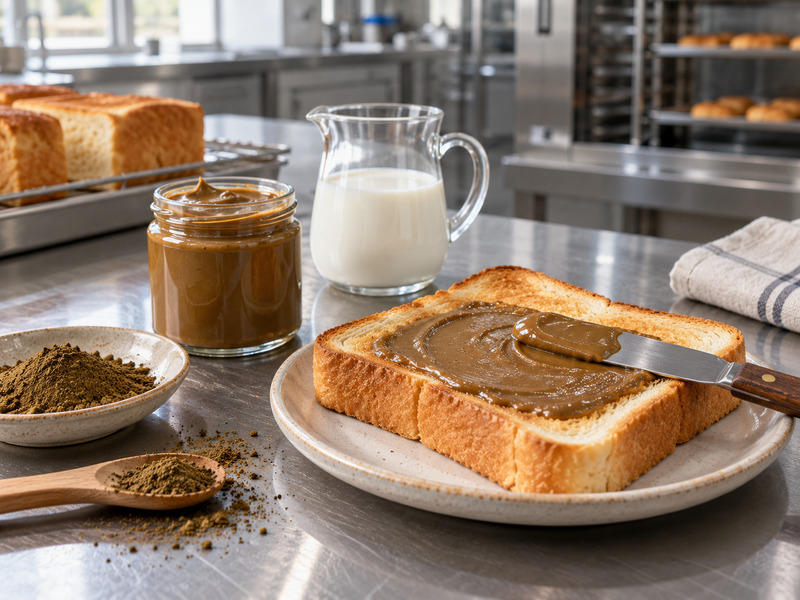
Contents: definition · tea · dairy · sweetness · cooking · texture · safety · packaging · cost · launch
1. What product does “hojicha milk jam” describe?
Define the use and sales channel
The name can refer to a refrigerated café spread, a pastry filling, or a packaged jar meant for retail. These products face different handling and shelf-life demands. Choose the channel first. A breakfast café may make a small batch for short, controlled use. A wholesale brand may need a validated process, sealed package, distribution study, and market-specific label. Do not assume a recipe that thickens on a stovetop is safe at room temperature. Define whether the jam should spread cold, pipe into pastry, or remain smooth on warm toast. Each use needs a different viscosity and serving portion. The menu or label should identify milk and roasted tea accurately. If the product contains condensed milk, cream, or added flavor, those belong in the ingredient review. A development brief can say “toasted tea aroma, spoonable from refrigeration, no gritty finish” and give the team a more useful target than “luxury jam.”
| Sales format | Main need | Approval focus |
|---|---|---|
| Café spread | Portion and cold holding | Short service window |
| Pastry filling | Pipeability and bake behavior | Texture after use |
| Retail jar | Sealed distribution | Validated process and shelf life |
2. Which hojicha form gives a clean spread?
Compare infusion with powder
Loose-leaf hojicha can be infused into milk and strained, giving a cleaner texture but perhaps a softer tea note after cooking. Pure powder can deliver stronger color and flavor, yet may make the spread gritty or settle unevenly. Test both in small, measured batches with the same dairy and target solids. Taste after cooling. Heat and cold alter aroma; a batch that smells strong over the pan can feel muted on toast the next day. If using powder, pre-disperse it in a portion of liquid and inspect the final jam for specks. If infusing leaves, record leaf mass, milk mass, temperature, time, and filtered yield; milk retained by leaves changes the recipe. Avoid a sweetened latte mix unless its added ingredients are deliberately built into the formula. Ask the tea supplier for the current specification and lot so the accepted roast can be repeated.
3. How does the dairy base affect flavor and safety?
Use a defined ingredient, not a generic “milk”
Whole milk, cream, evaporated milk, and condensed milk have different fat, sugar, water, and flavor profiles. A plant alternative can behave differently under heat and may not thicken in the same way. Write the full formula. Record exact brands, ingredient statements, and gram weights. Milk is a major allergen in the United States, and a plant-based variation may introduce soy, nuts, or other ingredients. Replacing dairy is a new formulation, not a one-for-one swap that inherits the original shelf life. The base also changes how hojicha reads: rich cream can soften bitterness while a sweet condensed milk may bury roast under caramel notes. Test the tea with the chosen dairy before adding other flavorings. If the product is a pastry filling, check whether its fat and water migrate into the baked item. A good spoonful in a jar does not guarantee a stable filled croissant the next morning.
| Base | Flavor effect to test | Process question |
|---|---|---|
| Milk | Clean dairy note | More water to remove |
| Cream | Rich mouthfeel | Fat separation |
| Condensed milk | Sweet, caramel notes | Sugar balance |
| Plant base | Different flavor | New stability study |
4. How should sugar be set?
Balance taste without making a safety assumption
Sugar affects sweetness, texture, and water behavior, but its presence alone does not prove a product is shelf-stable. Begin with a sensory target and a measured recipe, then have a qualified food scientist evaluate safety parameters for the intended channel. Do not infer from appearance. A thick jam can still have water activity or acidity conditions that require refrigeration or a specific process. Trial a small sugar range while keeping tea and dairy fixed, then taste the cooled spread on the food it will accompany. A version that tastes balanced from a spoon may be too sweet on pastry. If a “reduced sugar” variant is wanted, it requires its own texture, process, and shelf-life assessment; removing sugar can change more than taste. For nutrition and front-of-pack claims, use the final formula and applicable rules. Avoid promising a low-sugar or ambient-stable product from kitchen intuition.
5. What should a kitchen cooking trial record?
Track yield and temperature through the process
A pilot batch should state starting masses, vessel, heat source, stirring method, process time, measured temperature where relevant, and final yield. Evaporation changes concentration, so “cook until thick” can produce different results from batch to batch. Weigh the finished batch. Compare the same recipe at several endpoints and check texture after complete cooling. Tea aroma may fade during prolonged heating; a different addition stage could improve it, but any process change needs safety review. Watch for scorching on the pan base, skin formation, and uneven tea distribution. A larger kettle will not necessarily behave like a saucepan because heating and evaporation differ. If the product moves toward commercial manufacture, the process authority or qualified team should define controls and validation. A blog recipe can inspire a flavor trial; it cannot authorize a retail shelf-life claim.
| Trial record | Why it matters | Failure signal |
|---|---|---|
| Start and end mass | Concentration | Variable yield |
| Heat and time | Repeatability | Scorching |
| Tea addition | Aroma retention | Flat flavor |
| Cooling | Final texture | Separation |
6. How should texture be evaluated?
Test the use temperature and surface
Spreadability changes between a warm pan, a chilled jar, and a piece of toast. Set the intended serving temperature and test there. Use the real food. Spread a measured amount on bread, pipe it into pastry if that is the channel, and check whether it runs, tears the crumb, or leaves a gritty tea residue. Observe oil or water separation after the planned hold. A powder can make the jam seem smooth at first and grainy after cooling. If the formula uses a thickener, document its identity and label implications. If it uses no stabilizer, assess whether the desired texture remains through normal handling. A photographic standard should show an ordinary portion, not a large glossy spoonful prepared only for styling. If the product will be sold in jars, test whether customers can spoon it at the storage temperature stated on the pack.
7. What safety questions require specialist review?
Validate the finished product and process
Milk-based spreads can require control of water activity, acidity, heat treatment, packaging, and storage, depending on the formula and market. FDA technical guidance explains that water activity affects stability; it does not provide a shortcut that makes an untested milk jam safe on a shelf. Bring in qualified review. A food scientist or process authority should evaluate the intended product, test relevant parameters, and determine a defensible process and shelf-life plan. A café should follow its food-safety program for cooling, cold holding, dating, and discard. A sealed jar is not evidence of safety. Do not rely on a home canning method or a competitor's shelf life for a different formulation. Any change in sugar, dairy, tea dose, jar size, or process may require reassessment. Keep batch and ingredient lot records so issues can be traced. Safety validation should happen before a public retail claim, not after attractive packaging is printed.
8. Which pack or service container fits the product?
Design around temperature and use
A café squeeze bottle, pastry piping bag, chilled tub, and sealed retail jar expose the spread to different handling. Choose only after the intended shelf and service procedure is defined. Test normal use. Repeated opening can introduce contamination or moisture; a narrow nozzle may clog if tea powder or thickened milk forms particles. A retail jar needs a suitable closure, fill process, label, and distribution validation. Photograph the product after a realistic transport and storage period, checking for separation or condensation. Include lot code and storage instructions that match the approved process. Do not put “store at room temperature” on a pack because an unopened test jar looked fine for a week. For foodservice, train staff on clean utensils and avoiding cross-contact with other allergens. The pack should preserve the product the development team approved, not merely look attractive on a shelf.
| Container | Use case | Check |
|---|---|---|
| Chilled tub | Kitchen portioning | Clean spoon practice |
| Squeeze bottle | Fast café service | Nozzle and hold |
| Piping bag | Pastry filling | Texture under pressure |
| Retail jar | Packaged sale | Process and seal validation |
9. What is the cost per usable portion?
Include evaporation and unsold spread
Start with all ingredient purchase costs, then divide by the finished sellable yield after cooking and cooling. Add jar or service container, labor, energy, quality tests, cold storage, and waste. Cost the portion actually served. A café may spread 25 g on toast even if its menu photo shows 40 g; a packaging line may leave product in the kettle or filler. Record those losses. An intense hojicha powder may achieve flavor at a lower dose than a milder one, but compare in the final milk jam. If a retail jar requires process validation and specialized packaging, those costs belong in the business case. A high margin on paper is meaningless if a short shelf life creates frequent disposal. Test expected sales volume and batch size together. A smaller fresh batch may beat a large inexpensive batch that sits unused at the end of the week.
10. When is the product ready for a trial sale?
Match channel to the evidence
For a café trial, the team needs an approved formula, sensory standard, safe preparation and holding procedure, portion tool, allergen information, and a realistic sale window. For a retail jar, formal process and shelf-life validation, packaging review, and market-specific labeling are additional gates. Do not blur the two. A delicious kitchen prototype can be served in a controlled setting before it is ready for nationwide shipment, if the operation's safety team approves that specific use. Taste from a second tea lot and repeat the cooking trial with another operator. For B2B sourcing, request Matcha Village's pure hojicha powder specification and test its flavor after cooking and cooling. The ingredient supplier's records support tea qualification; the finished milk jam still needs its own safety and quality approval.
The launch file should distinguish sensory approval from process approval. A panel can decide that the spread tastes right; only qualified review can establish a process and storage claim for the chosen formula and pack. Keep those signatures separate. If a later recipe change improves tea aroma, repeat the relevant safety review rather than assuming the prior result still covers the new jar.
| Final check | Pass evidence | If it fails |
|---|---|---|
| Flavor | Tea clear after cooling | Revise formula |
| Texture | Spreadable at use temperature | Revise endpoint |
| Safety and shelf life | Validated for channel | Do not sell yet |
Final recommendation
Make hojicha milk jam only for a defined channel. Build roasted-tea flavor and spreadable texture, then validate the process and shelf life appropriate to that channel before making storage claims.
FAQ
Q1: Is hojicha milk jam shelf-stable?
Do not assume so. Shelf stability depends on the exact formulation, process, package, and testing.
Q2: Can brewed tea replace powder?
It can provide a smoother texture, but adds liquid and may produce a weaker flavor after cooking.
Q3: Can the product be dairy-free?
A plant-based version is a new formulation requiring its own sensory and safety assessment.
Q4: Does a thick texture prove it is safe?
No. Appearance alone does not establish water activity, acidity, or microbiological safety.
Q5: What should a café pilot measure?
Finished yield, spread texture, tea flavor after cooling, portion mass, and performance at the end of its approved holding window.
Sources: FDA, water activity and food stability; FDA, Food Code 2022; FDA, food allergens.