
“Dark roast” suggests a bold, toasty hojicha, but it is not a standardized grade that guarantees flavor. One sample may smell of caramel and toasted grain; another may taste scorched. A commercial buyer needs a sensory target and a way to check later lots against it. This guide covers roasted leaves and powder, with tests for plain tea, milk drinks, and supplier consistency.
Contents: meaning · aroma · leaf · brew · milk · defects · records · storage · cost · approval
1. What does “dark roast” mean on a hojicha specification?
Ask for measurable and sensory boundaries
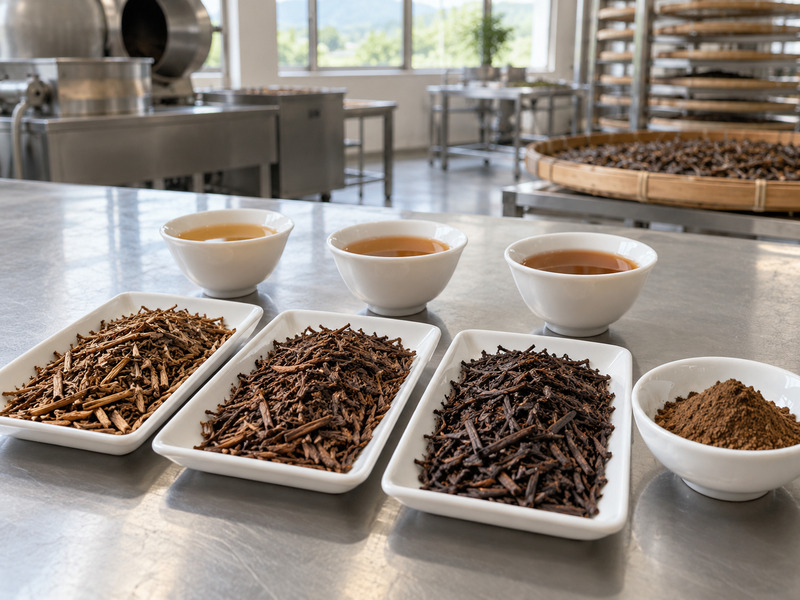
Hojicha is tea that has been roasted, and darker roasting tends to move aroma toward stronger toasted notes. Japan's agriculture ministry describes this relationship for Kaga bocha, a roasted stem tea, while also noting that lighter roasting preserves more original tea character. That does not create a universal dark-roast definition for every supplier. Ask what the seller means. Request leaf material, roast method, the supplier's accepted color or sensory range, and a retained reference sample. “Dark” can describe the dry leaf, the brewed liquor, the powder, or merely a marketing label. A procurement brief should state the cup outcome it needs: pronounced roast in milk, for example, without a burnt aftertaste. Define what is acceptable and what triggers a re-taste. This makes the term useful in a purchase agreement rather than an adjective that two people interpret differently.
| Description to define | Buyer question | Evidence |
|---|---|---|
| Dry-leaf color | Is the lot within range? | Reference sample |
| Brewed aroma | Toasted or smoky? | Blind cup |
| Milk performance | Does tea remain clear? | Standard latte trial |
2. Which aromas signal a good dark roast?
Separate appetizing toast from a fault
Dark-roast hojicha can suggest toasted grain, nuts, caramelized sugar, or cocoa-like notes to tasters. These are sensory descriptions, not added ingredients. Smoke, ash, stale oil, and a harsh dry finish may signal a sample outside the intended profile. Taste at several temperatures. A steaming cup can mask a rough aftertaste that appears as it cools. Smell the dry material, a warm infusion, and the empty cup after drinking. Ask several trained tasters to describe what they notice without seeing the supplier name. A vocabulary sheet helps teams compare lots over time, but avoid forcing every taster to use the same romantic language. The question is whether the roast supports the planned menu item. A plain tea may need more lift and a shorter finish than a sweetened milk drink. A very deep roast can be technically consistent and still be wrong for the buyer's product.
3. Does leaf material matter as much as roast depth?
Compare starting material and cut
Roasting cannot make every leaf or stem blend behave identically. Leaf grade, stem proportion, particle size, and freshness affect extraction and mouthfeel. Ask whether the product is leaf-heavy, stem-heavy, or a blend, and whether that composition can change between lots. Handle the sample. Excess dust can lead to a murky brew or rapid extraction; large pieces may require a different brew ratio. If the product will be milled into powder, the buyer also needs to assess grind and dispersion. A deeply roasted fine powder may look strong in a latte but settle heavily. Do not treat a dark color as proof of higher tea content or better quality. Evaluate the ingredient at the dose and method the business will use. When comparing two suppliers, normalize dry mass and brewing conditions for the initial sensory test, then allow each material its best recipe during the application test. Those are two distinct questions: intrinsic character and commercial fit.
| Material factor | Possible effect | Trial |
|---|---|---|
| Stem proportion | Aroma and body shift | Blind brew |
| Fines | Faster extraction, haze | Filter check |
| Powder grind | Mixing and sediment | Milk cup hold |
4. How should dark roast be brewed for comparison?
Use one baseline, then optimize
Set a fixed dry-leaf mass, water mass, measured pour temperature, contact time, and filter method for a first comparison. A 5 g leaf to 250 g water bench test can be a useful starting ratio, but it is not a standard for all dark roasts. Brew candidates side by side and strain fully at the planned time. Record filtered yield. Different leaf cuts retain different amounts of water, which affects both strength and cost. Taste the liquor hot and as it cools. Then run a second round at each candidate's best workable recipe. A tea that looks harsh under one fixed brew may be excellent with a shorter steep; another may require so narrow a window that service becomes difficult. For a café, test the actual pot or brewer. For retail loose leaf, test with a simple home method as well. A commercial decision should reflect the method customers or staff will actually use.
5. Does dark roast work better in a latte?
Milk can help or hide
A dark roast often has enough aromatic force to remain visible in milk, which makes it attractive for lattes. Yet dairy sweetness or oat cereal notes can also make it taste smoky, flat, or overly heavy. Use the exact milk brands and cup size planned for sale. If comparing powders, keep tea mass, water slurry, and milk volume constant before changing dose. Try the unsweetened version. Syrup can cover flaws and make a poor roast seem acceptable. Taste the cup after ten minutes for sediment and bitterness. A supplier's “latte grade” claim should be checked against your own target; it may describe grind, roast, or both. If the same tea must support hot and iced service, test both. Cold dilution can reduce aroma, and a darker roast may not compensate for a poorly measured ice load. The right purchase is the one that works in the intended drink, not the one with the most dramatic dry smell.
| Application | Main pass condition | Failure to watch |
|---|---|---|
| Plain hot tea | Clean toast and finish | Burnt aftertaste |
| Milk latte | Tea remains identifiable | Ashy with dairy |
| Iced latte | Aroma after dilution | Weak or gritty finish |
6. How can a buyer detect roast defects?
Use specific reject language
“Bad roast” is too vague for a supplier conversation. Record whether a sample smells burnt, smoky beyond target, stale, musty, or flat; note whether bitterness appears in the middle or the finish. Compare with the retained approved lot under the same brew method. Check more than one packet. A single opened pouch may have been stored poorly, so inspect sealed samples from the same lot before drawing conclusions. If a powder tastes charred only in milk, the issue may be roast-milk interaction rather than a defective dry product. Document the exact application where it fails. If the visual color is outside range but the cup passes, decide whether the appearance matters for the product. A retail leaf pack may have a visual promise; a back-of-house concentrate may not. A useful acceptance standard connects each defect to the consumer experience and provides a fair procedure for re-testing a disputed lot.
7. Which records matter for repeat purchasing?
Tie every cup to a lot
Request a specification, ingredient and origin information, lot identification, storage instructions, shelf life, and relevant quality documentation. Ask how the supplier monitors roast consistency and whether it can provide a second lot for validation. Keep a small library. Store approved dry samples and tasting notes with dates and recipes, then compare new shipments before they reach all stores. If a brand prints a geographic origin or certification claim, the current product must support it. A dark-roast label alone says nothing about origin or certification. Matcha Village's hojicha ingredient offering can be evaluated against such a brief, but the buyer should confirm the current SKU and lot paperwork. If the supplier changes leaf blend or roasting site, require notification and a new cup trial. Consistency is not absolute sameness; it is variation within a range that the business has chosen and can recognize.
8. How should dark roast be stored?
Protect aroma after opening
Roasted notes can fade or pick up foreign odors if material is handled carelessly. Follow the supplier's pack and storage instructions, keep lot codes visible, and use clean, dry tools. Open a real service pack. A sample stored carefully in a lab may not represent a large pouch opened many times on a humid café counter. Taste the material early and near the end of the planned open-pack period. If the aroma declines, smaller packs or better handling may be worth their higher unit cost. Powder deserves particular attention because a large surface area can make aroma loss and clumping more noticeable. Do not transfer tea into unmarked containers that break traceability. A prepared brew or latte base has a different holding problem and needs its own food-safety and quality procedure; dry-leaf shelf life cannot be applied to a liquid batch.
| Storage point | Check | Possible response |
|---|---|---|
| Sealed pack | Aroma at receipt | Reject or investigate |
| Open pack | Aroma and clumping | Smaller pack, better closure |
| Service container | Lot and date | Restore traceability |
9. Is a deeper roast worth a higher price?
Cost the recipe that passes tasting
A dark roast may deliver flavor at a lower dose, or it may require more powder to overcome bitterness and milk. Calculate landed price per gram times approved grams per cup, then add preparation loss, milk, packaging, and labor. Compare sellable cups. A low-cost tea that produces remakes or an ashy aftertaste is not cheap in practice. If the product is sold as loose leaf, calculate filtered yield and the number of acceptable servings per pack. If used in a powder mix, include blending and pack losses. Price alone cannot capture a roast's menu value, but neither can dramatic sensory language. Conduct a blind test at the actual serving price and ask whether customers can distinguish the candidate they prefer. A premium material can be justified when it improves the cup or reduces dose and waste in a measurable way.
10. What makes a dark-roast purchase ready to approve?
Sign off a range, not a single perfect cup
Buyers, product developers, and operations should agree on the intended use, recipe, reference sample, sensory pass range, and documents. Test a second lot and a second operator if the product will scale. Write the reject rule. “Must smell strongly roasted” is less useful than a short list of unacceptable faults and a defined comparison brew. Keep the normal milk or water application in the approval test. A tea selected only in a plain cupping can disappoint in a latte. Reassess when the supplier changes the blend, roast method, or grind. The customer should receive a reliably pleasant roasted tea experience, not a promise that every batch will look identical under a studio light. For a sample request, state the desired roast note, application, serving size, and market so a supplier can send material fit for the actual product.
Procurement should attach a small sensory card to the approved roast sample. Include preparation method, flavor words that describe a pass, and a short reject list. When a new shipment arrives, staff can brew against that reference instead of debating what “dark” meant months earlier. If a lot falls between pass and reject, hold distribution until the application cup is evaluated by the product team.
| Final check | Pass evidence | If it fails |
|---|---|---|
| Dry sample | Within approved appearance | Investigate lot |
| Plain brew | Clean toasted finish | Reject or re-brew |
| Milk cup | Roast remains pleasant | Change application |
Final recommendation
Choose hojicha dark roast by a repeatable cup and a documented sensory range. Darker color is evidence of appearance, not proof of superior flavor.
FAQ
Q1: Is dark-roast hojicha a formal tea grade?
The phrase is used commercially, but buyers should ask each supplier to define its roast and acceptance range.
Q2: Does darker roast always mean more flavor in milk?
No. It may carry through milk or become ashy. Test the finished drink.
Q3: Can dark roast be served plain?
Yes, if the brewed cup has a clean aroma and finish at a practical recipe.
Q4: Does dark roast mean caffeine-free?
No. It remains tea. Any exact caffeine claim needs product and serving evidence.
Q5: What should be compared across lots?
Use the same brew or latte recipe and compare aroma, flavor, color where relevant, and visible defects.
Sources: Japan MAFF, Kaga bocha roasting; Japan MAFF, Uji tea categories.