
Hojicha affogato replaces the usual espresso pour with warm roasted tea over ice cream. The idea is simple, but a weak tea vanishes as the ice cream melts, and a powder slurry can leave a gritty pool. Dessert operators need a tea base that carries through cold dairy, an ice cream that supports it, and a service method fast enough to deliver the contrast before it disappears.
Contents: definition · tea base · ice cream · ratio · temperature · texture · service · allergens · cost · launch
1. What makes a hojicha affogato different?
Keep the hot-cold encounter
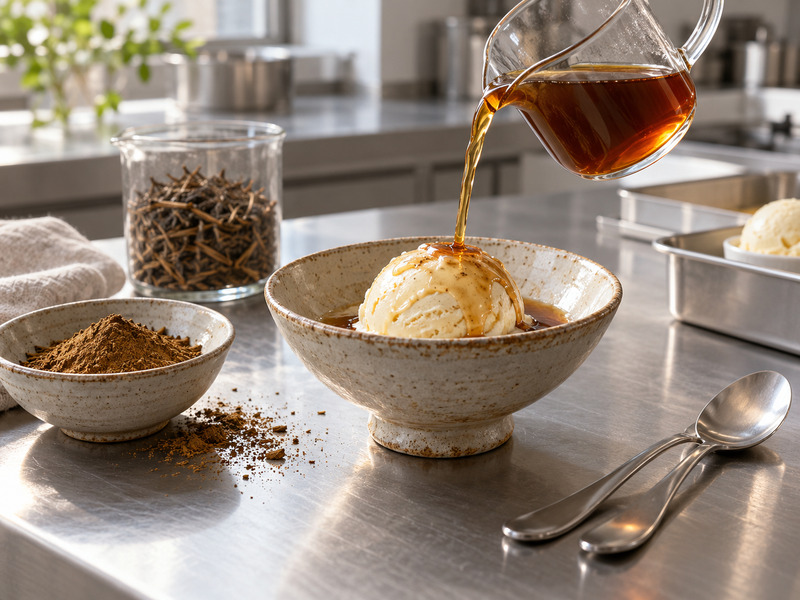
An affogato works through contrast: a concentrated warm pour meets frozen dessert, creating a sauce around still-cold ice cream. Hojicha contributes roasted tea rather than coffee. The menu should state that plainly, since guests may assume an affogato contains espresso. Serve the contrast. If tea is poured long before the bowl reaches the table, the customer receives melted ice cream with a brown sauce instead of the intended experience. Decide whether staff pour at the counter, at the table, or provide a small pitcher. Each format changes labor and presentation. A tea-only version still contains caffeine unless product-specific evidence says otherwise; it should not be advertised as caffeine-free. A coffee-and-hojicha version is a separate recipe and should be named separately. The drink or dessert needs enough tea flavor to remain distinct once the first few spoonfuls have diluted the pour.
| Service format | Guest experience | Operational question |
|---|---|---|
| Pre-poured | Fast handoff | Does it melt before serving? |
| Side pitcher | Guest controls pour | Spill and portion control |
| Table pour | Strong presentation | Labor and consistency |
2. Should the pour use brewed hojicha or powder?
Choose flavor and texture together
A strong leaf concentrate can make a clean liquid that runs around ice cream, but a weak brew will disappear. Pure hojicha powder can produce a more intense pour with body, though particles may collect at the bowl's bottom. Prepare both at the same pour mass and taste after mixing with the same ice cream. Inspect the empty bowl. A gritty residue suggests the powder or mixing process needs work. For leaf concentrate, record leaf mass, water mass, temperature, time, and filtered yield. For powder, weigh the powder and warm water and specify the whisk or frother. A sweetened premix may work, but it brings sugar and other ingredients that change the dessert's balance and label. The tea should taste good alone at its intended concentration; if it is merely harsh, melting ice cream may soften the edge briefly but will not create a clean finish.
3. Which ice cream supports roasted tea?
Use a quiet base before adding flavor
Vanilla ice cream is a logical first trial because its sweetness and cream provide contrast without adding another dominant flavor. But vanilla products vary in fat, sugar, and flavor intensity. Compare a restrained vanilla with the shop's standard one and taste the combined bowl blind. Watch the melt. Some frozen desserts become thin quickly; others hold a scoop while the tea pools around it. Dairy-free ice cream can be an option, but its base may introduce coconut, soy, nuts, or other flavors. Do not assume the tea will behave identically. The scoop weight should be measured and consistent. A large scoop with a tiny pour becomes mostly ice cream; a small scoop can disappear in an overly hot tea bath. If the menu uses a brown-sugar, chocolate, or sesame ice cream, test whether hojicha remains recognizable instead of turning into a generic sweet roast dessert.
| Frozen base | Potential advantage | Test |
|---|---|---|
| Simple vanilla | Tea remains prominent | Sweetness and melt |
| Chocolate | Familiar dessert | Does tea vanish? |
| Sesame | Toasted pairing | Heavy finish |
| Plant-based | Dairy-free option | Exact ingredients and texture |
4. What tea-to-ice-cream ratio should be tested?
Measure both parts in grams
Set one scoop weight, then trial several tea pour masses at a fixed concentration. For example, a development panel could compare 30 g, 45 g, and 60 g of warm tea over the same ice cream portion. Those values are trial settings, not a universal recipe. Keep bowl shape and serving delay constant. Taste the last spoonful. A small pour may give a dramatic first bite but no tea later; a large pour may melt the scoop and create a thin soup. If a powder concentrate is used, record tea grams within each pour, not only liquid grams. Compare a stronger small pour with a weaker large one to see whether flavor or coverage matters more. Count any tea left in the pitcher and the bowl after service. The approved ratio must work with the actual scoop tool and portion staff can deliver on a busy night.
5. How warm should the tea be?
Choose a temperature by the served result
The tea must be warm enough to create contrast, yet not so hot that the ice cream collapses before the guest sees it. Measure pour temperature at the station rather than relying on the kettle setting. Time the handoff. Record the interval between brewing, pouring, and the first bite. A dessert bar and a table-service restaurant may need different methods. If the tea is prepared in advance, define its quality and food-safety hold under the operation's procedures. A reheated concentrate can lose aroma or develop a harsher finish; taste it after the planned hold. If a side pitcher is used, check whether it stays warm enough through the walk to the table. The goal is a pleasant transition from warm roasted tea to cool cream, not a theatrical pour that sacrifices texture. A short service window may be acceptable for dine-in but unsuitable for delivery.
| Variable | Record | Failure signal |
|---|---|---|
| Pour temperature | Measured at service | Instant collapse |
| Scoop temperature | Normal freezer condition | Hard or melting scoop |
| Handoff time | Seconds | Contrast lost |
| Bowl shape | Approved ware | Pooling or spill |
6. How can the texture stay pleasant?
Check both tea particles and melting dairy
Powder can leave sediment; leaf concentrate can be thin; melted ice cream can make either pour feel heavy or watery depending on the formula. Test the dessert after one minute and after a realistic eating interval. Use a spoon, not only a straw. The dessert should offer distinct bites and a pleasant liquid at the end. If a powder slurry forms clumps when poured, pre-disperse it more thoroughly or filter the concentrate if the concept allows. A garnish of cookie crumbs or nuts can add texture, but also introduces allergens and may become soggy. Taste the ungarnished version first. Check whether the tea stains the bowl in a way that looks messy, and whether the pour has a smooth visual flow. The most convincing affogato is often restrained: one good scoop and a tea pour that tastes complete without several sauces competing for attention.
7. Which service method can a team repeat?
Write a short sequence with a timing standard
The recipe card should specify scoop mass, bowl, tea concentration, pour mass, temperature range, and whether the pour happens at the table. Have ordinary staff make consecutive desserts while a colleague times each step. Keep the station close. If the ice cream freezer and tea preparation area are far apart, the bowl can melt before service. A pre-portioned scoop may save time but needs a validated storage procedure and a test for texture. A side pitcher adds washing and breakage costs. If the server pours at the table, train a safe, controlled motion rather than improvising above a guest. Consider how the dessert reaches the customer during a rush: does it wait at the pass, or can it be delivered immediately? Do not sell a delivery version unless the combined dessert survives a real delivery test, which is a demanding standard for an affogato.
8. What allergens and claims need review?
Describe the actual ice cream and garnish
Dairy ice cream contains milk; some formulas also contain egg. Cookies may add wheat, nuts, or other ingredients. The U.S. FDA identifies major allergens that must be declared in applicable packaged foods, and cafés should use the actual ingredients in customer communication. Review each variant. A plant-based frozen dessert can still contain soy or nuts and may share equipment with dairy. Do not call the full bowl caffeine-free merely because it has no coffee; hojicha is tea. If the menu states calories, calculate the ice cream, tea, syrup, and garnish in the served portion. A tea ingredient supplier can provide information about the tea, but not the complete dessert's nutrition. If a private-label packaged affogato kit is proposed, its labeling and shelf-life questions are separate from the café plate and require formal product development.
| Ingredient | What to verify | Communication point |
|---|---|---|
| Ice cream | Milk, egg, other ingredients | Standard version |
| Tea | Form and dose | Contains tea |
| Garnish | Wheat, nuts, sesame | Optional or standard |
9. What is the cost of one sellable affogato?
Include waste and presentation labor
Cost the weighed scoop, tea dose, sweetener, garnish, bowl handling, and labor. Record how much concentrate is left unused after service and how many scoops are lost to melting or poor portioning. Count the table work. A table pour can justify a premium experience but consumes staff time. Compare the dessert's contribution with other menu sweets at realistic order volume. A higher-priced ice cream may be worthwhile if its texture holds and the tea remains clear; a cheaper one may melt into a watery bowl. Packaging for takeaway is especially difficult: a separate hot tea container and frozen portion add cost and handling. Test the customer experience before building a delivery price around a product that may not arrive intact. A dramatic presentation has value only when the guest actually receives it.
10. When is the dessert ready for the menu?
Approve the served bowl, not the demo pour
Run a pilot across several shifts using the actual freezer, tea station, dishware, and staff. Observe texture at the pass and at the table. Ask for the last spoonful. It should taste of tea and ice cream rather than diluted sweet liquid or gritty powder. Keep a recipe card, reference photograph, and ingredient list with a revision date. Recheck if the ice cream brand, scoop, bowl, or tea lot changes. For tea sourcing, send Matcha Village the ice cream style, pour mass, and desired roast profile when asking for a hojicha sample. A powder that excels in milk lattes may not be the cleanest affogato pour, so test both tea forms. The finished dessert should make roasted tea understandable through flavor, not only through its name.
The final approval test should start only when a normal order is called. Have staff scoop, prepare the pour, carry the bowl, and serve it with the same delay a guest would experience. Photograph and taste at the table, then taste the remaining liquid. This short service rehearsal often reveals more than another quiet test-kitchen tasting, because temperature is an ingredient in an affogato.
| Final check | Pass evidence | If it fails |
|---|---|---|
| Scoop shape | Intact at delivery | Shorten handoff |
| Tea flavor | Clear in final spoonful | Adjust concentration |
| Pour control | Measured mass, no spill | Change vessel |
Final recommendation
Use a concentrated, clean hojicha pour over a measured scoop and deliver it before the contrast disappears. The service clock is part of the recipe.
FAQ
Q1: Is hojicha affogato made with coffee?
This version uses roasted tea instead of espresso. If coffee is added, the menu should state it.
Q2: Can hojicha powder be used?
Yes, if it disperses smoothly and does not leave a gritty bowl. Compare it with a leaf concentrate.
Q3: Can it be dairy-free?
A plant-based frozen dessert can be tested, but review its ingredients and shared equipment.
Q4: Is affogato suitable for delivery?
Only if a real travel test shows that temperature and texture remain acceptable, often a difficult requirement.
Q5: What is the key ratio test?
Compare several measured tea pours over the same weighed scoop and taste the final spoonful.
Sources: Japan MAFF, Uji tea categories; FDA, food allergens.