
A ceremonial matcha powder factory can offer several powders under that name, yet the label alone does not define a measurable B2B product. Buyers need an agreed drinking target, a coded reference sample and records that connect leaf material, milling and release to future lots. Ask what the supplier means by the grade before approving artwork or a standing order. The matcha reference sample guide can help turn a promising cup into a repeatable acceptance decision.
Contents
- 1. What does ceremonial mean in this purchase?
- 2. Which cup should the product deliver?
- 3. What tea material creates the offered grade?
- 4. How are tencha lots selected and blended?
- 5. Which milling route made the sample?
- 6. How should a blind tasting be run?
- 7. What belongs in the written specification?
- 8. How do packing and storage affect the cup?
- 9. Which claims can the factory support?
- 10. When should a buyer accept the grade?
1. What does ceremonial mean in this purchase?
Replace a broad label with a decision
Ask the seller to describe its own grade system and the intended use of the proposed powder. “Ceremonial” may signal a powder intended for drinking with water, but sellers can apply the term differently. Avoid treating it as a universal specification or as evidence of cultivation method, origin or certification. Write down the exact item code and the sensory outcome the business needs. A tea retailer may prioritize a pleasing straight cup; a café chain might use the same powder in a premium latte line.
State what would fail. Harsh bitterness, gritty texture, weak aroma or an unsupported origin claim may each be a hard rejection for a particular product. Another buyer may have different limits. Ask whether the quoted grade is an ongoing blend or a finite lot. If marketing intends to print “ceremonial,” have the brand and destination reviewer decide what accompanying claims are supportable. The factory discussion should then focus on a real powder, not a debate about how another company uses a sales adjective.
2. Which cup should the product deliver?
Prepare a reference drink
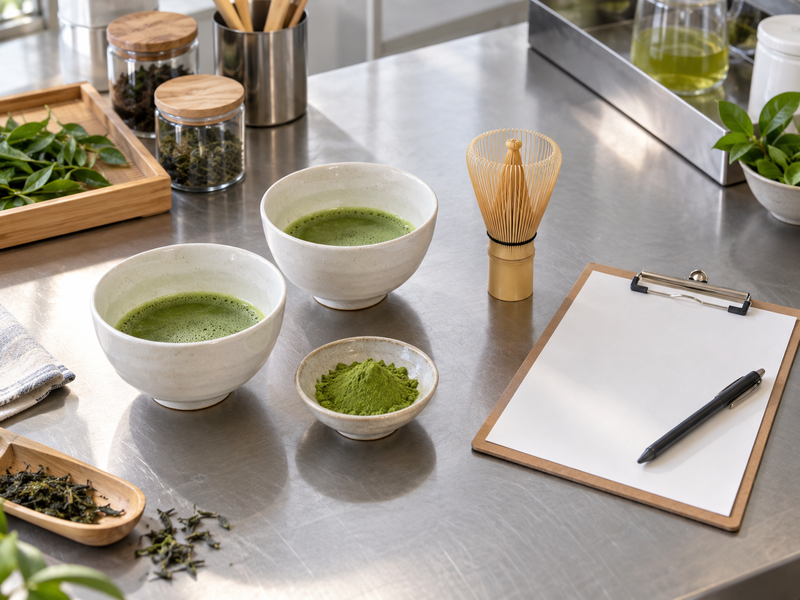
Agree on powder weight, water volume, water temperature, whisking method and serving time for evaluation. A retail brand should consider what a typical customer can reproduce, not only a carefully prepared cup at a supplier showroom. If the powder will also enter milk drinks, run a separate test with the actual menu recipe. Ask evaluators to record aroma, umami or savoriness, bitterness, body, texture and aftertaste in plain terms. A numerical score can help compare samples, but short observations explain the score.
Make the method teachable. If the product requires unusually careful preparation to taste acceptable, decide whether the business can provide that instruction to customers or staff. Do not let one specialist’s skill conceal a powder that ordinary operations will struggle with. Retain the chosen sample in a suitable container and record its code and preparation notes. A future lot can then be checked against a specific cup rather than a vague memory of “excellent ceremonial matcha.” The reference method also keeps a price comparison from drifting between very different grades.
| Cup field | Control | Record |
|---|---|---|
| Dose | Same weighed amount | Grams used |
| Water | Same source and temperature | Trial condition |
| Mixing | Same whisk and time | Staff method |
| Evaluation | Same serving point | Panel notes |
3. What tea material creates the offered grade?
Ask about the input, not the scenery
The Japanese agriculture ministry describes matcha made by grinding tencha, a tea prepared through covered cultivation, steaming and drying without rolling. Ask the proposed supplier what material enters its mill and where it comes from. If the company buys prepared tencha, request its acceptance and source controls. If it grows or processes tea, request a route that links that work to the offered sample. The supplier need not disclose every proprietary field, but it should support any specific claim your brand will make.
Follow one input lot. Determine how it is identified, stored and selected for the grade. If several harvests or areas may be blended, ask which boundaries remain fixed. A photograph of shaded tea is useful educational material but not proof that the proposed powder came from that field. Different tencha can create different cups even on the same mill. Treat raw material selection as a product decision and ask what would happen if the preferred source becomes unavailable during a repeat program.
4. How are tencha lots selected and blended?
Understand the grade’s consistency plan
Ask whether the grade uses a fixed source, an approved pool of tencha or a blend adjusted to reach a sensory target. Each approach can work for B2B supply if it is described honestly. A single-lot powder may give a distinctive cup but limited availability. A managed blend may give a more stable year-round profile while needing clear source and origin rules. Request a sample-linked blend or source record and ask who authorizes changes to the inputs.
Test the next lot. A supplier can describe consistency without proving it through one pouch. Ask for another coded production sample when the program will repeat. Prepare it with the same water method and compare against the retained benchmark. If the new lot differs, ask whether tea material, blend, milling or storage changed before jumping to conclusions. Put acceptable sensory variation into an internal evaluation guide. Purchasing should know when a lot requires product-team review rather than shipping it because the carton bears the same grade name.
| Supply model | Buyer benefit | Question |
|---|---|---|
| Single lot | Distinct identity | How long available? |
| Fixed sources | Defined origin | Can supply repeat? |
| Target blend | Consistency goal | Which changes allowed? |
| Substitute grade | Backup option | Separate trial? |
5. Which milling route made the sample?
Link equipment to the powder offered
If a seller claims stone milling or another specific method, ask which site and equipment made the sample and which would make commercial lots. The answer matters for a printed process claim and for any demonstrated cup difference. Request a batch record showing the feed material, milling run and finished product code. Do not assume a machine in a factory photograph produced the sample. Ask how the supplier monitors its own process and what happens to output during a stop or maintenance event.
Test the finished result. Particle size may be reported by a defined method, yet the buyer should still evaluate texture and settling in the intended preparation. A numerical fineness claim without method and lot identity is difficult to use. If the supplier proposes switching mills as volume grows, request a new coded sample and compare it against the reference. The point is not to prescribe factory engineering. It is to make a claimed premium grade reproducible and to know when a process change might alter the cup customers expect.
6. How should a blind tasting be run?
Remove brand and price cues
Give samples neutral codes and let evaluators taste without knowing supplier, region or price. Use the reference cup method for every powder. Ask the panel to write notes before group discussion, then compare scores and descriptions. If people disagree, look for the specific attribute causing it. One person may prefer stronger savoriness while another notices astringency. The buyer’s target customer and product promise should settle the trade-off, not the loudest taster.
Repeat under ordinary service. A supplier’s representative may prepare a beautiful demonstration cup; your staff should also make the powder with the equipment they will use. Assess color, foam, body and flavor at the planned serving time. For a retail product, consider a preparation instruction that ordinary customers can follow. Keep water and dose variation out of the comparison. A blind test does not replace quality documents, but it prevents a famous origin or high price from receiving an automatic sensory pass.
| Evaluation | What to note | Recheck trigger |
|---|---|---|
| Aroma | Specific impression | Later lot change |
| Texture | Smoothness and residue | Mill change |
| Taste | Balance and finish | Source change |
| Preparation | Staff repeatability | New equipment |
7. What belongs in the written specification?
Define the approved grade without pretending every note is a number
Start with SKU, ingredients, source definition, appearance and pack format. Add the quality fields chosen by your team for its destination and application, with methods and units where measurements are used. Include a reference sample and preparation method for sensory review. A claim such as “ceremonial” may remain part of the product name, but it should not be the only release rule. Ask how the supplier reports each commercial lot and who approves shipment after results and records are reviewed.
Protect the reference. If a grade name stays the same while the source or mill route changes, require notice and a new sample review. Keep the specification revision on the quote and purchase order. Ask quality to distinguish sensory ranges from test limits so staff do not treat a tasting note as a laboratory value. A clear document makes a difficult conversation easier: if a later lot tastes different, both sides can compare the same reference and trace the material rather than arguing over the word “premium.”
8. How do packing and storage affect the cup?
Review the unit customers receive
Ask for the actual pouch, tin or bulk pack proposed for your order. Check closure, lot-code readability, opening behavior and the storage guidance supplied for that product. A small sample bag may taste good when opened immediately but tells little about a packed retail unit handled through a distribution route. The factory should describe how it protects and identifies powder between milling and sealing. Your team should test a production-like pack if shelf presentation is part of the offer.
Separate pack choice from flavor claim. A premium grade in a difficult pack can create waste and inconsistent customer preparation. A café using small daily quantities has different needs from a tea shop selling sealed tins. Ask how artwork versions are checked on the line and how a damaged seal is handled. Avoid inventing a shelf life from the product’s color; use the supplier’s documented basis and your own market review. Record any change to pack material as a condition for reapproval when it affects the product experience.
| Pack question | Why it matters | Reviewer |
|---|---|---|
| Closure | Open-product handling | Operations |
| Lot code | Complaint trace | Quality |
| Artwork | Claim accuracy | Brand |
| Storage | Product care | Distribution |
9. Which claims can the factory support?
Review every adjective and place name
Ask which claims are factual descriptions of the proposed SKU and which are marketing preferences. “Stone milled,” “single origin,” “organic” and a named Japanese region each require their own evidence. Do not treat the word ceremonial as proof of any of them. Have brand and compliance review the exact text planned for labels and sales materials. Ask the supplier whether the claim remains true across its allowed source and process changes.
Use the lot as the test. Can the factory connect a finished code with records supporting each factual statement? If a claim applies only to one seasonal lot, keep that lot on a distinct SKU. If a seller’s catalogue uses broad language that the contract cannot support, revise the copy before printing. The customer is buying a cup and a story; the story should survive a routine reorder. A careful claim review also protects sales teams from promising details the production team never agreed to maintain.
10. When should a buyer accept the grade?
Close sensory, technical and commercial decisions
Product staff should approve the coded reference cup. Quality should approve the specification, lot trace and release records. Brand should approve supported wording. Purchasing should obtain a quote for the same SKU and pack, with realistic repeat-supply terms. These gates may finish at different times. A striking sample can justify further work, but it does not by itself establish an ongoing ceremonial-grade supply program.
Plan one repeat check. Compare the first commercial lot with the reference under the same preparation method before distributing it widely. If the supplier offers an alternate when material is short, give it a separate sample and decision. Matcha Village’s supplied profile lists ceremonial-grade options, but the actual product needs its own coded sample, process route and agreed claims. Approve what your customer will drink and what your team can document, rather than the most persuasive grade description in a catalogue.
If the item will be sold in several countries, keep separate label approvals for each destination. The same sensory benchmark can support a product range, but a regional, organic or milling statement may require different wording or evidence. Give the packer the final approved artwork version for each SKU.
| Gate | Evidence | Owner |
|---|---|---|
| Cup | Blind trial | Product team |
| Product | Specification and lot report | Quality |
| Claim | Source and process proof | Brand |
| Supply | Current written offer | Purchasing |
FAQ
Q1: Is ceremonial grade a complete technical specification? No. Name the SKU, sensory reference, product fields, pack and change conditions.
Q2: Must every ceremonial powder be stone milled? Check the supplier’s actual method and the claim you intend to make; test the resulting cup.
Q3: Can a seasonal lot support a permanent product? Only with a credible repeat plan or a separately approved replacement.
Q4: Does an organic certificate prove ceremonial quality? No. Certification and cup quality answer different questions.
Q5: What should the first commercial lot be compared with? The retained coded sample and preparation method used during approval.
Final thought
A ceremonial matcha purchase becomes clear when the factory and buyer agree on one cup, one SKU and one set of supported claims. Test the powder, keep the reference and review the first repeat lot before calling the program stable.