
Bulk matcha shipping is finished only when the receiving team can release the same lot that purchasing approved. A neat quote and a quick transit time do not protect a powder that arrives with punctured pouches, missing lot codes, or boxes left in a damp loading bay. Matcha is finely milled tea, so packaging and handling deserve as much attention as freight price. This guide gives importers, foodservice buyers, and private-label teams a practical shipping plan: what to agree before dispatch, what to record in transit, and what to check before the powder enters production. Matcha Village can discuss pack formats and order planning, but each buyer should validate the route and receiving process for its own market.
1. What belongs in a bulk matcha shipping brief?
Give the supplier one version of the order that purchasing, quality, logistics, and receiving can all use. Specify the product and grade, net weight, units per case, case count, pallet configuration, lot coding, shelf-life requirement, destination, and requested delivery window. Identify who may approve a substitution if a pack size is unavailable. The words “ship 200 kg quickly” leave too much to interpretation. A supplier might send one large bag per case while the café team expects smaller working packs. Both can total 200 kg, yet only one fits the buyer’s storage and opening routine.
Include the acceptance criteria that will be checked at arrival. State whether each inner pouch must remain sealed, whether pallets must be wrapped, and what documents must travel with the lot. Decide how short shipments, damaged cases, and a missed booking window will be reported. A buyer who discovers these questions at the dock often loses time while usable stock sits on hold. A clear brief also makes competing freight quotes comparable because carriers price the same carton count, dimensions, and service level.
| Brief field | Buyer states | Supplier confirms |
|---|---|---|
| Product identity | Grade, blend, lot rules | Exact item and lot allocation |
| Pack | Inner size, case count | Final pack drawing and count |
| Destination | Receiving address and hours | Route and appointment plan |
| Acceptance | Seal and document checks | Dispatch evidence available |
2. How should the pack system protect matcha?
Think in layers. The inner food-contact pack protects the powder from ordinary handling and environmental exposure. The outer carton protects that pack against abrasion and compression. Pallet wrap, corner boards, and load restraint keep cartons together while the shipment moves. An attractive printed carton cannot compensate for a weak pouch seam. Ask for the proposed inner material, closure, fill weight, seal method, and a filled-pack transport trial. If the buyer will open a large pouch repeatedly after arrival, test that closure as well; the factory’s one-time heat seal tells only part of the story.
Matcha packs should remain dry and protected from strong odors and direct light during the agreed route. A high-barrier opaque pouch is a common option, but the exact material and seal performance matter more than the label “premium.” Check whether the outer case allows an inner pouch to rub against staples or sharp folds. Avoid packing so tightly that opening the case risks cutting the pouch. Put a sample of the complete packed unit through normal lifting, stacking, and unpacking before approving a large order. The useful question is whether the tea arrives in a pack that the receiving team can inspect and store, not whether the empty pouch looks impressive.
3. Which transit conditions should a buyer control?
Temperature, humidity, sunlight, dwell time, and odor exposure all deserve a route review. That does not mean every shipment needs a refrigerated vehicle. Cold handling can create condensation concerns if a sealed pack is opened while still cooler than a humid room. Instead, define the conditions the product and pack have been tested to tolerate, then select a route and handling plan that stays within them. Ask the forwarder where cartons may wait: the origin warehouse, airport or port, transfer terminal, and destination depot can matter more than the time on the main vehicle.
For a new route, a small monitored pilot can show whether the shipment encounters long hot or humid periods. Place a logger according to a written plan, record its position, and compare its readings with the agreed criteria. A single logger is evidence for that location, not proof that every carton saw the same conditions. If the data causes concern, inspect the product and packaging before deciding whether it can be used. Set the decision maker in advance: logistics reports the excursion, quality decides disposition, and purchasing handles commercial resolution.
| Exposure | Route question | Practical control |
|---|---|---|
| Humidity | Where may cases wait uncovered? | Dry staging and intact inner seals |
| Heat | How long can freight dwell? | Tested route or monitored pilot |
| Odor | What shares the vehicle? | Clean vehicle and segregation |
| Light | Is inner pack exposed? | Opaque pack and closed cases |
4. How do air, ocean, and domestic freight change the plan?
Air can shorten transit and reduce the time stock is tied up, but it often raises freight cost and can still include terminal dwell and multiple handoffs. Ocean service can suit planned replenishment, yet the longer journey asks more from pallet stability, moisture control, and inventory forecasting. Domestic road delivery offers more appointment control for some routes, while a parcel network may handle small trial orders through many sorting points. Quote the complete door-to-door journey, including pickup, transfer, clearance, and final delivery, rather than comparing the main leg alone.
Choose a mode from the required arrival date and the cost of failure. A bakery launching a seasonal item may pay for air on a pilot lot, then switch to planned ocean replenishment once consumption is known. A distributor with steady sales may hold a buffer so it can use a slower service without frequent emergency shipments. Ask the carrier about handling limits, carton and pallet requirements, tracking events, and loss or damage procedures. Shipping method is an inventory decision as well as a freight decision.
5. What should Incoterms settle before dispatch?
Write the chosen Incoterms® 2020 rule and the named place into the purchase contract or order confirmation. “FOB” or “DAP” without a named point can leave a dispute about where delivery occurs. The International Chamber of Commerce rules explain how delivery, risk, and costs differ by term. For example, under FCA, risk transfers at the agreed delivery point; under DAP, the seller carries risk to the named destination ready for unloading. The term does not replace an agreement on product quality, inspection rights, or insurance claims handling.
Have a logistics specialist review the term for the actual mode of transport and named location. Confirm who books the carrier, arranges export documents, handles customs clearance, pays duties, and buys insurance if needed. Put the handoff contact on the order. A buyer can own the freight yet still need the supplier’s pallet dimensions, commercial invoice, packing list, and timely dispatch notice. Equally, a delivered-price quote is not a reason to ignore what happens before the warehouse gate. The receiving team still needs a way to document damage and hold stock.
| Decision | Write in the order | Why it matters |
|---|---|---|
| Delivery point | Rule plus named place | Defines risk handoff |
| Carrier booking | Responsible party | Prevents missed pickup |
| Insurance | Coverage and claimant | Clarifies damage process |
| Customs | Broker and record owner | Prevents document delays |
6. Which documents should travel with a bulk matcha lot?
At minimum, align the commercial invoice, packing list, product description, weights, case count, and lot identifiers. A buyer may also request a certificate of analysis, product specification, origin information, production or packing dates, and food safety records appropriate to the destination and its own supplier program. The exact regulatory set depends on the import market and transaction. In the United States, importers should check the FDA’s FSVP requirements with qualified advisers where applicable. Do not assume a supplier’s generic certificate replaces the importer’s own obligations.
Check the documents against the physical goods before dispatch. A packing list that says 20 cartons while the pallet has 19 is easier to correct at the origin than after customs or receiving. Make sure the lot code on the inner pouch matches the lot shown on the analysis document. If one shipment combines lots, list quantities by lot and keep them identifiable on the pallet. Send digital copies to the broker and receiver before arrival, with a named person responsible for corrections. Good paperwork reduces idle time; it also preserves traceability if a later quality question arises.
7. What dispatch evidence is worth keeping?
Ask for dated photographs of the sealed inner pack, open case layout, closed cases, pallet configuration, and final load. Record case and pallet counts, gross and net weights, lot codes, seal numbers where used, and carrier pickup details. A short dispatch checklist is more useful than dozens of random photos. Each image should answer a possible receiving question: Was the pouch already damaged? Was a carton corner crushed before pickup? How many pallets left the site? Was the lot marking legible? Keep the evidence with the purchase order, not in an employee’s private phone.
Consider a retained sample from the dispatched lot under controlled conditions. It gives quality staff a reference if the received material looks different. A retained sample cannot by itself prove that transport caused a problem; sampling method and storage history matter. Use it as part of a documented comparison. For repeat routes, review claims and logger data by carrier, season, and pack type. A pattern of torn pouches may point to carton geometry rather than a bad driver. Dispatch records help the team distinguish packaging design, handling, and product variation.
| Record | Collected by | Used for |
|---|---|---|
| Sealed-pack photo | Supplier QC | Pre-pickup condition |
| Pallet and load photo | Dispatch team | Count and restraint |
| Pickup receipt | Carrier | Handoff time |
| Retained lot sample | Quality team | Later comparison |
8. How should the receiving team inspect arrival?
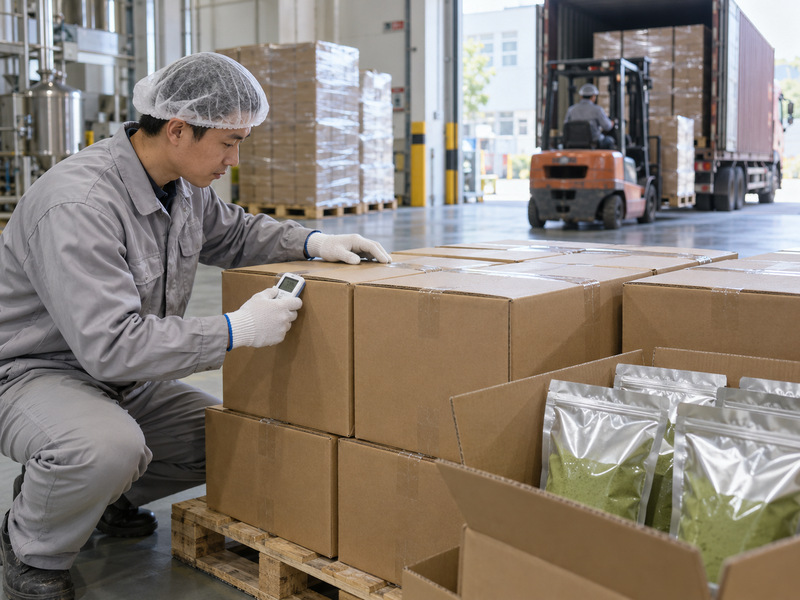
Start outside the carton. Compare the delivery note with the order, count pallets and cases, and photograph any wet, crushed, punctured, or opened package before it is moved or discarded. Record the vehicle condition if relevant and note obvious odors or water exposure. Then sample cases according to the buyer’s receiving procedure and inspect inner pouch seals, lot codes, and counts. Do not open every pouch merely to prove it is intact; the inspection plan should protect sealed stock while giving enough evidence to release it.
Quality should review documents and any route exception before release. Put questionable stock in a clearly marked hold area. A damaged outer carton does not automatically mean the sealed product is unusable, while a clean outer carton does not guarantee an intact inner seal. The decision belongs to the buyer’s approved quality process. Record which lot and units were accepted, rejected, or held. If stock is urgently needed for production, keep that pressure visible but do not let it erase the evidence needed for a sound decision. Receiving is the point where the shipping plan becomes a real control.
9. How should shortages and damage claims be handled?
Set claim deadlines and evidence requirements before the first order, since carrier and insurance terms vary. At arrival, document the condition on the delivery receipt where appropriate, keep damaged packaging until instructed otherwise, and notify the supplier and carrier through the agreed channel. Send a concise claim packet: order number, shipment reference, affected lot, quantity, photos, receiving notes, and any temperature record. Separate a quantity shortage from quality deterioration; the investigation and remedy may differ.
Do not rework a torn food-contact pouch into a saleable pack without a documented quality decision. If an outer case is damaged but inner packs are sealed and acceptable, record that finding rather than treating every unit as lost. Agree whether the remedy is replacement, credit, partial acceptance, or another commercial solution. Meanwhile, protect operations with a reorder buffer. A claim may take longer than a menu launch or production schedule can wait. The useful outcome is both a fair resolution of this shipment and a changed pack or route that prevents the same failure.
| Problem | First action | Decision owner |
|---|---|---|
| Missing case | Count and reconcile documents | Receiving and logistics |
| Wet carton | Photograph; hold affected units | Quality |
| Broken inner seal | Segregate lot units | Quality |
| Transit excursion | Review logger and product | Quality with supplier |
10. What should change after the first shipment?
Review the first arrival with the people who handled it. Did the cases fit the receiving dock and storage racks? Were documents available before the truck arrived? Were lot labels readable once pallets were wrapped? How long did inspection take, and how much stock stayed on hold? Update the brief with specific answers. A supplier should receive feedback that it can act on, such as “move the lot code to the short case side” or “add a board between the pouch and carton seam,” rather than a vague request for better shipping.
Track landed cost per usable kilogram, not freight alone. Include packaging, transport, customs and broker charges, inspection time, damage, and stockouts caused by lead-time variation. A cheaper service can cost more if a café chain repeatedly pays for emergency replacements. Discuss order cadence with your supplier and reserve enough lead time for sampling, production, documents, and transit. If you are evaluating Matcha Village for a bulk order, share the route, destination, pack size, and usage rate when requesting a quote. A useful shipping proposal begins with those operating facts.
Frequently asked questions
Q1: Does bulk matcha shipping always require refrigeration? No universal rule fits every pack and route. Use product-specific storage guidance and a tested transit plan; consider condensation before choosing cold transport.
Q2: Is an intact outer carton enough for release? No. The receiving procedure should also check inner seals, lot identity, documents, and any route exceptions.
Q3: Which Incoterm should every matcha buyer use? There is no single best term. Choose the rule and named place that match who will book transport, clear customs, and carry risk.
Q4: Can several matcha lots share one pallet? Yes if the buyer agrees and the cases and documents keep each lot traceable.
Q5: What is the fastest way to resolve shipping damage? Keep the packaging and send a complete receiving record promptly through the agreed claim channel.
Bulk matcha shipping works when the written brief, packed unit, route, and receiving check describe the same product journey. Run one monitored trial, record what arrives, and revise the next purchase order from that evidence.