
Private label matcha manufacturers can turn a powder concept into a finished retail SKU, but “we can put your logo on it” tells a buyer almost nothing about the work. The factory may source and mill tea, blend ingredients, fill packs, print labels, or subcontract some of those steps. Each arrangement changes minimum orders, document control, and who owns a problem when a launch pack fails. This guide helps brand managers and importers shortlist partners, test production packs, and agree on change rules before paying for artwork. Our supplier view is grounded in ingredient and packaging decisions: a sellable matcha product needs a defined formula and a manufacturing route that can repeat it.
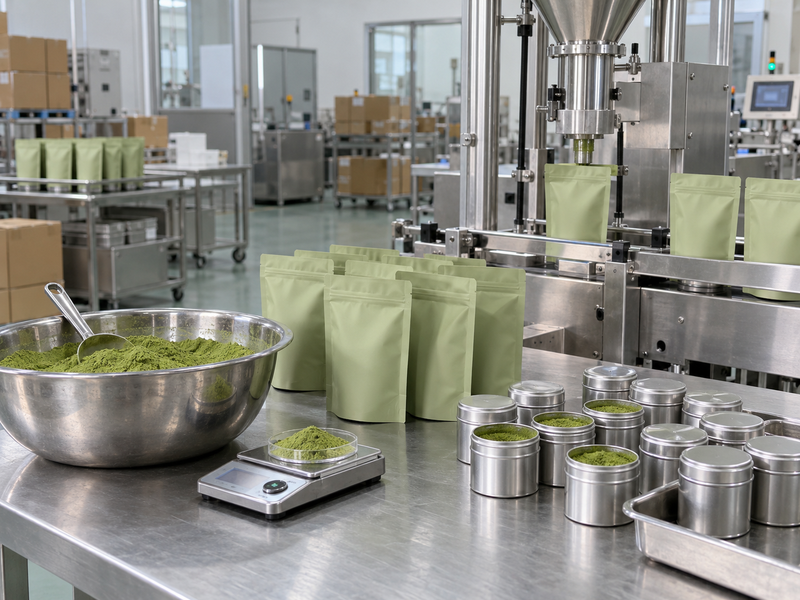
1. What do private label matcha manufacturers actually deliver?
List each service instead of buying a vague bundle
One partner may offer a stock matcha packed under the buyer’s brand. Another may develop a custom blend, fill printed pouches, assemble a gift set, and arrange export. A trading company may coordinate those services across several factories. All can be legitimate business models, but the buyer needs to know who performs each step and who signs off on finished quality. Ask for the legal seller, production site, packing site, and any critical subcontractor roles.
Define the finished SKU before comparing offers: powder or latte blend, net weight, primary pack, outer case, target market, intended claims, and expected launch volume. A quote for loose powder cannot be compared with a quote for filled retail tins. The brand should also decide whether it wants a fast stock product or a formula it can differentiate. Put the handoffs on paper: raw material approval, blend release, packaging artwork, fill inspection, and shipment release. If no one owns a handoff, the brand will discover the gap when a launch date is near.
2. Which private-label model fits the brand stage?
Match customization to demand evidence
A new brand may learn more from a smaller run of an existing powder than from a large custom formula with elaborate packaging. A mature brand may need exclusive taste, dosage, and pack geometry. The model should reflect what the brand has validated: target customer, channel, price, and repeat order potential. Minimums and development fees often rise as the product becomes more customized, though the exact structure must be quoted by each partner.
| Model | Buyer advantage | Question to settle |
|---|---|---|
| Stock powder, buyer label | Faster test of channel | Who else sells the same formula? |
| Custom powder or blend | Distinct sensory target | Who owns formulation and changes? |
| Full finished-pack service | One commercial handoff | Which steps are subcontracted? |
| Ingredient supply plus local packer | Control near destination market | Who manages cross-site traceability? |
Ask what happens after a successful first run. Can the same formula be produced at higher volume? Will the package component remain available? A low launch minimum is useful only if reorder terms also work. Document sample and commercial terms separately so a one-off development concession does not become the planning assumption for year two.
3. How should a buyer vet the production facility?
Verify the site and the work it performs
Request the exact facility name and address for blending, packing, and any milling that matters to your product. Review a current scope of operation, relevant third-party documents, and a process description. If the supplier offers a remote tour or audit, look at material segregation, line clearance, cleaning, packaging storage, and how lot codes are applied. A polished showroom does not demonstrate how powder moves through the packing line.
Ask who releases raw ingredients and finished goods, how deviations are recorded, and how a buyer is notified of a site change. A site certificate can be useful, but confirm that it covers the facility and activity for your SKU and remains current. If a trader holds the sales contract, identify the actual manufacturer on the approval record. The brand’s quality team should decide what evidence is sufficient for the destination market. Facility vetting is not about collecting the most badges; it is about knowing where the product is made and how the lot will be controlled.
4. What formula decisions must be fixed before packaging?
Approve the cup and the ingredient deck together
For pure matcha, define sensory target, use case, and acceptable batch variation. For a latte blend, specify matcha content, sweetener, creamer or milk components, flavor, allergen profile, and preparation method. Test the formula in the finished serving. A powder that tastes good in water may be weak in milk; a blend that looks green dry may lose its tea note after dilution. Keep the approved recipe version tied to the sample lot.
| Formula item | Approval evidence | Later change risk |
|---|---|---|
| Matcha ingredient | Specification and sample lot | Flavor or color shift |
| Other dry ingredients | Ingredient and allergen list | Label revision |
| Serving instruction | Tested dose and liquid | Customer complaint |
| Finished sensory range | Reference preparation | Disputed release decision |
Do not print cartons while the formula is still a moving target. If a component changes, review taste, label text, and required documentation before the next run. A private-label contract should state who may propose substitutions and who must approve them. The formula is the product; the package cannot rescue a drink that misses its target.
5. How should the brand choose a retail pack?
Test protection, filling, and customer use
Pouches, tins, jars, and single-serve sachets offer different opening experiences and line requirements. The best-looking pack may have a high minimum print quantity or poor fill efficiency. Ask for filled samples and check seal integrity, scuffing, net-fill consistency, closure after opening, and how easily a customer measures one serving. Protecting powder from moisture, light, and oxygen exposure is part of pack design, with details validated for the selected material and shelf-life target.
| Pack option | Use case | Trial focus |
|---|---|---|
| Resealable pouch | Everyday retail powder | Closure after repeated use |
| Tin | Premium shelf or gift | Inner seal and shipping dents |
| Sachet | Portion control or travel | Fill variance and pack waste |
| Bulk ingredient bag | Foodservice or local repacking | Handling and traceability |
Request the case configuration and pallet pattern if distribution is planned. A small pack can have a large logistics cost when shipped mostly as air and carton. Also clarify who pays for unused printed film or tins if the artwork changes. Packaging economics belong in the quote from the beginning.
6. Who checks claims and label copy?
Separate artwork production from legal approval
A manufacturer may place the brand’s design on a pack, but the brand or importer still needs the appropriate review for its destination market. Confirm ingredient naming, net quantity, allergen information, preparation directions, origin wording, and any claims before files go to print. Do not assume a claim is permitted because it appears on another market’s package. If organic positioning is planned, verify the exact product, handler, and certification chain rather than relying on a general facility statement.
| Artwork decision | Evidence needed | Approver |
|---|---|---|
| Ingredient panel | Final formula | Brand regulatory team |
| Origin statement | Traceability for SKU | Brand and importer |
| Certification mark | Product-specific permission | Authorized owner |
| Preparation claim | Tested recipe | Product team |
Lock an artwork version and require written approval for proofs. Check the printed pack against that version during the pilot. A mismatched ingredient list can make an otherwise acceptable lot unusable. Leave enough time in the schedule for label review; it is a real development stage, not a final decorative step.
7. How do minimum orders change the business case?
Calculate inventory across powder and packaging
Ask for minimums separately: matcha or blend production, printed pouch film, tins, labels, cases, and finished units. One component may set the practical minimum even when the factory advertises a small product run. Check whether packaging inventory is stored for later orders, who owns it, and what happens if it becomes obsolete. A low price per unit can still tie up more cash than a new brand can use before the product’s quality window closes.
Model a conservative sell-through scenario. If the first run takes twice as long to sell as forecast, will the product remain within its approved life and will the packaging still be current? Ask for a pilot size that supports a real market test, even if the unit cost is higher. Compare that learning cost with the risk of a large unproven launch. Request clear reorder prices and lead times, not only a launch quote. A partner should be able to explain when volume discounts begin and what production efficiencies drive them.
Printed packaging can create a second inventory clock alongside the matcha itself. A brand may use powder before it loses quality yet still hold cartons carrying an outdated address, claim, or flavor name. Ask whether plain packaging with an applied label can support the market test, and compare that choice with fully printed material on unit cost and customer appearance. If the brand commits to printed stock, set a review date for artwork and a disposition plan for unused rolls or tins. Those terms belong in the launch budget.
8. What should a production pilot prove?
Use the intended line and finished pack
A hand-filled sample tin cannot qualify an automated fill line. Run enough units to inspect start, middle, and end of the pilot for weight, seal, lot code, powder flow, and pack appearance. Prepare drinks from packs at each point and compare them with the approved reference. Record rejects and causes. If the product is a blend, sample for uniformity using a method agreed by quality staff. Retain production samples for later comparison.
| Pilot checkpoint | What to inspect | Decision |
|---|---|---|
| Incoming ingredients | Identity and lot approval | Release to line |
| Filling | Net weight and powder flow | Adjust or stop |
| Sealing | Integrity and cleanliness | Accept or reject |
| Finished pack | Artwork, code, and sensory | Commercial signoff |
Send pilot cases through a realistic shipping path and inspect damage. For retail, try opening and preparing the product as a customer would. The pilot should expose usability problems while changes are still affordable. Approval means the team has a reproducible specification, not merely a photograph of a good-looking pack.
9. Which contract terms protect both sides?
Write down ownership and change control
Clarify ownership of the formula, custom artwork, printing plates, unused packaging, and development data. State whether the supplier may sell the same formula to others. Agree on specification, test methods, lot-release documents, complaint handling, and the process for replacing nonconforming units. The commercial agreement should also describe payment, shipping terms, lead times, forecast commitments, and how prices change if raw material or packaging costs move.
Focus on realistic procedures. If a batch tastes different, who supplies retained samples and how is the dispute tested? If a packaging supplier changes film, who approves the new material? If the factory changes site, how much notice does the buyer receive? A clear contract does not eliminate production issues, but it gives both teams a way to resolve them without debating what was promised in an email months earlier.
10. How should a brand launch and manage reorders?
Use the first run to check assumptions
Track sell-through by channel, returns, customer preparation questions, and complaints by lot. Compare actual consumption with the demand used to choose the first production run. Keep a retained sample and the approved artwork file available when ordering again. Before a reorder, ask the manufacturer to confirm the same formula, ingredient sources, pack materials, production site, and quoted lead time. Review any change before it enters the next lot.
Private label matcha manufacturers should be judged on repeatable finished packs and clear ownership of each step. Matcha Village can discuss ingredient selection, blends, OEM packing options, and production samples for a defined brief. If your brand is ready to qualify a partner, send the target SKU, market, pack, expected volume, and launch date through Matcha Village. The first conversation can then address a real manufacturing route rather than a generic logo mockup.
FAQ
Q1. Is white label the same as a custom private-label formula?
No. White label often uses an existing product; a custom formula changes ingredients, tests, minimums, and ownership terms.
Q2. Should a brand visit the packing facility?
A visit or suitable audit can help. At minimum, identify the actual site and review evidence for the work it performs.
Q3. Who approves the retail label?
The brand or importer should arrange market-specific review; the manufacturer can supply formula and production information.
Q4. Can a hand-packed sample approve a full run?
It can guide development, but a production-line pilot is needed to check fill, seal, coding, and shipped-pack quality.
Q5. What should a buyer ask before paying for printed packs?
Confirm the final formula, approved label, packaging specification, minimum quantities, and ownership of unused materials.