
Matcha authenticity testing should investigate a specific product claim, such as ingredient identity, an undeclared addition or a stated origin. A request to prove genuine matcha gives a laboratory too little direction. Define the claim, preserve identified samples and ask which evidence can answer the question before paying for a test package or accusing a supplier of misrepresentation.
Contents
- 1. Which claim should matcha authenticity testing examine?
- 2. What documents should the buyer review before testing?
- 3. How should a buyer choose the sample for examination?
- 4. How do you choose an analytical approach?
- 5. What questions should you ask about method validation?
- 6. How should origin evidence be assessed?
- 7. How do you read a result without overstating it?
- 8. What should happen when the result is inconclusive?
- 9. How should testing fit a supplier monitoring program?
- 10. What should you send a laboratory before ordering a test?
1. Which claim should matcha authenticity testing examine?
Turn the concern into a precise question
Write down what the supplier or label claims and what evidence prompted doubt. Keep the exact product and lot attached to that statement. An origin claim, a single-ingredient claim and a named processing claim require different supporting evidence. Do not combine them into one pass-or-fail question unless the laboratory has explained the scope of each conclusion it can provide.
FDA describes economically motivated adulteration as intentional substitution, addition or omission for economic gain. That framework helps distinguish the claim under investigation from ordinary variation or a handling problem. A disappointing taste alone does not establish deliberate fraud.
| Stated claim | Purchasing question | Initial evidence |
|---|---|---|
| Single ingredient | Does the supplied composition support the statement? | Specification and relevant analysis |
| Named origin | Can the lot’s origin be substantiated? | Traceable source and trade records |
| Named production method | What supports the process description? | Production and supplier evidence |
2. What documents should the buyer review before testing?
Build the product’s identity record
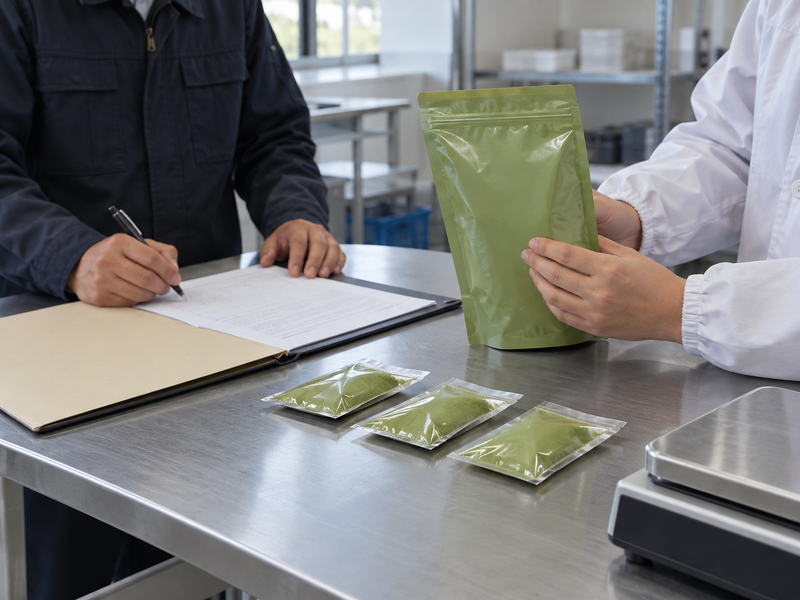
Collect the quotation, approved specification, label or ingredient statement, purchase order and lot documents. Record the legal seller and the manufacturing or packing operation. Check whether each document describes the same material. A discrepancy in product code or supplier name may need clarification before the laboratory can know what claim it is being asked to assess.
Preserve the original wording and files. If the supplier corrects an error, retain both versions with the explanation. Ask focused questions about missing links rather than requesting a generic assurance that the product is authentic. A response that identifies the source lot, packing step and supporting record is easier to investigate than an undated marketing declaration.
Use the matcha certificate of analysis guide to review analytical report fields separately. A routine report may address composition or contaminants within its stated panel without investigating an origin or process claim. List which questions remain unanswered after the document review, then use that list to scope laboratory work. This prevents purchasing a broad panel that leaves the actual concern untouched.
3. How should a buyer choose the sample for examination?
Preserve the connection to the disputed material
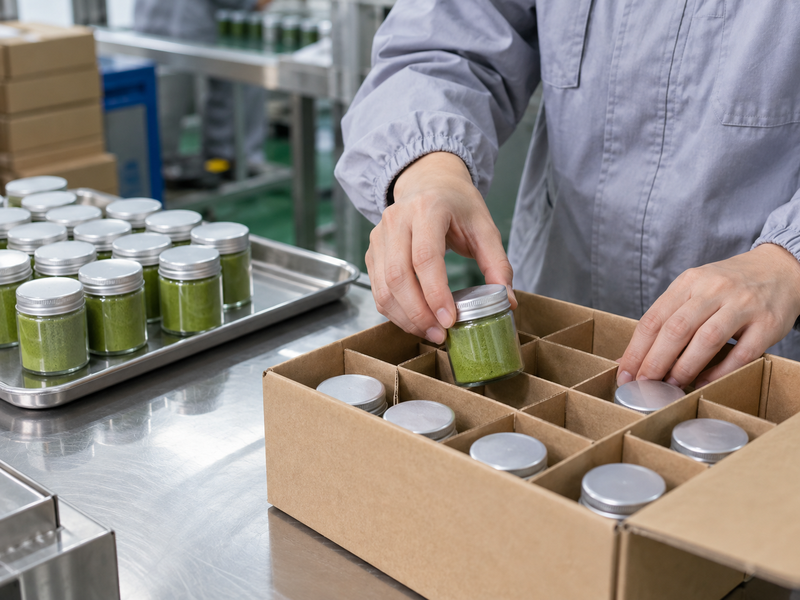
Agree a sampling plan with quality and the laboratory before opening or dispatching material. Identify the lot, source containers, sampling personnel and intended question. Tell the laboratory whether the sample is an unopened commercial pack, a retained portion or material returned by a customer. Each history affects what the result can be said to represent.
Keep separate portions when the investigation may require confirmation or comparison between laboratories. Ask the laboratory about suitable containers, required quantity and transport conditions. Document seals and custody transfers without making a routine food sample look like evidence from a different shipment.
| Sample record | Detail to preserve | Why the buyer needs it |
|---|---|---|
| Origin of portion | Lot and source container | Connects result to material |
| Collection | Person, date and procedure | Explains sample selection |
| Custody | Seals, transfers and receipt | Supports evidence review |
| Remaining material | Reserved portion and location | Allows planned follow-up |
If only a customer-opened sample exists, record that limitation openly. The laboratory can help explain which questions remain answerable and which require additional identified material.
4. How do you choose an analytical approach?
Ask the laboratory to justify the method
Provide the claim, the suspected problem and the available evidence. Ask which method can address the question in matcha, what sample preparation it requires and what its report will conclude. An instrument name alone does not establish that the method has been demonstrated for your material or suspected addition.
The European Commission’s Food fraud laboratory describes several approaches, including chemical, isotope, genetic and magnetic-resonance methods. It emphasizes reliable, validated measurement. This range illustrates why a buyer should match the method to the claim; it does not establish a universal authenticity test for matcha.
Ask whether the proposed work targets a named substance or compares a broader profile against reference material. Clarify what a negative or inconclusive result would mean. If the laboratory cannot support the requested origin or processing conclusion, narrow the scope or seek a competent specialist. Purchasing should approve a written technical proposal rather than allowing an attractive test package name to define the investigation after the sample has already been submitted.
5. What questions should you ask about method validation?
Review capability for the exact question
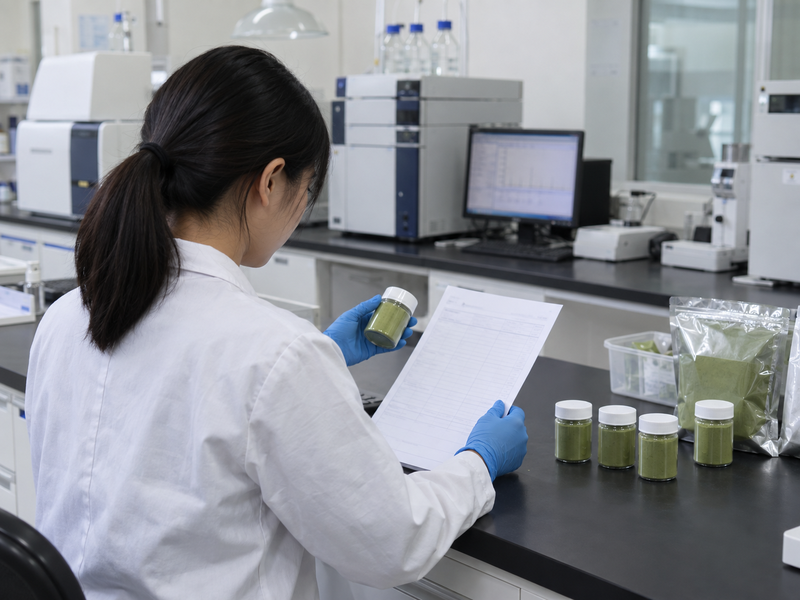
Ask the laboratory how it established that its method is suitable for the matrix and claim. Request a plain-language explanation of relevant performance characteristics and limitations. For targeted work, discuss the substance sought and the reporting capability. For a classification approach, ask how reference groups were selected and how samples outside those groups are treated.
Review the laboratory’s claimed accreditation or other competence evidence against the actual service offered. Do not assume that a general accreditation logo covers every test or interpretation. Ask the laboratory to identify the scope and any subcontracted work, then keep that information with the proposal.
| Laboratory question | Useful response | Follow-up if vague |
|---|---|---|
| Is matcha within the demonstrated scope? | Matrix-specific explanation | Request technical review |
| What conclusion can the method support? | Defined claim and limitations | Narrow the requested opinion |
| What is outside the reference set? | Handling of unknown or atypical material | Avoid forced classification |
| Who performs the work? | Laboratory and subcontractor identities | Verify responsibility |
Have the buyer’s technical adviser review the proposal when the commercial consequence is substantial. A method limitation discovered before testing is easier to manage than one discovered after a disputed rejection.
6. How should origin evidence be assessed?
Keep analytical and supply records connected
Define the origin statement precisely. Country, region, farm and processing location are different claims, and the label may refer to more than one. Ask the supplier to explain the intended meaning and provide traceable supporting records. A product packed in one country should not acquire an unverified growing origin through ambiguous sales wording.
If a laboratory proposes an origin assessment, ask which origins, harvests and product conditions its reference set covers. Ask how confidently it can distinguish the alternatives relevant to your question and what it will report for material outside the set. Do not ask the laboratory to choose a country from an incomplete comparison simply because purchasing needs a binary answer.
Review analytical findings alongside the lot’s source and trade history. Differences between these evidence streams need investigation, not selective acceptance of whichever answer suits the transaction. Apply the same standard to every producing country. Authenticity concerns whether the supplied product supports the claims made for it; an honestly described Chinese-origin product should be assessed against its own claims and specification.
7. How do you read a result without overstating it?
Preserve the laboratory’s conclusion and limits
Read the report’s sample description, method, result wording and qualifications together. Confirm that the laboratory received the intended material and answered the agreed question. Ask for clarification of technical terms before translating the report into a purchasing decision. Keep the original report available when management reviews a summary.
Distinguish a finding about the submitted portion from a statement about every unit supplied by a business. The sampling plan and lot connection determine the scope of the commercial investigation. A result may justify further action without supporting a public accusation about an entire supplier or region.
| Report wording or outcome | Question for the laboratory | Buyer action |
|---|---|---|
| Target not detected | What scope and reporting capability apply? | Keep conclusion within that scope |
| Profile outside reference group | What explanations remain possible? | Seek defined follow-up evidence |
| Identified nonconformity | How does sampling support the lot conclusion? | Technical and commercial review |
Record who interpreted the report and what additional information they used. Avoid replacing a qualified laboratory conclusion with a broader phrase such as guaranteed authentic in the supplier approval file.

8. What should happen when the result is inconclusive?
Plan the next question before another test
Ask why the laboratory could not reach the requested conclusion. Possible issues include insufficient sample, a method limitation, an unsuitable comparison set or evidence that does not distinguish the relevant alternatives. Record the laboratory’s explanation in its own technical terms, then translate it into a practical decision for the order.
Consider whether additional documents, another identified portion or a different analytical approach would answer the remaining question. Agree that work before commissioning it. Repeating the same poorly scoped test may consume the reserved sample without improving the evidence. A second laboratory also needs the relevant context and an independently defined task.
Keep the stock status aligned with the unresolved issue and the site’s quality procedures. Purchasing may need to defer an order or obtain an approved alternative while the review continues. An inconclusive result should remain inconclusive in the record; it is neither a clean certificate of authenticity nor proof of fraud. Document the basis for any commercial decision made despite the remaining uncertainty and identify the person authorized to make it.
9. How should testing fit a supplier monitoring program?
Use evidence to choose the next review
Select monitoring activities according to the product claims, supply route and history of issues. Ask which changes would justify a new review, such as a new source operation, altered formulation or unexplained document discrepancy. Avoid a fixed impressive-looking test list that no one revisits when the actual exposure changes.
Keep routine incoming checks, food-safety controls and authenticity investigations connected but separately described. Each has its own question and evidence. Testing for a contaminant does not automatically verify origin, and a supported origin claim does not close every safety question. Assign an owner to each part of the program so gaps do not hide between purchasing and quality.
| Trigger | Proposed review | Record to update |
|---|---|---|
| New source or processor | Claim and evidence mapping | Supplier approval scope |
| Repeated identity discrepancy | Focused document investigation | Corrective action record |
| Credible product concern | Laboratory-scoped examination | Lot disposition file |
Review whether the monitoring work answered its intended questions. Remove redundant activity and direct attention to unresolved claims, while preserving the evidence supporting prior decisions.
10. What should you send a laboratory before ordering a test?
Prepare a claim-based brief
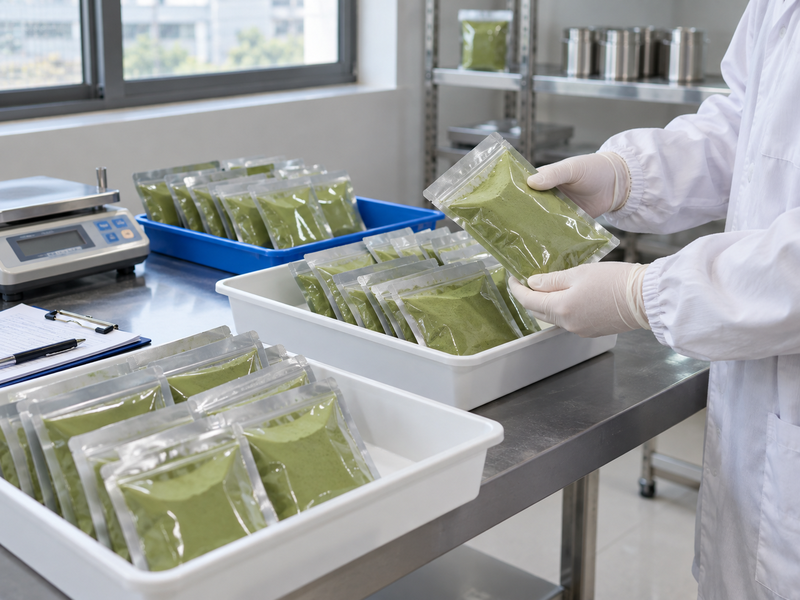
Describe the product, lot, claim under examination and available sample history. Attach relevant specifications and documents, identifying anything that is unverified. Explain the commercial decision the result will support without asking the laboratory to produce a predetermined answer. Request the proposed method, scope, sample requirements, report wording and limitations in writing.
Ask how the laboratory handles subcontracting, confirmation work and unused sample. Clarify whether the service includes technical interpretation or only a result. Agree the authorized recipients and the process for correcting a factual sample-description error without altering the scientific finding.
For the current concern, write one sentence naming the disputed claim and a second naming the evidence already available. Have quality identify suitable portions and reserve material for follow-up. Send that brief to a competent laboratory, review its response with the buyer’s technical adviser and approve testing only when the proposed output can inform the actual purchase or lot-disposition decision.
FAQ
Q1: Can price alone identify counterfeit matcha?
A price can prompt commercial questions, but it does not prove composition or origin. Investigate the claim with product records, identified samples and appropriately scoped technical evidence.
Q2: Does bright green color prove authenticity?
Appearance can be recorded during examination, but it does not settle ingredient identity, origin or processing claims. Define the specific question and obtain evidence capable of answering it.
Q3: Can a routine contaminant panel prove that no filler was added?
Ask what the panel measures. A report can support only the questions addressed by its methods and sampling scope; a filler concern may require different evidence or analysis.
Q4: Should a buyer publish a supplier’s name after one unusual result?
Complete the technical investigation and obtain appropriate legal advice before making accusations. Preserve the report’s limitations, sample history and supplier response in the internal decision record.
Q5: Is every unexpected flavor evidence of fraud?
Record and investigate the observation without assigning intent. Product variation, preparation and handling questions may also need review; the evidence should determine which explanation remains supported.